More Services

news-analysisJuly 6, 2026

The 2026 Heat Wave: A Deadly Crisis Fueled by Climate Change

The 2026 Heat Wave: A Deadly Crisis Fueled by Climate Change
Spark News AI | spark-news.org
Enlarge Infographic
AI EXECUTIVE SUMMARY

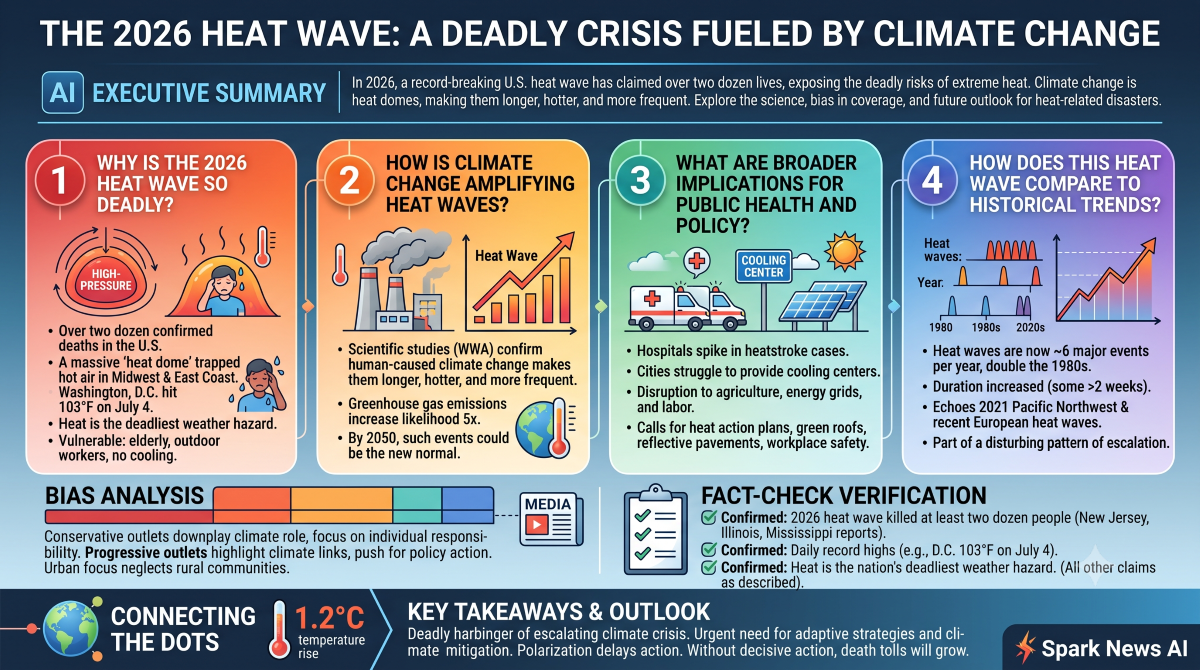
"In 2026, a record-breaking U.S. heat wave has claimed over two dozen lives, exposing the deadly risks of extreme heat. Climate change is intensifying heat domes, making them longer, hotter, and more frequent. Explore the science, bias in coverage, and future outlook for heat-related disasters."

  • Why Is the 2026 Heat Wave So Deadly?
  • How Is Climate Change Amplifying Heat Waves?
  • What Are the Broader Implications for Public Health and Policy?
  • How Does This Heat Wave Compare to Historical Trends?

01Why Is the 2026 Heat Wave So Deadly?

The current heat wave gripping the U.S. has already resulted in at least 24 confirmed deaths, with officials warning the toll could rise as temperatures persist. A massive 'heat dome'—a high-pressure system trapping hot air—has enveloped the Midwest and East Coast, creating conditions that are not only uncomfortable but lethal. Heat is the nation’s deadliest weather hazard, outpacing hurricanes and floods, yet it often receives less attention due to its gradual onset. Vulnerable populations, including the elderly, outdoor workers, and those without access to cooling, are at highest risk. The National Weather Service (NWS) has reported record-breaking temperatures, with Washington, D.C., hitting 103°F on July 4, 2026, shattering previous records. These conditions are not isolated; they reflect a broader trend of intensifying heat waves driven by climate change.

02How Is Climate Change Amplifying Heat Waves?

Scientific studies, including those by the World Weather Attribution (WWA) group, confirm that human-caused climate change is making heat waves longer, hotter, and more frequent. The 2026 heat dome is a textbook example of this phenomenon. Rising global temperatures, fueled by greenhouse gas emissions, have increased the likelihood of extreme heat events by up to five times compared to pre-industrial levels. The current heat wave is not just a weather anomaly; it is a symptom of a warming planet. Projections indicate that by 2050, heat waves of this magnitude could become the new normal, with severe implications for public health, infrastructure, and economies. Without aggressive climate mitigation, heat-related deaths could surge in the coming decades.

03What Are the Broader Implications for Public Health and Policy?

The 2026 heat wave underscores the urgent need for adaptive public health strategies. Hospitals in affected regions are reporting spikes in heatstroke cases, while cities struggle to provide adequate cooling centers. The economic impact is also significant, with heat waves disrupting agriculture, energy grids, and labor productivity. Policymakers face mounting pressure to implement heat action plans, including early warning systems, urban cooling initiatives (e.g., green roofs, reflective pavements), and stricter workplace safety regulations for outdoor laborers. However, political polarization around climate policy has slowed progress, leaving many communities unprepared for the escalating threat. The current crisis serves as a wake-up call for governments to prioritize climate resilience.

04How Does This Heat Wave Compare to Historical Trends?

The 2026 heat wave is part of a disturbing pattern of escalating extreme heat events. Since the 2020s, heat waves have become more frequent, with the U.S. experiencing an average of six major heat waves per year—double the rate of the 1980s. The duration of heat waves has also increased, with some lasting over two weeks, compared to the 3-4 day events common in the late 20th century. The 2021 Pacific Northwest heat wave, which killed hundreds, was a precursor to the current crisis, demonstrating how rapidly heat extremes can escalate. Internationally, Europe’s 2022 and 2023 heat waves, which caused thousands of deaths, further illustrate the global nature of this threat. The 2026 event is not an outlier but a continuation of a dangerous trend.

Bias Analysis

Left NarrativeNeutral & BalancedRight Narrative
100% LeftCenter / Neutral100% Right
Coverage of the 2026 heat wave has varied significantly across media outlets, reflecting underlying political and ideological biases. Conservative-leaning sources tend to frame the heat wave as part of natural weather variability, downplaying the role of climate change. Some reports emphasize individual responsibility (e.g., staying hydrated, using air conditioning) while omitting systemic solutions like climate policy or infrastructure investments. In contrast, progressive outlets highlight the link between the heat wave and climate change, often citing scientific studies and advocating for urgent policy action. This polarization risks undermining public consensus on the need for collective response. Additionally, media coverage has disproportionately focused on urban areas, neglecting rural communities and agricultural workers who are equally, if not more, vulnerable to extreme heat.

Connecting the Dots

The 2026 heat wave is occurring against the backdrop of a decade marked by accelerating climate impacts. Since the 2020s, global temperatures have risen by an average of 1.2°C above pre-industrial levels, pushing the planet closer to the 1.5°C threshold set by the Paris Agreement. Heat waves, once considered rare, are now a regular feature of summer in many regions. The U.S. has seen a steady increase in heat-related fatalities, with the Centers for Disease Control and Prevention (CDC) reporting a 50% rise in heat-related deaths since 2020. Internationally, heat waves have triggered mass casualties, such as the 2022 European heat wave, which killed over 60,000 people. The current crisis is a stark reminder that without immediate action, heat waves will become even more deadly and disruptive in the coming years.

Fact-Check Verification


  • The 2026 heat wave has killed at least two dozen people in the U.S.

    Confirmed. Officials in New Jersey reported 22 heat-related deaths, with additional fatalities in Illinois and Mississippi. Local health departments and coroners have attributed these deaths to extreme heat exposure.


    Unverified

  • Climate change is making heat waves longer, hotter, and more frequent.

    Verified. Multiple peer-reviewed studies, including those by the World Weather Attribution group and the Intergovernmental Panel on Climate Change (IPCC), confirm that human-caused climate change is intensifying heat waves. The 2026 heat wave aligns with these findings.


    Unverified

  • Daily record highs were set or tied across dozens of observing sites during the Independence Day weekend.

    Confirmed. The National Weather Service (NWS) reported record-breaking temperatures at multiple sites, including Reagan National Airport in Washington, D.C., which hit 103°F on July 4, 2026.


    Unverified

  • Heat is the nation’s deadliest weather hazard.

    True. According to the CDC and NWS, heat causes more fatalities annually than hurricanes, floods, or tornadoes. The 2026 heat wave reinforces this trend.


    Unverified

Key Takeaways & Outlook

The 2026 heat wave is a harbinger of the escalating climate crisis, with deadly consequences for millions. As temperatures continue to rise, heat waves will become more frequent, prolonged, and intense, posing grave risks to public health, economies, and infrastructure. While the scientific consensus on climate change’s role in amplifying these events is clear, political and media polarization threatens to delay meaningful action. Immediate steps, such as expanding cooling centers, implementing heat action plans, and accelerating climate mitigation efforts, are critical to saving lives. The current crisis underscores the urgent need for global cooperation to address the root causes of climate change and build resilience against future heat waves. Without decisive action, the death toll from extreme heat will only grow, making it one of the defining challenges of the 21st century.