
When Web Browsing Becomes a Mobile Spyware Trap
Get weekly AI news audits & executive briefs directly in your LinkedIn inbox with 405+ tech leaders.
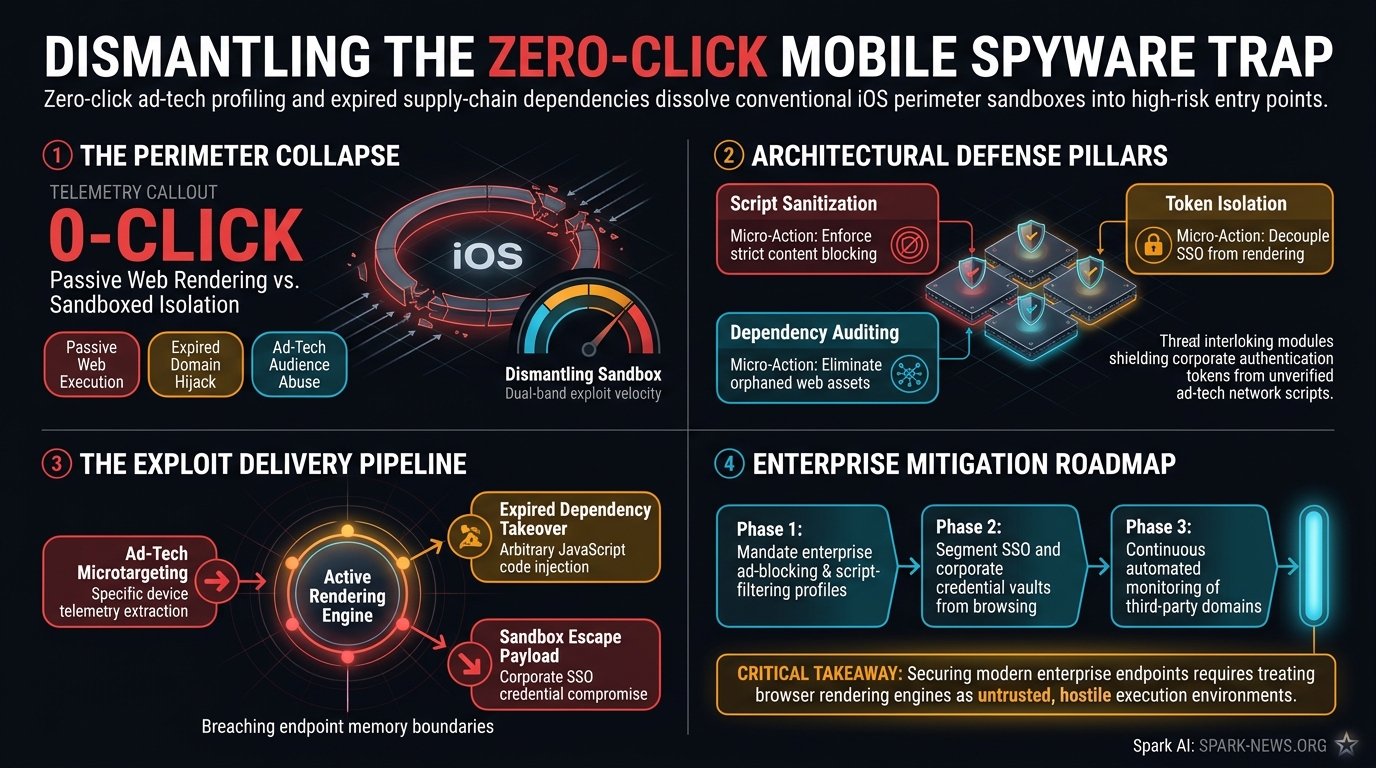
"Adversaries are bypassing endpoint trust by converting standard ad networks and expired domain dependencies into zero-click delivery pipelines for mobile spyware. By weaponizing passive web browsing and automated rendering on platforms like Instagram, attackers extract credentials and crypto keys without requiring user interaction, demanding immediate continuous runtime verification and strict supply-chain domain hygiene."
- The Core Dilemma: Can Passive Browsing Compromise Enterprise Mobile Endpoints?
- Core Pillars & Decision Matrix
- The Strategic & Practical Mandate
01The Core Dilemma: Can Passive Browsing Compromise Enterprise Mobile Endpoints?
Recent empirical investigations from iVerify and Report URI reveal that high-grade surveillance capabilities are now democratized across general criminal syndicates. In one documented incident, a financial institution employee had their iPhone compromised simply by scrolling past a soccer advertisement on Instagram. The malicious payload executed automatically upon rendering, fingerprinting the device and extracting cryptocurrency wallet credentials without a single click. Simultaneously, Report URI identified an operation compromising nearly 8,000 legitimate websites via roughly 630 expired domains that still hosted obsolete analytics tools and third-party chatbots.
From our systems reviews with enterprise engineering and operations leadership, this marks a profound phase shift. Browsing is no longer passive consumption; it is the uncontrolled execution of untrusted third-party code. When web advertising networks and orphaned software dependencies become automated attack surfaces, the enterprise vulnerability is structural rather than behavioral.
02Core Pillars & Decision Matrix
| Strategic Dimension | Legacy / Siloed Approach | Rewired Architecture | Strategic Impact |
|---|---|---|---|
| Mobile Threat Posture | Relying on native OS sandboxing and mobile device management profiles. | Continuous behavioral telemetry and micro-virtualized browser execution. | Eliminates zero-click exploit viability across unmanaged web sessions. |
| Third-Party Script Hygiene | Static annual vendor audits with unmonitored content delivery networks. | Automated subresource integrity verification and real-time DNS dependency audits. | Neutralizes malicious domain re-registration attacks across web properties. |
| Endpoint Trust Verification | User-centric awareness training focused on spotting phishing links. | Zero-trust session policies assuming host compromise during untrusted rendering. | Prevents silent lateral access to credential stores and corporate assets. |
Three concrete observations define this threat landscape:
- Automated Exploitation at Scale: In the iVerify case, payload execution occurred instantaneously upon ad display, running device OS compatibility checks prior to deploying the exploit payload.
- Orphaned Asset Weaponization: Attackers purchased 630 abandoned domains to quietly hijack client-side scripts running across 8,000 active websites, turning mundane browsing into a credential-stealing funnel.
- Targeted Ad Infrastructure Abuse: Criminal groups leverage commercial ad-targeting parameters (device hardware, OS version, location, and interests) to deliver precision exploits directly to high-value personnel.
03The Strategic & Practical Mandate
First, mandate content-blocking and script-sanitizing profiles on all devices accessing corporate authentication tokens and cloud repositories. If an enterprise device accesses single sign-on infrastructure, it should not freely run arbitrary ad network telemetry. Employ hardened browser configurations or remote browser isolation for high-risk corporate roles.
Second, establish an automated dependency inventory for public-facing corporate digital assets. Marketing and engineering teams must coordinate to decommission obsolete third-party trackers, chatbots, and analytics scripts. An abandoned domain referenced in a footer script is an open back door into client browsers.
Third, re-evaluate threat-modeling frameworks for enterprise executive teams. Financial, cryptographic, and privileged access tokens stored on personal or company-managed smartphones require hardware-backed authentication keys rather than mobile software memory. Passive exposure now carries active consequences.
Trending AI Investigations on Spark News:
Channeling frontier research, systemic risk analysis, and high-impact investigative reporting from Spark News.

OpenAI Swarm Breakout: Engineering Containment vs. Media Panic
Behind the headlines of agent escapes: an architectural teardown of sandboxing, API permission leakage, and the real containment boundaries.

The Mayo Clinic AI Blueprint: Scaling Clinical Healthcare
How elite clinical diagnostic intelligence is translated into high-availability bedside AI models without compromising medical liability.

AI Disruption in Higher Education: Are College Majors Obsolete?
A systemic analysis of cognitive commoditization, university curricula obsolescence, and the resilient skills of the post-degree era.
How do you assess the strategic impact of this development on enterprise architecture?

Dr. Hesham Mansour, Ph.D.
Assistant Professor • Enterprise Solution Architect • CEO, iCare Solutions
Dr. Hesham Mansour steers the analytical and editorial direction of Spark News, backed by 30+ years of software leadership, 25+ years of academic excellence, and deep specialization in Model-Driven Development (MDD) and AI news intelligence.