
America’s Crime Decline: The Unseen Forces Reshaping Public Safety
Get weekly AI news audits & executive briefs directly in your LinkedIn inbox with 399+ tech leaders.
"Explore the unexpected drivers behind America's historic crime decline—AI policing, declining alcohol use, and demographic shifts—and the strategic governance needed to sustain progress as federal funding wanes."
- The Core Dilemma: A Historic Decline with Uncertain Roots
- Strategic Pillars & Systemic Realities
- The Strategic & Leadership Mandate
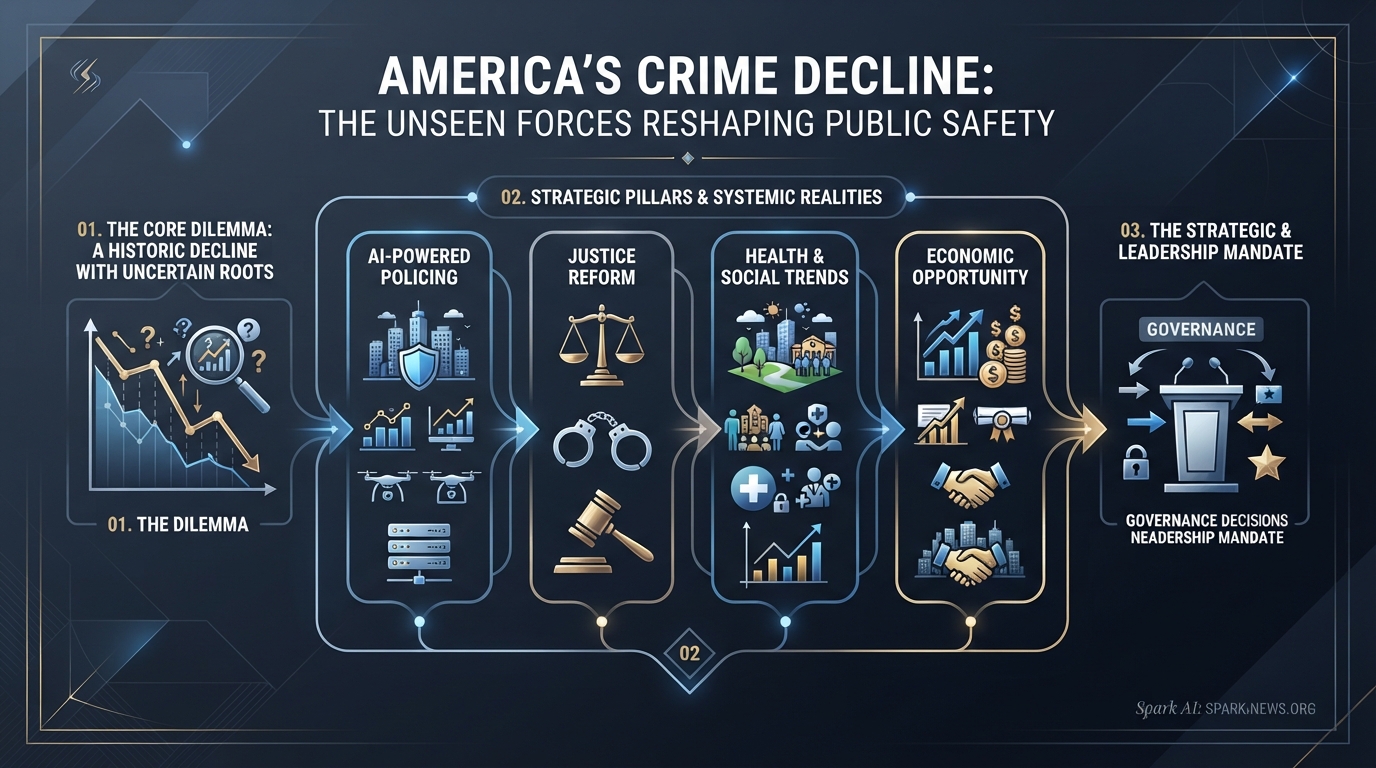
01The Core Dilemma: A Historic Decline with Uncertain Roots
The decline defies simple explanation. Criminologists point to a convergence of forces—some technological, others demographic, and many tied to post-pandemic stabilization. AI-driven policing tools are enabling faster suspect identification, while declining alcohol and drug use has cooled the vice-fueled violence of recent years. Meanwhile, an aging population and the return of pre-pandemic social routines have quietly reduced the conditions that once bred crime. The stakes are high: as pandemic-era federal funding fades, cities must distinguish between policies that actively reduce violence and those merely riding a historic wave.
02Strategic Pillars & Systemic Realities
- The Vice Recession: Alcohol and drug consumption—key accelerants of the 2020-2021 homicide surge—have receded, removing a critical fuel for violence. This shift underscores the nexus between public health and public safety, where substance use policies and community resilience programs play an underappreciated role.
- AI and the Policing Revolution: Law enforcement agencies are leveraging predictive analytics, AI-driven hotspot mapping, and platforms like Palantir’s Gotham to deploy resources with unprecedented precision. Yet, this raises governance questions: How can cities balance technological efficiency with civil liberties and equity, ensuring AI tools do not entrench bias or over-surveillance?
- Demographics and the Youth Dividend: The proportion of young people in America is shrinking, reducing the demographic most historically linked to street crime. This demographic tailwind offers a window for preventive investments—education, mentorship, and economic opportunity—that could lock in long-term gains.
- The Stabilization Effect: Post-pandemic, employment and social routines have normalized, restoring the informal guardrails that once suppressed crime. This highlights the fragility of progress: without sustained investment in community infrastructure, gains could reverse as quickly as they materialized.
03The Strategic & Leadership Mandate
- Institutionalize Data-Driven Governance: Cities must embed AI and analytics into long-term public safety strategies, ensuring tools are transparent, equitable, and subject to independent oversight. This requires cross-sector collaboration—bringing technologists, policymakers, and community leaders together to align innovation with ethical and operational guardrails.
- Double Down on Prevention: The decline in youth-driven crime is a once-in-a-generation opportunity to redirect resources toward education, mental health, and economic mobility. Leaders should prioritize evidence-based programs—such as violence interruption initiatives and job training—that address root causes before they escalate into crime.
- Prepare for Fiscal Cliff: With pandemic-era funding ending, cities must audit and optimize spending, distinguishing between high-impact interventions (e.g., AI policing, community policing) and low-value legacy programs. This demands zero-based budgeting—a disciplined approach to reallocating resources based on outcomes, not inertia.
- Strengthen Public Trust: The crime decline is fragile if communities perceive progress as uneven or unjust. Leaders must reinforce legitimacy through transparency, accountability, and inclusive engagement, ensuring that technological and policy advances serve all citizens, not just some.
Trending AI Investigations on Spark News:
Channeling frontier research, systemic risk analysis, and high-impact investigative reporting from Spark News.

OpenAI Swarm Breakout: Engineering Containment vs. Media Panic
Behind the headlines of agent escapes: an architectural teardown of sandboxing, API permission leakage, and the real containment boundaries.

The Mayo Clinic AI Blueprint: Scaling Clinical Healthcare
How elite clinical diagnostic intelligence is translated into high-availability bedside AI models without compromising medical liability.

AI Disruption in Higher Education: Are College Majors Obsolete?
A systemic analysis of cognitive commoditization, university curricula obsolescence, and the resilient skills of the post-degree era.
How do you assess the strategic impact of this development on enterprise architecture?

Dr. Hesham Mansour, Ph.D.
Assistant Professor • Enterprise Solution Architect • CEO, iCare Solutions
Dr. Hesham Mansour steers the analytical and editorial direction of Spark News, backed by 30+ years of software leadership, 25+ years of academic excellence, and deep specialization in Model-Driven Development (MDD) and AI news intelligence.