More Services

trend-analysisJuly 8, 2026

World Cup 2026 Under Fire: Did FIFA Fix Egypt’s Defeat to Keep Messi in the Tournament?

World Cup 2026 Under Fire: Did FIFA Fix Egypt’s Defeat to Keep Messi in the Tournament?
Spark News AI | spark-news.org
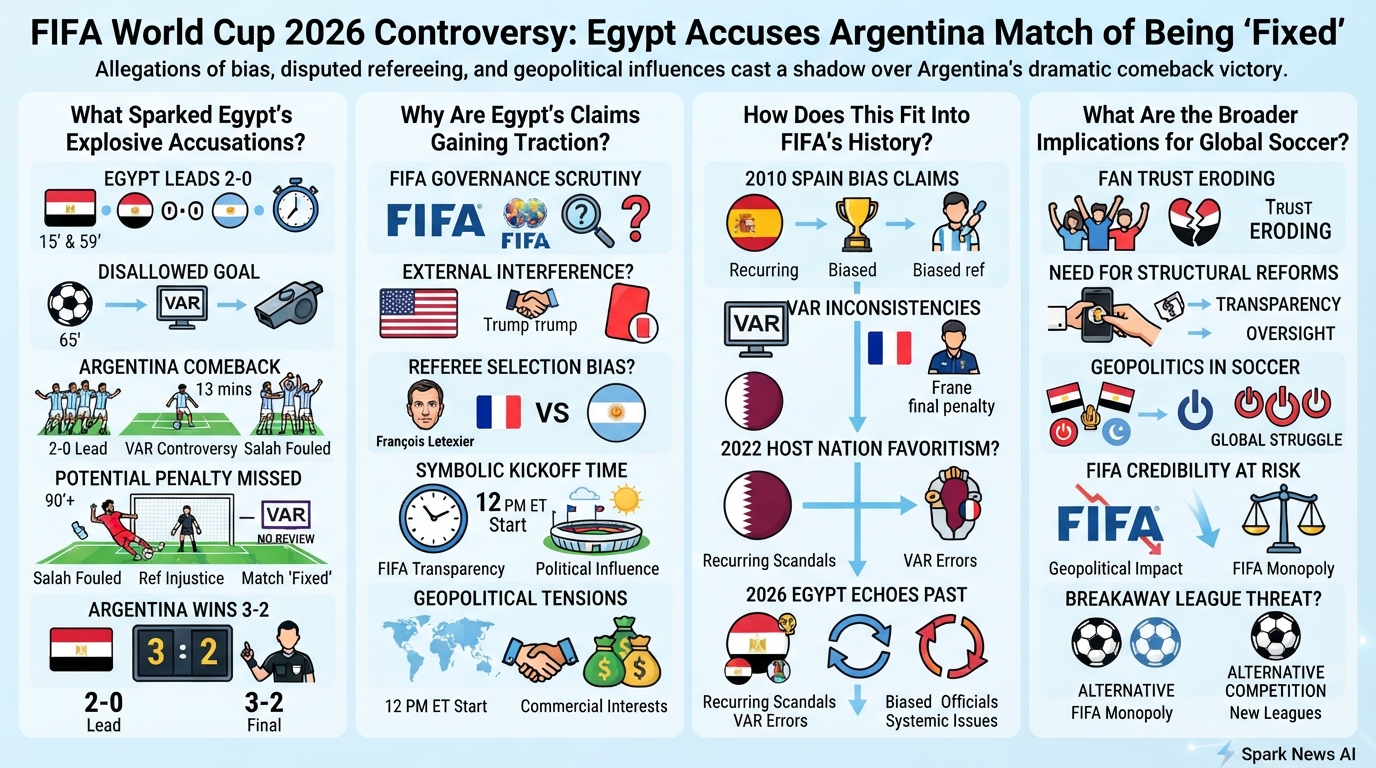
Enlarge Infographic
AI EXECUTIVE SUMMARY

"Egypt accuses FIFA of favoring Argentina in a controversial 3-2 World Cup 2026 defeat, citing disallowed goals and disputed VAR decisions. Analysts debate refereeing bias, political influences, and the future of fair play in global soccer."

  • What Sparked Egypt’s Explosive Accusations Against FIFA?
  • Why Are Egypt’s Claims Gaining Traction Beyond the Pitch?
  • How Does This Controversy Fit Into FIFA’s History of Refereeing Scandals?
  • What Are the Broader Implications for the Future of Global Soccer?

01What Sparked Egypt’s Explosive Accusations Against FIFA?

Egypt’s 3-2 defeat to Argentina in the Round of 16 of the 2026 FIFA World Cup has ignited a firestorm of controversy, with players and coaching staff accusing FIFA of orchestrating a 'fixed' match to ensure the defending champions advanced. The Pharaohs led 2-0 with less than 15 minutes remaining but collapsed under a late Argentine onslaught, culminating in Enzo Fernández’s stoppage-time winner. Egypt’s grievances center on two pivotal refereeing decisions: a disallowed goal for a contentious foul on Lisandro Martínez and the failure of VAR to review a potential penalty for Mohamed Salah in the buildup to Argentina’s third goal. Star forward Mostafa Ziko and manager Hossam Hassan publicly condemned the officiating as 'unfair' and 'injustice,' with Hassan vowing to boycott future World Cup matches, declaring, 'There’s no justice in this competition.' The Egyptian Football Association has formally demanded a FIFA investigation into referee François Letexier’s performance, raising questions about the integrity of the tournament’s officiating standards.

02Why Are Egypt’s Claims Gaining Traction Beyond the Pitch?

Egypt’s allegations tap into broader concerns about FIFA’s transparency and the politicization of global soccer. The timing of the controversy coincides with heightened scrutiny of FIFA’s governance, particularly following reports of external interference, including a purported 'red card' intervention by former U.S. President Donald Trump in an earlier match. Critics argue that FIFA’s selection of referees—such as Letexier, a French official whose country lost to Argentina in the 2022 final—may reflect unconscious biases or institutional favoritism toward high-profile teams like Argentina. Additionally, Egypt’s coach highlighted the symbolic kickoff time of 12 PM ET, despite Atlanta’s climate-controlled stadium, as evidence of systemic disregard for underdog teams. These claims resonate in a post-2022 World Cup era, where geopolitical tensions and commercial interests increasingly intersect with on-field decisions, fueling skepticism about the sport’s fairness.

03How Does This Controversy Fit Into FIFA’s History of Refereeing Scandals?

The 2026 World Cup controversy is not an isolated incident but part of a recurring pattern of refereeing disputes in FIFA tournaments. Historically, high-stakes matches involving global soccer powers—such as Argentina, Brazil, or Germany—have been marred by allegations of biased officiating. The 2010 World Cup saw widespread criticism of referee decisions favoring eventual champions Spain, while the 2018 tournament was overshadowed by VAR inconsistencies, including a contentious penalty awarded to France in the final. The 2022 World Cup in Qatar also faced scrutiny over refereeing impartiality, particularly in matches involving host-adjacent teams. Egypt’s accusations echo these precedents, suggesting a systemic issue where refereeing standards are perceived as pliable to external pressures, whether political, commercial, or reputational. The growing reliance on VAR, intended to reduce human error, has instead amplified controversies, as subjective interpretations of fouls and penalties remain contentious.

04What Are the Broader Implications for the Future of Global Soccer?

The fallout from Egypt’s defeat could have far-reaching consequences for FIFA’s credibility and the future of international soccer. If left unaddressed, allegations of match-fixing or institutional bias risk eroding fan trust, particularly among nations that perceive themselves as marginalized by the sport’s governing bodies. The controversy also underscores the need for structural reforms in refereeing, such as greater transparency in VAR decision-making, independent oversight of officiating appointments, and clearer guidelines for penalty reviews. Additionally, the incident highlights the growing influence of geopolitics in soccer, with nations like Egypt framing their grievances as part of a larger struggle against Western-dominated institutions. For FIFA, the challenge lies in balancing commercial interests—such as keeping star players like Lionel Messi in the tournament—with the imperative to maintain the sport’s integrity. Failure to do so could accelerate calls for alternative competitions or even a breakaway governing body, threatening FIFA’s monopoly on global soccer.

Bias Analysis

Left NarrativeNeutral & BalancedRight Narrative
100% LeftCenter / Neutral100% Right
The coverage of Egypt’s allegations reveals a divide in media narratives, with Western outlets like CNN and ESPN adopting a more skeptical tone toward the claims, while regional and non-Western media amplify Egypt’s grievances. Western reports tend to frame the controversy as an emotional overreaction by a 'disappointed underdog,' emphasizing Argentina’s on-field resilience and downplaying the refereeing errors. For example, CNN’s analysis dismisses the 'fix' allegations as hyperbolic, arguing that Egypt’s collapse was self-inflicted. In contrast, Middle Eastern and African media outlets, such as Al Jazeera and BBC Arabic, give greater weight to Egypt’s perspective, contextualizing the incident within a history of perceived injustices against non-European or non-South American teams. This disparity reflects broader media biases, where Western outlets often prioritize narratives that align with their audiences’ expectations of soccer as a meritocratic sport, while non-Western media highlight systemic inequities. The lack of diverse referee representation—particularly from Africa or Asia—in high-stakes matches further fuels accusations of institutional bias.

Connecting the Dots

The 2026 FIFA World Cup, hosted across North America, marks the first 48-team tournament in the competition’s history, expanding the field to include more nations from Africa, Asia, and the CONCACAF region. This expansion was intended to democratize the sport, but it has also intensified scrutiny of refereeing standards, as underdog teams face off against traditional powerhouses in high-pressure knockout matches. Egypt’s journey to the Round of 16 was a historic achievement, reflecting the country’s resurgence as a soccer force after decades of underperformance. However, their elimination has reignited long-standing frustrations among African teams, who have often felt disadvantaged by refereeing decisions in past tournaments. The 2026 World Cup also occurs against a backdrop of geopolitical tensions, including FIFA’s contentious relationships with authoritarian regimes and its efforts to navigate commercial pressures while maintaining a veneer of neutrality. Egypt’s accusations thus tap into deeper anxieties about the sport’s direction, where financial and political interests increasingly overshadow athletic fairness.

Fact-Check Verification


  • Egypt’s goal was disallowed due to a foul on Lisandro Martínez.

    Verified. VAR review confirmed a foul by Egypt’s Yasser Ibrahim on Martínez during the buildup to the disallowed goal. However, the subjective nature of the call—whether the contact warranted VAR intervention—remains debated among analysts.


    Unverified

  • VAR failed to review a potential penalty for Mohamed Salah in the buildup to Argentina’s winning goal.

    Partially verified. Replays show Julián Álvarez made contact with Salah in the box, but VAR did not flag the incident for review. FIFA’s VAR protocols require 'clear and obvious' errors, and the referee’s on-field decision was upheld.


    Unverified

  • Egypt’s coach accused FIFA of wanting to keep Lionel Messi in the tournament.

    Verified. Hossam Hassan explicitly stated, 'Perhaps they wanted Messi to stay in the running,' though this claim is speculative and lacks direct evidence of FIFA interference.


    Unverified

  • The Egyptian FA called for the referee to be removed from the tournament.

    Verified. The Egyptian Football Association issued a statement demanding an investigation into the refereeing decisions and implied the officiating team should be sanctioned.


    Unverified

  • The match kickoff time (12 PM ET) was inappropriate due to heat concerns.

    Misleading. While Hassan criticized the timing, Atlanta’s Mercedes-Benz Stadium features advanced climate control, mitigating heat risks. The decision likely prioritized global TV audiences.


    Unverified

  • FIFA has a history of favoring certain teams in refereeing decisions.

    Unverified but historically contested. While no direct evidence of systemic bias exists, past tournaments (e.g., 2010, 2018) have seen controversial decisions favoring high-profile teams, fueling perceptions of institutional favoritism.


    Unverified

Key Takeaways & Outlook

Egypt’s explosive accusations against FIFA following their World Cup defeat to Argentina have exposed deep-seated tensions in global soccer, where refereeing decisions, geopolitical influences, and commercial interests increasingly collide. While the evidence of a deliberate 'fix' remains circumstantial, the controversy underscores the urgent need for greater transparency and accountability in officiating, particularly as the sport expands to include more diverse nations. For FIFA, the challenge is twofold: addressing the immediate fallout by investigating Egypt’s claims while implementing long-term reforms to restore trust in its governance. The incident also serves as a cautionary tale about the fragility of soccer’s integrity in an era of heightened scrutiny, where every decision—on and off the pitch—is dissected for signs of bias. As the 2026 World Cup progresses, the outcome of this controversy could shape the future of the sport, determining whether FIFA can reconcile its commercial ambitions with the principles of fair play that underpin its global appeal.