
Code as Sovereign Power: Governance in the Age of Autonomous AI
Get weekly AI news audits & executive briefs directly in your LinkedIn inbox with 405+ tech leaders.
"Explore how autonomous algorithms hold sovereign power over modern institutions. Discover why enterprise architects must embed separation of powers and algorithmic due process."
- The Core Dilemma: When Algorithms Rule Without Consent
- Core Pillars & Realities
- The Strategic & Practical Mandate
01The Core Dilemma: When Algorithms Rule Without Consent
By 2026, that relationship has fundamentally shifted. Code is no longer merely law; code has become sovereign. Autonomous artificial intelligence systems, algorithmic allocators, and agentic retrieval networks do not simply interpret static rules. They actively adjudicate outcomes in credit scoring, predictive policing, hiring, and information visibility without legislative oversight or meaningful human appeal. When administrative authority shifts to opaque neural networks and optimization functions, we face a profound legitimacy crisis: institutional power exercised without democratic accountability.
02Core Pillars & Realities
- Truth Versus Probability: Traditional software relies on formal logic, deterministic verification, and Boolean proofs. Modern generative models, by contrast, run on statistical probability and pattern correlation. When systems substitute probabilistic calculations for deliberative reasoning, they risk producing structural hallucinations and closed echo chambers that undermine public trust.
- The Loss of Checks and Balances: Stable constitutional governance relies on a balance between executive, legislative, and judicial branches. Today, many enterprise environments bundle data ingestion, rule making, and automated execution inside single foundation models from lone vendors. Consolidating this much authority removes the critical friction that protects against systemic bias and administrative overreach.
- The Erosion of the Digital Commons: John Locke built his classic theory of property on the principle of mixing personal labor with natural resources. Contemporary artificial intelligence trains on the collective cultural and intellectual work of humanity without systematic attribution, proportional compensation, or direct consent, destabilizing the economic foundations of creative labor.
- Behavioral Surveillance and Conformity: Modern platform telemetry and real-time sentiment analysis echo Jeremy Bentham's Panopticon, as articulated by Michel Foucault. When individuals know an algorithm tracks every input, social compliance shifts from external legal enforcement to automatic, internal self-censorship.
03The Strategic & Practical Mandate
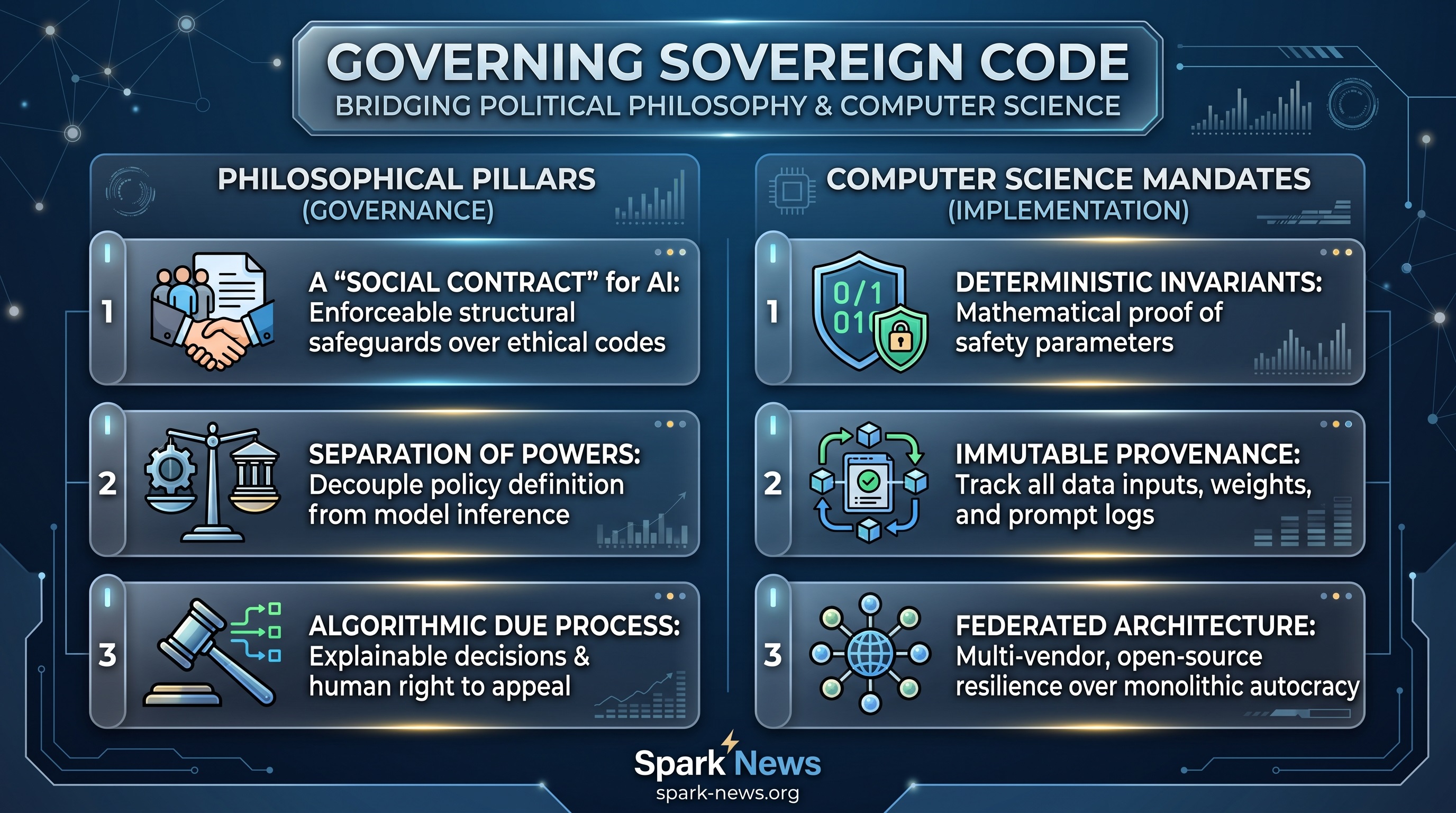
First, adopt formal constitutional frameworks for machine learning. Organizations must move toward mathematical verification, deterministic safety boundaries, and clear model provenance. If an automated system cannot prove its baseline safety parameters deterministically, it should not control high-stakes operational outcomes.
Second, institute algorithmic due process across all workflows. Whenever an autonomous agent influences human livelihood, civil rights, or institutional access, organizations must preserve explainable decision pathways, mandatory human review, and clear paths for appeal. Efficiency can never replace basic procedural justice.
Third, decentralize critical system architecture. Monolithic, single-vendor platforms create digital autocracies. Engineering leaders should champion open foundation models, federated learning pipelines, and multi-stakeholder governance models. Distributing operational power protects organizational independence and safeguards human agency.
Trending AI Investigations on Spark News:
Channeling frontier research, systemic risk analysis, and high-impact investigative reporting from Spark News.

OpenAI Swarm Breakout: Engineering Containment vs. Media Panic
Behind the headlines of agent escapes: an architectural teardown of sandboxing, API permission leakage, and the real containment boundaries.

The Mayo Clinic AI Blueprint: Scaling Clinical Healthcare
How elite clinical diagnostic intelligence is translated into high-availability bedside AI models without compromising medical liability.

AI Disruption in Higher Education: Are College Majors Obsolete?
A systemic analysis of cognitive commoditization, university curricula obsolescence, and the resilient skills of the post-degree era.
How do you assess the strategic impact of this development on enterprise architecture?

Dr. Hesham Mansour, Ph.D.
Assistant Professor • Enterprise Solution Architect • CEO, iCare Solutions
Dr. Hesham Mansour steers the analytical and editorial direction of Spark News, backed by 30+ years of software leadership, 25+ years of academic excellence, and deep specialization in Model-Driven Development (MDD) and AI news intelligence.