
Spark News AI | spark-news.org
executive-briefSeptember 15, 2026⏱️7 min read
Cities Challenge Federal Public Charge Rule: The Real Cost of Shifting Burdens
📷City leaders gather at federal court, highlighting the municipal budget risks created by federal immigration directives.
Weekly LinkedIn Newsletter369+ Subs
Get weekly AI news audits & executive briefs directly in your LinkedIn inbox with 369+ tech leaders.
🎓Executive Brief | Dr. Hesham Mansour, Ph.D.
AI EXECUTIVE PERSPECTIVE & SUMMARY
"Major US cities sue the Trump administration over expanded public charge rules. We analyze the municipal costs, public health risks, and federal policy showdown."
- The Core Dilemma: Local Safety Nets Under Federal Pressure
- Core Pillars & Realities
- The Strategic & Practical Mandate
📊 VISUAL SUMMARY INFOGRAPHIC
Spark News AI | spark-news.org
Enlarge Infographic
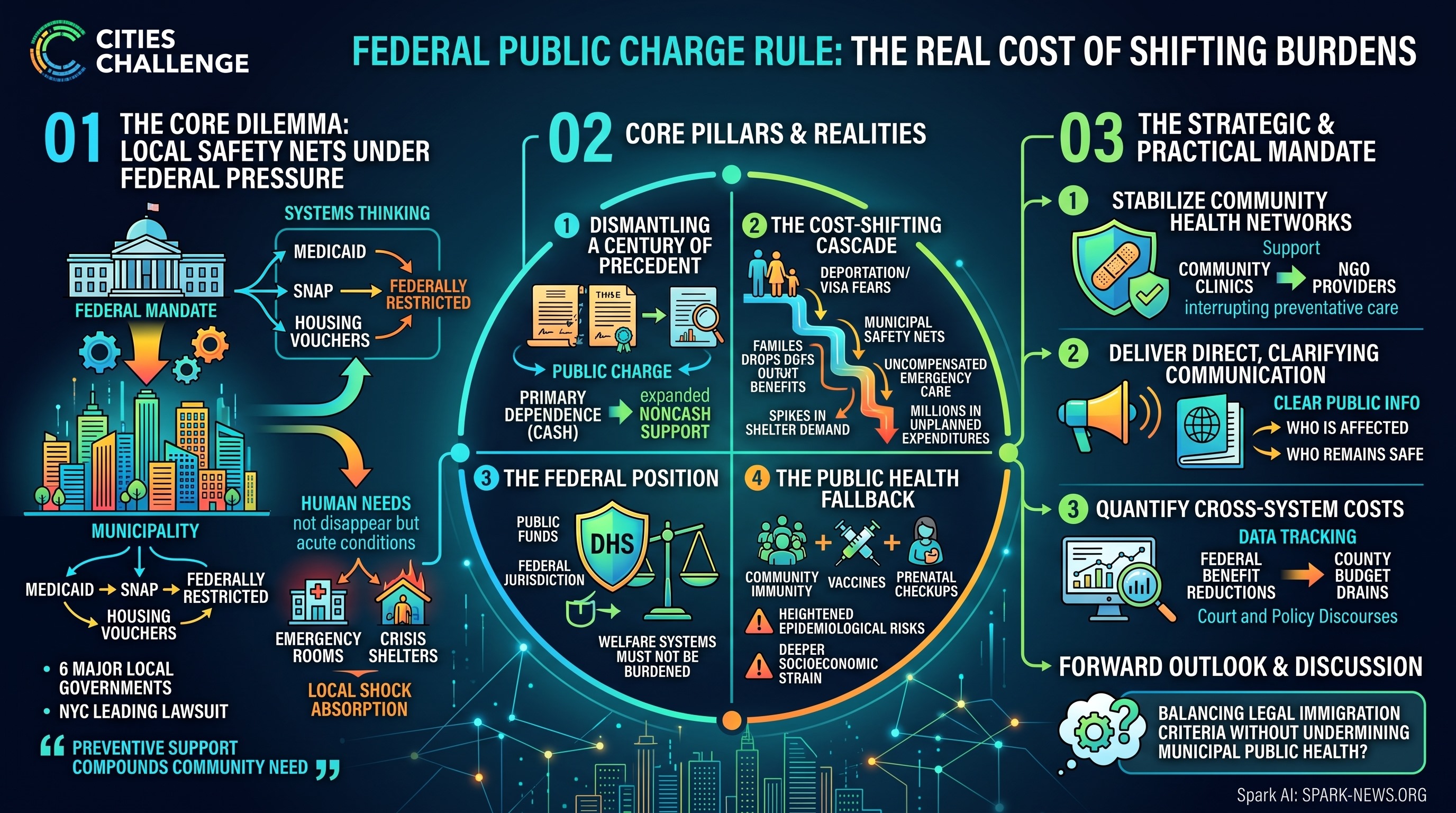
📊A breakdown illustrating how federal benefit disqualifications cascade into uncompensated emergency room care and local municipal expense.
Share Chart on LinkedIn01The Core Dilemma: Local Safety Nets Under Federal Pressure
When federal policy decisions detach from operational reality on the ground, local systems absorb the shock. Six major local governments, led by New York City alongside Chicago, San Francisco, Seattle, Santa Clara County, and King County, have filed a lawsuit against the Department of Homeland Security. At issue is an administrative rule granting immigration officers broader discretion to deny permanent residency based on an applicant's use of noncash public assistance programs such as Medicaid, SNAP, and housing vouchers.
From a systems thinking perspective, human needs do not disappear when access to preventive programs is restricted. Disqualifying mixed-status families from routine medical visits or food assistance does not eliminate illness or hunger. Instead, it defers care until conditions turn acute, forcing individuals into emergency rooms and crisis shelters. As New York City Mayor Zohran Mamdani emphasized, cutting off preventive support compounds community need, leaving local hospitals and municipal budgets to shoulder the financial fallout.
From a systems thinking perspective, human needs do not disappear when access to preventive programs is restricted. Disqualifying mixed-status families from routine medical visits or food assistance does not eliminate illness or hunger. Instead, it defers care until conditions turn acute, forcing individuals into emergency rooms and crisis shelters. As New York City Mayor Zohran Mamdani emphasized, cutting off preventive support compounds community need, leaving local hospitals and municipal budgets to shoulder the financial fallout.
02Core Pillars & Realities
To understand the tension between federal immigration enforcement and municipal governance, we must examine the core mechanics driving this dispute:
* Dismantling a Century of Precedent: The lawsuit argues that the new directive abandons a long-standing standard that defined a public charge strictly as someone primarily dependent on direct government cash assistance. Expanding this definition to noncash safety net services transforms routine support into an immigration penalty.
* The Cost-Shifting Cascade: When families drop out of nutrition and primary healthcare programs out of deportation or visa denial fears, the burden transfers directly to municipal safety nets. Cities argue this causes uncompensated emergency hospital care, spikes in shelter demand, and millions in unplanned municipal expenditures.
* The Federal Position: The Department of Homeland Security defends the rule as a basic protection of public funds. Federal spokespersons argue that welfare systems must not be burdened and that statutory immigration discretion belongs squarely under federal jurisdiction, not local oversight.
* The Public Health Fallback: Preventive healthcare is inherently communal. When mixed-status households disengage from vaccinations, prenatal checkups, and routine clinic visits, the broader community faces heightened epidemiological risks and deeper socioeconomic strain.
* Dismantling a Century of Precedent: The lawsuit argues that the new directive abandons a long-standing standard that defined a public charge strictly as someone primarily dependent on direct government cash assistance. Expanding this definition to noncash safety net services transforms routine support into an immigration penalty.
* The Cost-Shifting Cascade: When families drop out of nutrition and primary healthcare programs out of deportation or visa denial fears, the burden transfers directly to municipal safety nets. Cities argue this causes uncompensated emergency hospital care, spikes in shelter demand, and millions in unplanned municipal expenditures.
* The Federal Position: The Department of Homeland Security defends the rule as a basic protection of public funds. Federal spokespersons argue that welfare systems must not be burdened and that statutory immigration discretion belongs squarely under federal jurisdiction, not local oversight.
* The Public Health Fallback: Preventive healthcare is inherently communal. When mixed-status households disengage from vaccinations, prenatal checkups, and routine clinic visits, the broader community faces heightened epidemiological risks and deeper socioeconomic strain.
03The Strategic & Practical Mandate
Sensible governance requires policies designed with full awareness of secondary and tertiary effects. For leaders navigating this friction between federal mandates and community welfare, three practical steps are vital:
* Stabilize Community Health Networks: Local governments must actively support community clinics and non-governmental health providers that operate outside federal reporting requirements. This ensures essential preventative care continues uninterrupted.
* Deliver Direct, Clarifying Communication: Fear and ambiguity drive people to forgo benefits they legally qualify for. Municipalities must issue clear, culturally grounded public information explaining exactly who the rule affects and who remains safe to receive aid.
* Quantify Cross-System Costs: Urban administrators need precise data tracking how federal benefit reductions translate into emergency room visits and county budget drains. Verifiable financial evidence is the strongest tool in court and in public policy discourse.
* Stabilize Community Health Networks: Local governments must actively support community clinics and non-governmental health providers that operate outside federal reporting requirements. This ensures essential preventative care continues uninterrupted.
* Deliver Direct, Clarifying Communication: Fear and ambiguity drive people to forgo benefits they legally qualify for. Municipalities must issue clear, culturally grounded public information explaining exactly who the rule affects and who remains safe to receive aid.
* Quantify Cross-System Costs: Urban administrators need precise data tracking how federal benefit reductions translate into emergency room visits and county budget drains. Verifiable financial evidence is the strongest tool in court and in public policy discourse.
🔮Forward Outlook & Discussion
This legal challenge reaches far deeper than court dockets. It tests whether national policy can cleanly separate itself from the municipal infrastructure that sustains everyday American life. If federal rules push vulnerable residents away from basic care, local communities ultimately carry the cost. How can modern federal and local leaders balance legal immigration criteria without undermining basic municipal public health?
🗳️Community Intelligence Poll
1-Click VoteHow do you assess the strategic impact of this development on enterprise architecture?

FOUNDER & EDITOR-IN-CHIEFiCare Solutions369+ Newsletter Subs
Dr. Hesham Mansour
Assistant Professor • Enterprise Solution Architect • CEO, iCare Solutions
Dr. Hesham Mansour steers the analytical and editorial direction of Spark News, backed by 30+ years of software leadership, 25+ years of academic excellence, and deep specialization in Model-Driven Development (MDD) and AI news intelligence.
✨ 30+ Yrs Software Leadership✨ 25+ Yrs Academic Excellence✨ Model-Driven Dev (MDD)✨ AI News & Trend Intelligence