news-analysisJuly 17, 2026

Kimi K3: How China’s Open-Weight AI Model Is Redefining the Global AI Race

Kimi K3: How China’s Open-Weight AI Model Is Redefining the Global AI Race
Spark News AI | spark-news.org
Enlarge Infographic
AI EXECUTIVE SUMMARY

"China's Moonshot AI unveils Kimi K3, an open-weight model with 2.8T parameters, rivaling U.S. AI leaders like GPT-5.6 and Opus 4.8 at a fraction of the cost. Discover why this breakthrough is reshaping global AI competition and sparking concerns in Silicon Valley and Washington."

  • Why Is Kimi K3 a Game-Changer in the AI Industry?
  • How Does Kimi K3 Compare to U.S. AI Models Like GPT-5.6 and Opus 4.8?
  • What Are the Geopolitical Implications of China’s AI Advancements?
  • What Challenges and Limitations Does Kimi K3 Face?

01Why Is Kimi K3 a Game-Changer in the AI Industry?

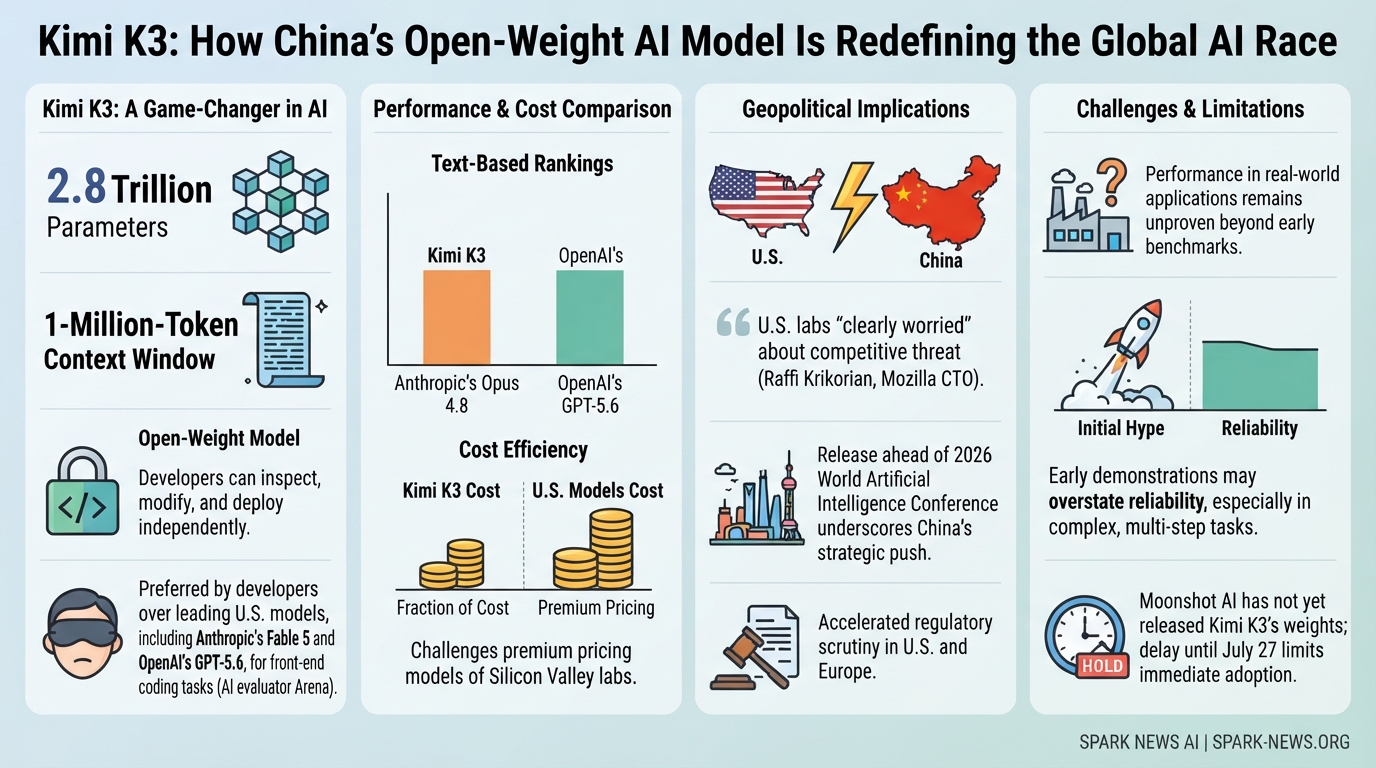
Kimi K3, developed by Chinese startup Moonshot AI, has sent shockwaves through the global AI community by achieving frontier-level performance with 2.8 trillion parameters and a 1-million-token context window. Unlike proprietary models from U.S. labs like OpenAI and Anthropic, Kimi K3 is open-weight, allowing developers to inspect, modify, and deploy it independently. Early blind testing by AI evaluator Arena revealed that developers preferred Kimi K3 over leading U.S. models, including Anthropic’s Fable 5 and OpenAI’s GPT-5.6, for front-end coding tasks. This marks a pivotal shift in the AI landscape, as China demonstrates its ability to compete with—and potentially surpass—U.S. AI dominance in both performance and cost efficiency.

02How Does Kimi K3 Compare to U.S. AI Models Like GPT-5.6 and Opus 4.8?

Kimi K3’s performance in Arena’s benchmarks has positioned it as a direct competitor to premium U.S. models. In text-based rankings, it outperformed Anthropic’s Opus 4.8, a model that was considered state-of-the-art just weeks prior. Additionally, Kimi K3 tied with OpenAI’s GPT-5.6 in broader evaluations. What sets Kimi K3 apart is its pricing strategy: Moonshot AI is offering the model at a fraction of the cost of its U.S. counterparts, challenging the premium pricing models of Silicon Valley labs. This cost-performance ratio raises critical questions about the sustainability of high-margin AI models in the face of aggressive competition from Chinese firms.

03What Are the Geopolitical Implications of China’s AI Advancements?

The launch of Kimi K3 comes at a time of heightened geopolitical tension between the U.S. and China, particularly in the technology sector. U.S. AI labs and policymakers are increasingly concerned about China’s rapid progress, as evidenced by statements from industry leaders like Mozilla CTO Raffi Krikorian, who noted that U.S. labs are "clearly worried" about the competitive threat posed by open-weight models. The timing of Kimi K3’s release, just ahead of the 2026 World Artificial Intelligence Conference in Shanghai, underscores China’s strategic push to position itself as a global leader in AI. This development could accelerate regulatory scrutiny in the U.S. and Europe, potentially leading to restrictions on AI collaboration or exports of critical technologies to China.

04What Challenges and Limitations Does Kimi K3 Face?

Despite its impressive early benchmarks, Kimi K3 is not without challenges. The model has only been available for a short period, and its performance in real-world applications remains unproven. Early demonstrations and benchmarks may overstate its reliability, particularly in complex, multi-step tasks. Additionally, Moonshot AI has not yet released Kimi K3’s weights, meaning developers cannot independently verify, modify, or deploy the model until July 27. This delay could limit its immediate adoption and raise questions about transparency. Furthermore, the AI industry has seen instances where initial hype around new models did not translate into long-term dominance, as seen with previous high-profile releases.

Bias Analysis

Left NarrativeNeutral & BalancedRight Narrative
100% LeftCenter / Neutral100% Right
The coverage of Kimi K3’s launch exhibits a mix of awe and alarm, particularly in Western media outlets. U.S.-based sources, such as Axios and VentureBeat, frame the development as a direct challenge to American AI dominance, often emphasizing the geopolitical stakes and potential threats to Silicon Valley’s leadership. This narrative aligns with broader media trends that portray China’s technological advancements as a zero-sum competition with the U.S. However, there is a risk of overstating the immediate impact of Kimi K3, as early benchmarks may not fully capture its real-world performance or limitations. Chinese state-affiliated media, on the other hand, is likely to highlight this achievement as a testament to China’s innovation and strategic vision, potentially downplaying any shortcomings or challenges.

Connecting the Dots

China’s rise as a global AI powerhouse has been years in the making, driven by substantial government investment, a thriving tech ecosystem, and a focus on open-weight models. The Chinese government has prioritized AI development as part of its "New Generation Artificial Intelligence Development Plan," aiming to become the world leader in AI by 2030. In recent years, Chinese AI labs like Moonshot AI and DeepSeek have made significant strides, often releasing models that challenge the performance of U.S. counterparts at lower costs. The 2026 World Artificial Intelligence Conference in Shanghai, where President Xi Jinping is expected to outline China’s AI priorities, serves as a critical milestone in this trajectory. The conference is likely to showcase further advancements, reinforcing China’s ambition to lead the next wave of AI innovation.

Fact-Check Verification


  • Kimi K3 contains 2.8 trillion parameters, making it one of the largest open-weight AI models ever released.

    This claim is supported by Moonshot AI’s official announcement and is consistent with early technical reports. However, independent verification of the model’s architecture and parameter count is pending until the release of its weights on July 27.


    Unverified

  • In blind testing by AI evaluator Arena, developers preferred Kimi K3 over Anthropic’s Fable 5 and OpenAI’s GPT-5.6 for front-end coding.

    This claim is based on Arena’s early benchmarks, which are widely regarded as credible within the AI community. However, these results are preliminary and may not reflect long-term performance or broader use cases.


    Unverified

  • Kimi K3 outperformed Anthropic’s Opus 4.8 in text-based rankings and tied with GPT-5.6.

    This is corroborated by Arena’s rankings, but it is important to note that Opus 4.8 was considered state-of-the-art only weeks prior. The rapid pace of AI development means such comparisons may quickly become outdated.


    Unverified

  • Moonshot AI is offering Kimi K3 at prices well below premium U.S. models.

    Moonshot AI has publicly stated its intention to undercut U.S. competitors on pricing, but specific pricing details have not been fully disclosed. The cost advantage will need to be validated as the model becomes more widely adopted.


    Unverified

Key Takeaways & Outlook

The launch of Kimi K3 marks a watershed moment in the global AI race, demonstrating China’s ability to develop frontier-level models that rival—and in some cases surpass—U.S. offerings. While early benchmarks are impressive, the true test of Kimi K3’s impact will lie in its real-world performance, adoption, and long-term competitiveness. For the U.S. and its allies, this development underscores the urgency of addressing China’s rapid advancements in AI, whether through increased investment, regulatory measures, or strategic collaborations. As the 2026 World Artificial Intelligence Conference approaches, the AI world will be watching closely to see how China’s ambitions unfold and what it means for the future of global technology leadership.