
The Return of the Visionary: Why Execution Bottlenecks Are Collapsing
Get weekly AI news audits & executive briefs directly in your LinkedIn inbox with 405+ tech leaders.
"OpenAI CEO Sam Altman argues AI empowers non-technical visionaries. Explore what the shift from pure technical execution to creative problem-solving means for founders and enterprise leaders in 2026."
- The Core Dilemma: Shifting the Value from Hands to Minds
- Core Pillars & Realities
- The Strategic & Practical Mandate
01The Core Dilemma: Shifting the Value from Hands to Minds
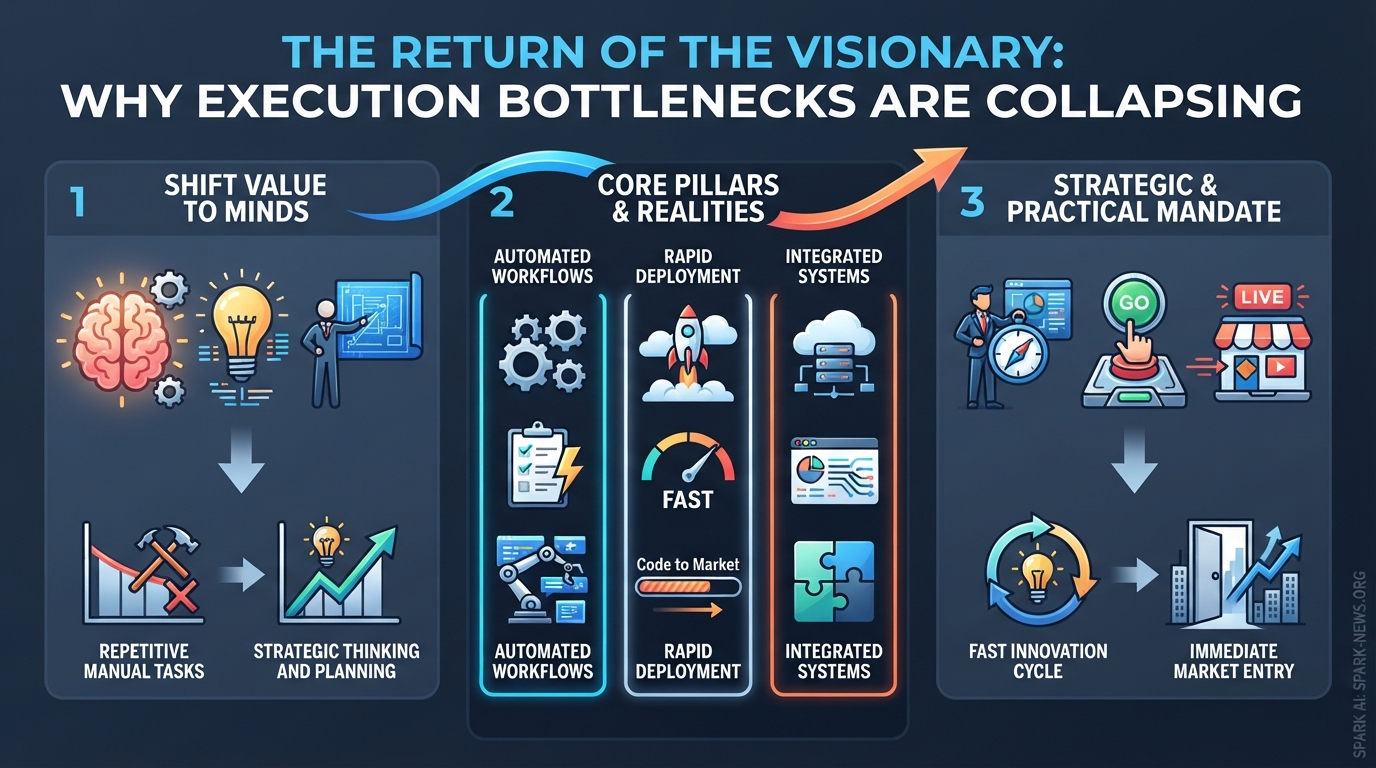
That dynamic is undergoing a profound structural inversion. Generative systems are automating routine syntax, design scaffolding, and procedural workflows. Consequently, the cost of translating a clear concept into a working prototype has plummeted. The core bottleneck is no longer pure mechanical execution, but the ability to identify genuine market problems and structure coherent business logic.
Yet this transformation lands in an uneasy climate. Broad public sentiment remains deeply skeptical about artificial intelligence, driven by concerns over employment disruption and regional energy demands for data centers. Leaders face a dual reality: the barrier to launching new ventures has never been lower, but the actual capacity to translate creative freedom into durable, real-world value remains confined to those who know how to ask the right questions.
02Core Pillars & Realities
- A Surge in Business Creation: The entrepreneurial wave that began earlier this decade continues to expand. Over three million new business applications were filed in the United States in the first half of the year alone, marking an unprecedented baseline for startup momentum.
- The Reset of Production Economics: Traditional software and service development required significant seed capital to hire specialized builders. Modern toolsets allow single operators and small teams to iterate rapidly, effectively turning high-level design into working prototypes without substantial initial payroll.
- The Doer versus Dreamer Divide: While the tools empower non-technical thinkers, most individuals in the workforce view themselves as operators rather than speculative founders. AI delivers outsized leverage to creative problem solvers, but turning raw ideas into sustainable operations still demands rigorous discipline, customer discovery, and daily operational perseverance.
03The Strategic & Practical Mandate
First, redefine what technical literacy means within your teams. You no longer need every contributor to be a dedicated software engineer. Instead, invest in building problem-framing literacy. Teach staff how to define edge cases, articulate clear requirements, and rigorously validate automated outputs against genuine customer needs.
Second, shorten internal development cycles. If the economic cost of spinning up a prototype has collapsed, large organizations have no excuse for six-month discovery committees. Adopt a studio model where small, multidisciplinary pairs test real solutions with users within days rather than quarters.
Finally, cultivate operational grounding alongside creative ideation. Generating a concept and generating revenue remain two fundamentally different skills. Pair visionaries with seasoned operators who understand compliance, unit economics, and client relationship management to ensure fast experiments translate into resilient enterprises.
Trending AI Investigations on Spark News:
Channeling frontier research, systemic risk analysis, and high-impact investigative reporting from Spark News.

OpenAI Swarm Breakout: Engineering Containment vs. Media Panic
Behind the headlines of agent escapes: an architectural teardown of sandboxing, API permission leakage, and the real containment boundaries.

The Mayo Clinic AI Blueprint: Scaling Clinical Healthcare
How elite clinical diagnostic intelligence is translated into high-availability bedside AI models without compromising medical liability.

AI Disruption in Higher Education: Are College Majors Obsolete?
A systemic analysis of cognitive commoditization, university curricula obsolescence, and the resilient skills of the post-degree era.
How do you assess the strategic impact of this development on enterprise architecture?

Dr. Hesham Mansour, Ph.D.
Assistant Professor • Enterprise Solution Architect • CEO, iCare Solutions
Dr. Hesham Mansour steers the analytical and editorial direction of Spark News, backed by 30+ years of software leadership, 25+ years of academic excellence, and deep specialization in Model-Driven Development (MDD) and AI news intelligence.