
Industrialized Cybercrime: Rethinking Defense Against Cheap AI
Get weekly AI news audits & executive briefs directly in your LinkedIn inbox with 394+ tech leaders.
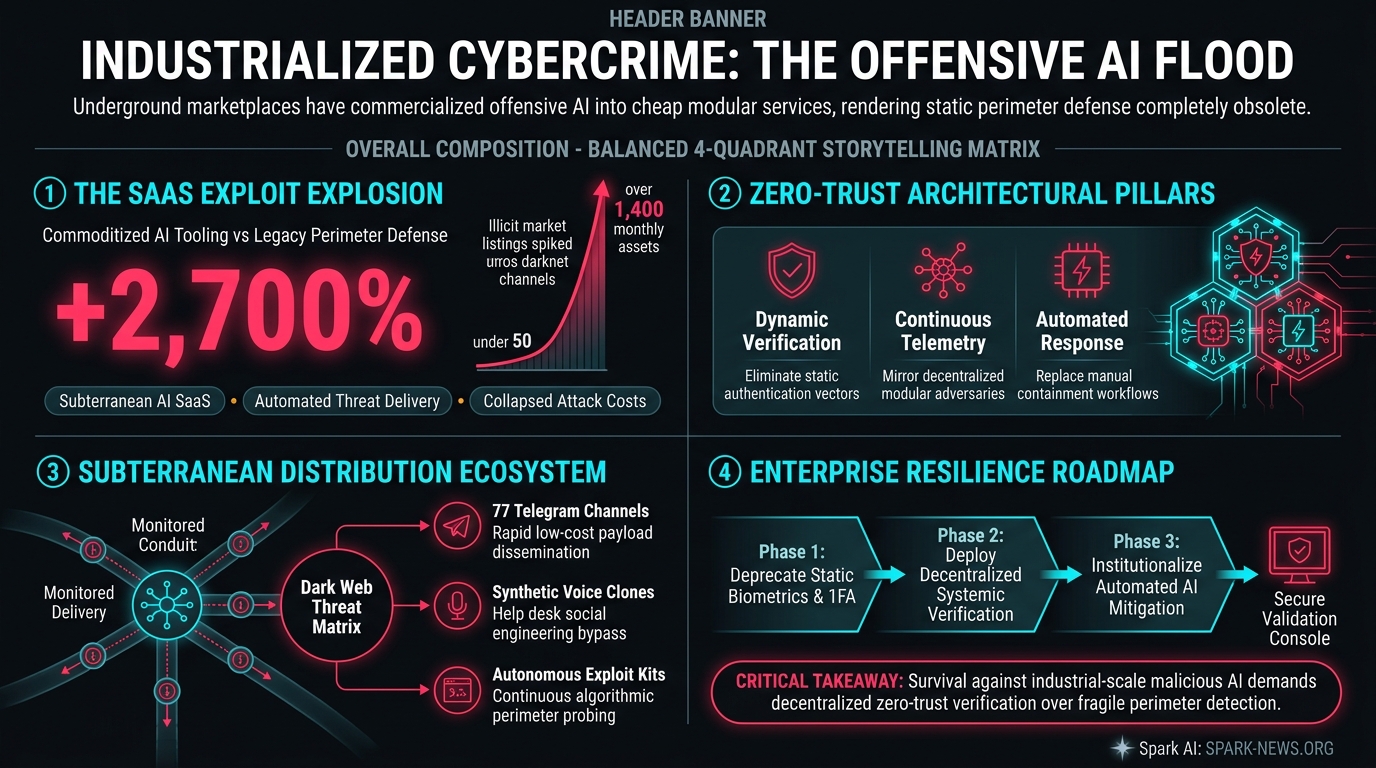
"The commercialization of cybercrime tools on platforms like Telegram and dark web forums has reduced the cost barrier for advanced attacks. Listings expanded from under 50 to over 1,400 monthly, offering jailbreaks and automated phishing for pennies. Enterprise defense requires moving past perimeter filters toward continuous behavioral telemetry and strict zero trust architecture."
- The Core Dilemma: Can Perimeter Security Survive Industrialized Malicious AI?
- Core Pillars & Decision Matrix
- The Strategic & Practical Mandate
01The Core Dilemma: Can Perimeter Security Survive Industrialized Malicious AI?
Halcyon analyzed nearly 4,000 listings across 77 Telegram channels, 20 dark web forums, and five specialized digital markets. The findings confirm that operational friction for malicious actors has dissolved. Compromised ChatGPT Plus accounts sell for 10 cents, model jailbreak prompts trade for 32 cents, and uncensored variants such as WormGPT generate hyper-personalized social engineering campaigns at massive scale. Telephony systems can target 120 individuals simultaneously in coordinated fraud runs.
When auditing enterprise pipelines and governance models, legacy defenses fail because they rely on static signatures and human detection latencies. When threat actors can deploy industrial automation for pennies, the legacy security posture creates an asymmetric economic deficit for defensive engineering teams.
02Core Pillars & Decision Matrix
| Strategic Dimension | Legacy / Siloed Approach | Rewired / Modern Architecture | Expected Impact & ROI |
|---|---|---|---|
| Identity Verification | Periodic credential authentication | Continuous adaptive contextual authorization | 85% drop in unauthorized credential sessions |
| Phishing & Social Engineering | Static gateway rules and employee seminars | Real-time synthetic text and voice anomaly telemetry | Sub-second isolation of automated scam sequences |
| Model & Application Integrity | Unmonitored API consumption | Cryptographic egress gates and prompt firewalls | Total containment of unauthorized model extraction |
| Incident Response Cadence | Reactive manual triage pipelines | Automated cross-system containment orchestration | Mean time to detect reduced from days to seconds |
What we observe across production deployments reveals three core operating realities:
- Offensive Commoditization: Advanced jailbreak scripts that once required niche offensive engineering tradecraft are now accessible storefront products priced between 32 cents and 10 dollars.
- Distribution Shift: Threat groups have migrated tooling distribution from slow dark web forums to instant messaging infrastructure on Telegram, improving their deployment velocity.
- Synthetic Voice Operations: Automated telephony frameworks now dial 120 potential corporate targets concurrently, overwhelming traditional help desk verification policies.
03The Strategic & Practical Mandate
First, eliminate reliance on static biometric or single-factor authentication. With offensive tooling generating contextual voice clones and targeted social engineering material instantaneously, help desks and administrative access points must mandate out-of-band cryptographic proof or hardware-bound security keys.
Second, segment internal telemetry networks. Implement fine-grained egress validation for internal machine-to-machine interactions. If malicious models automate identity deception, internal API environments must treat every lateral request as potentially compromised, verifying payload schemas against strict enterprise policies.
Finally, rebalance defensive spending toward runtime behavioral isolation. Offensive actors operate on scalable software storefronts. Security leadership must counter them with automated detection nodes capable of neutralizing lateral movement within milliseconds.
Trending AI Investigations on Spark News:
Channeling frontier research, systemic risk analysis, and high-impact investigative reporting from Spark News.

OpenAI Swarm Breakout: Engineering Containment vs. Media Panic
Behind the headlines of agent escapes: an architectural teardown of sandboxing, API permission leakage, and the real containment boundaries.

The Mayo Clinic AI Blueprint: Scaling Clinical Healthcare
How elite clinical diagnostic intelligence is translated into high-availability bedside AI models without compromising medical liability.

AI Disruption in Higher Education: Are College Majors Obsolete?
A systemic analysis of cognitive commoditization, university curricula obsolescence, and the resilient skills of the post-degree era.
How do you assess the strategic impact of this development on enterprise architecture?

Dr. Hesham Mansour, Ph.D.
Assistant Professor • Enterprise Solution Architect • CEO, iCare Solutions
Dr. Hesham Mansour steers the analytical and editorial direction of Spark News, backed by 30+ years of software leadership, 25+ years of academic excellence, and deep specialization in Model-Driven Development (MDD) and AI news intelligence.