
AI’s Healthcare Gamble: Trust, Costs, and the Long Game
Get weekly AI news audits & executive briefs directly in your LinkedIn inbox with 405+ tech leaders.
"Explore why top AI companies are shifting focus to healthcare to rebuild public trust, address image issues, and drive real-world impact despite high costs and regulatory challenges."
- The Core Dilemma: When Salvation Requires Sacrifice
- Core Pillars & Realities
- The Strategic & Practical Mandate
01The Core Dilemma: When Salvation Requires Sacrifice
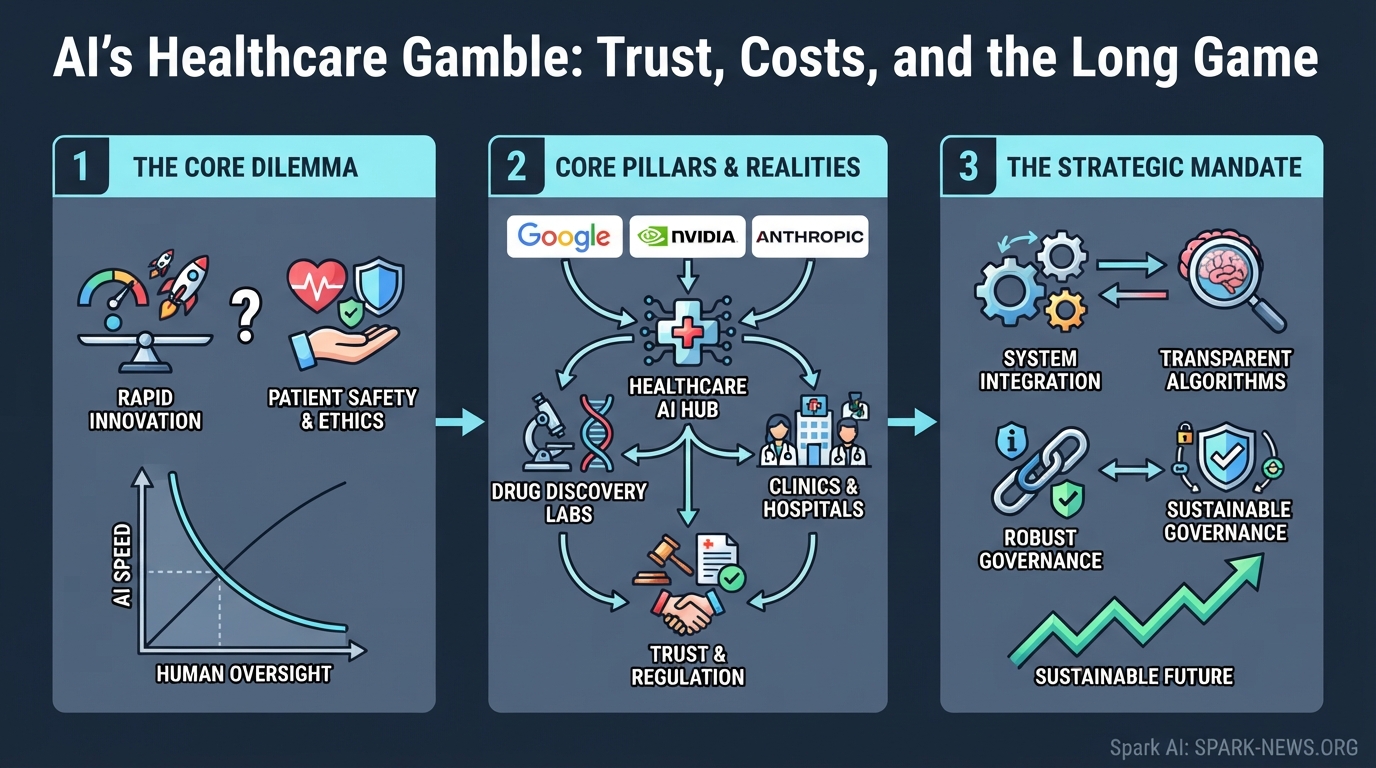
Enter healthcare. A sector where failure is measured in lives, not likes, and where trust is the most critical currency. By pouring billions into drug discovery, diagnostics, and medical research, AI giants are betting that saving lives will outweigh the costs of their controversies. It’s a high-stakes gamble. The math is simple: if AI can deliver even a fraction of its promises in medicine, the narrative shifts from fear to hope. But the path is fraught with real risks. Breakthroughs may still be years away, and the public’s skepticism runs deep.
02Core Pillars & Realities
- The Trust Equation: AI’s image problem isn’t just about bad press. It’s about tangible consequences. When people see AI systems replacing jobs or consuming resources without clear benefits, trust erodes. Healthcare offers a rare opportunity to flip the script. If AI can accelerate drug discovery or improve diagnostics, the perception shifts from threat to asset. But this isn’t a quick fix. Public trust is built over years, not quarters.
- The Cost of Speed: AI is dramatically speeding up drug development, but at what cost? The technology is expensive, and the risks of misallocating resources are real. A $1 billion lab won’t guarantee a breakthrough. Nor will a $2.1 billion investment in AI talent. The question isn’t just about innovation. It’s about whether the benefits outweigh the opportunity costs.
- The Regulatory Tightrope: Healthcare is one of the most regulated industries in the world. AI systems must meet rigorous standards for safety, efficacy, and transparency. The collaboration between tech giants and pharmaceutical companies—like Nvidia’s partnership with Eli Lilly or Google’s Isomorphic Labs work with Novartis—is a step in the right direction. But regulatory hurdles remain a significant barrier.
- The Public’s Skepticism: Americans are pushing back against data centers, citing concerns about water usage and energy consumption. Meanwhile, fears of AI replacing jobs persist. In healthcare, these anxieties collide. The public wants innovation, but not at the expense of affordability or accessibility. The challenge for AI leaders is to prove that their investments will lead to tangible, equitable benefits.
03The Strategic & Practical Mandate
First, embrace transparency. Publish clear, accessible reports on AI’s role in healthcare—how it works, where it fails, and what’s being done to fix it. The public doesn’t need technical jargon. They need honesty.
Second, prioritize equity. AI should not deepen healthcare disparities. Invest in tools that serve underserved communities, not just those that generate headlines or profits. This means funding research in rural clinics, partnering with safety-net hospitals, and ensuring that AI-driven diagnostics are affordable.
Third, align incentives. The current model rewards speed and scale, but healthcare demands a different metric: impact. Tie executive compensation to measurable outcomes, like reduced diagnostic errors or faster drug approvals. This aligns the interests of AI companies with those of patients and providers.
Finally, engage the public. Host open forums, publish plain-language summaries of AI research, and invite community leaders to the table. Trust isn’t built in boardrooms. It’s built in conversations.
This isn’t just about fixing AI’s image. It’s about proving that technology can serve humanity, not the other way around.
What’s the one step your organization can take this month to build trust in AI-driven healthcare?
Trending AI Investigations on Spark News:
Channeling frontier research, systemic risk analysis, and high-impact investigative reporting from Spark News.

OpenAI Swarm Breakout: Engineering Containment vs. Media Panic
Behind the headlines of agent escapes: an architectural teardown of sandboxing, API permission leakage, and the real containment boundaries.

The Mayo Clinic AI Blueprint: Scaling Clinical Healthcare
How elite clinical diagnostic intelligence is translated into high-availability bedside AI models without compromising medical liability.

AI Disruption in Higher Education: Are College Majors Obsolete?
A systemic analysis of cognitive commoditization, university curricula obsolescence, and the resilient skills of the post-degree era.
How do you assess the strategic impact of this development on enterprise architecture?

Dr. Hesham Mansour, Ph.D.
Assistant Professor • Enterprise Solution Architect • CEO, iCare Solutions
Dr. Hesham Mansour steers the analytical and editorial direction of Spark News, backed by 30+ years of software leadership, 25+ years of academic excellence, and deep specialization in Model-Driven Development (MDD) and AI news intelligence.