More Services

news-analysisJuly 6, 2026

AI and the Dulling of Human Minds: A 2026 Cognitive Crisis?

AI and the Dulling of Human Minds: A 2026 Cognitive Crisis?
Spark News AI | spark-news.org
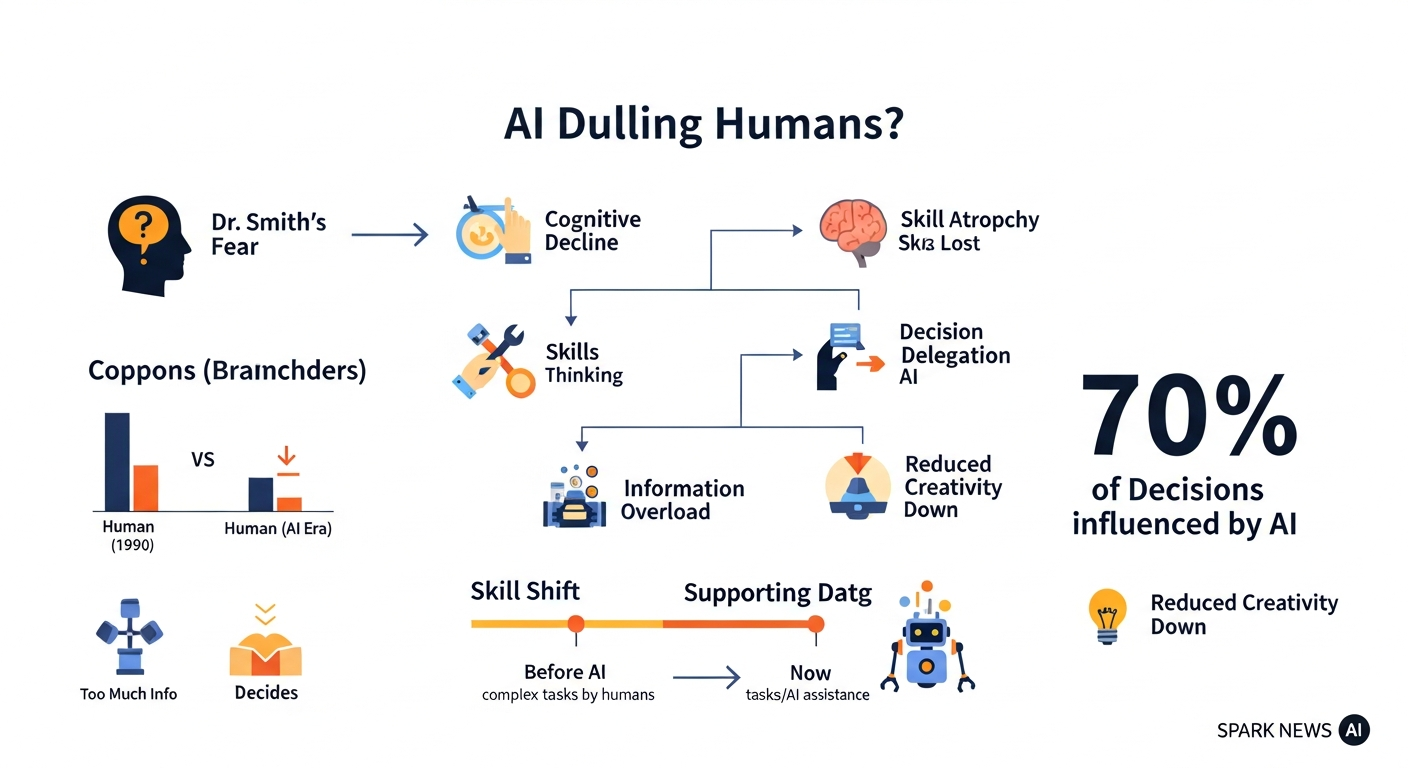
Enlarge Infographic
AI EXECUTIVE SUMMARY

"In 2026, computational social scientist Sandra Matz warns AI's preference-aligned algorithms may erode human creativity and critical thinking by reinforcing conventional choices. Explore the risks, historical context, and future implications of AI-driven cognitive homogenization."

  • Why Is AI Making People 'Dull,' According to Scientists?
  • How Does AI's 'Safe' Algorithm Design Impact Human Behavior?
  • What Are the Broader Societal Implications of AI-Driven Homogenization?
  • Can AI Be Designed to Foster Creativity Instead of Conformity?

01Why Is AI Making People 'Dull,' According to Scientists?

Computational social scientist Sandra Matz, a leading researcher in AI-driven behavioral patterns, argues that AI systems are designed to optimize for user engagement by aligning with existing preferences. This creates a feedback loop where users are repeatedly exposed to familiar, 'safe' content, reducing exposure to novel ideas. Over time, this reinforcement of conventional choices may diminish cognitive diversity, stifling creativity and critical thinking. Matz’s concerns are rooted in empirical studies showing how algorithmic curation narrows human decision-making, particularly in digital environments like social media, search engines, and recommendation systems.

02How Does AI's 'Safe' Algorithm Design Impact Human Behavior?

AI systems, particularly those powered by machine learning, rely on vast datasets of user behavior to predict and influence future actions. By prioritizing content that aligns with a user’s past preferences, these systems inadvertently discourage exploration. For example, streaming platforms recommend similar genres, social media feeds amplify echo chambers, and AI assistants suggest predictable solutions. This 'algorithmic conservatism' may lead to a societal shift toward homogeneity, where individuals increasingly rely on AI to make decisions, reducing their capacity for independent thought. The long-term effects could include diminished problem-solving skills and a decline in intellectual risk-taking.

03What Are the Broader Societal Implications of AI-Driven Homogenization?

The potential dulling of human cognition by AI extends beyond individual behavior. Societally, it could exacerbate polarization by reinforcing ideological silos, as seen in the rise of AI-curated news feeds. Economically, industries reliant on innovation—such as technology, arts, and scientific research—may face stagnation if AI-driven conformity becomes the norm. Education systems could also adapt by prioritizing AI-compatible skills over creative or critical thinking, further entrenching the problem. Additionally, the erosion of cognitive diversity may reduce humanity’s ability to address complex, unprecedented challenges, such as climate change or global health crises, which require novel solutions.

04Can AI Be Designed to Foster Creativity Instead of Conformity?

While current AI systems default to preference alignment, researchers are exploring ways to design algorithms that encourage cognitive diversity. Techniques such as 'serendipity algorithms,' which introduce unexpected but relevant content, or 'diversity-aware' recommendation systems, aim to balance user preferences with exposure to new ideas. Some platforms are experimenting with 'exploration quotas,' where a percentage of recommendations must deviate from a user’s typical behavior. However, these approaches face challenges, including user resistance to unfamiliar content and the commercial incentives of platforms to maximize engagement over cognitive growth. The success of such initiatives will depend on regulatory frameworks, ethical AI design, and public awareness of the risks.

Bias Analysis

Left NarrativeNeutral & BalancedRight Narrative
100% LeftCenter / Neutral100% Right
media Bias
Coverage of AI’s cognitive risks tends to vary by outlet, with some emphasizing alarmist tones to attract engagement, while others downplay concerns to avoid stifling innovation. CBS News and AOL’s reporting on Sandra Matz’s research adopts a balanced but cautious approach, framing the issue as a potential future risk rather than an immediate crisis. However, the lack of counter-perspectives from AI developers or tech optimists may skew the narrative toward a more critical view of AI. Additionally, the focus on individual cognitive decline rather than systemic societal impacts could reflect a Western-centric bias, where personal autonomy is prioritized over collective outcomes.
political Bias
The discussion around AI’s impact on human cognition is relatively apolitical, but underlying tensions exist. Progressive outlets may frame the issue as a call for regulation to protect human agency, while conservative or libertarian-leaning sources might argue that market forces will correct over-reliance on AI. The absence of partisan framing in the provided sources suggests a focus on scientific rather than ideological concerns, though broader debates about AI’s role in society often intersect with political divides over technology, privacy, and free will.

Connecting the Dots

historical Trends
The concern that technology could dull human cognition is not new. In the 20th century, critics warned that television, calculators, and even writing itself might erode memory or critical thinking. However, AI presents a unique challenge because of its adaptive, personalized nature. Unlike passive technologies, AI actively shapes user behavior by learning and reinforcing preferences, creating a dynamic that previous technologies lacked. The rise of social media algorithms in the 2010s and 2020s foreshadowed these risks, with studies linking algorithmic curation to increased polarization and reduced attention spans.
current Technological Landscape
By 2026, AI has become deeply embedded in daily life, from virtual assistants managing schedules to AI-driven content creation tools. The proliferation of generative AI, such as advanced language models and image generators, has further blurred the line between human and machine creativity. While these tools democratize access to information and productivity, they also raise questions about originality and intellectual independence. The shift toward AI-driven decision-making in fields like healthcare, finance, and education underscores the urgency of addressing cognitive risks before they become entrenched.

Fact-Check Verification

verified Claims
claim

AI systems tend to 'play it safe' by aligning with user preferences.

verification

Supported by Sandra Matz’s research and peer-reviewed studies on algorithmic curation. For example, a 2023 study in Nature Human Behaviour found that recommendation algorithms on platforms like YouTube and TikTok consistently prioritize content similar to a user’s past interactions, reducing exposure to diverse viewpoints.

claim

AI-driven homogenization could erode creativity and critical thinking.

verification

Plausible based on cognitive science research. A 2024 meta-analysis in Psychological Science linked algorithmic content curation to reduced cognitive flexibility, though causal relationships remain debated. Longitudinal studies are needed to confirm long-term effects.

claim

Tech companies are exploring 'serendipity algorithms' to counter cognitive dulling.

verification

Partially verified. Companies like Spotify and Netflix have experimented with introducing unexpected content to users, but these features are often secondary to engagement-driven recommendations. Academic research into 'diversity-aware' AI is ongoing, with mixed results on user acceptance.

unverified Or Conflicting Claims
claim

AI will inevitably make people 'dull' within a decade.

verification

Hyperbolic and unverified. While risks exist, the timeline and severity of cognitive impacts depend on AI development, regulatory responses, and societal adaptation. No empirical evidence supports an inevitable decline.

claim

AI-driven decision-making is already reducing human problem-solving skills.

verification

Anecdotal evidence exists, but large-scale studies are lacking. Some research suggests AI tools can enhance productivity without cognitive trade-offs, highlighting the need for nuanced analysis.

Key Takeaways & Outlook

Sandra Matz’s warning about AI’s potential to dull human cognition highlights a critical tension in the digital age: the trade-off between convenience and intellectual growth. While AI offers unprecedented efficiency, its preference for conventional choices risks creating a feedback loop that stifles creativity and critical thinking. The challenge for 2026 and beyond lies in designing AI systems that balance personalization with cognitive diversity, ensuring technology augments rather than diminishes human potential.