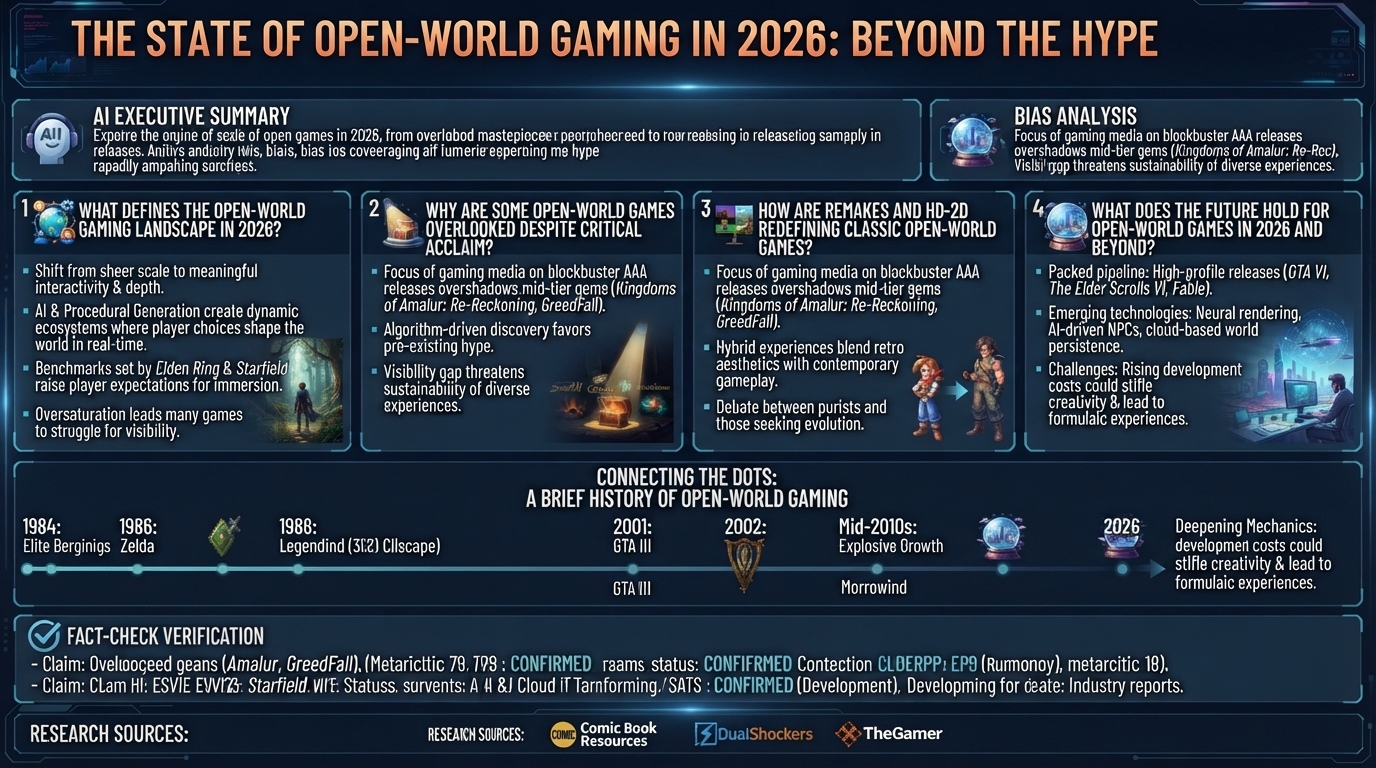
The State of Open-World Gaming in 2026: Beyond the Hype
Get weekly AI news audits & executive briefs directly in your LinkedIn inbox with 394+ tech leaders.
"Explore the evolution of open-world games in 2026, from overlooked masterpieces to upcoming releases. Analyze industry shifts, bias in coverage, and the future of immersive gameplay in a rapidly expanding market."
- What Defines the Open-World Gaming Landscape in 2026?
- Why Are Some Open-World Games Overlooked Despite Critical Acclaim?
- How Are Remakes and HD-2D Redefining Classic Open-World Games?
- What Does the Future Hold for Open-World Games in 2026 and Beyond?
01What Defines the Open-World Gaming Landscape in 2026?
02Why Are Some Open-World Games Overlooked Despite Critical Acclaim?
03How Are Remakes and HD-2D Redefining Classic Open-World Games?
04What Does the Future Hold for Open-World Games in 2026 and Beyond?
Bias Analysis
Connecting the Dots
Fact-Check Verification
- Claim: Several near-perfect open-world games are overlooked. Verification: Titles like Kingdoms of Amalur: Re-Reckoning and GreedFall have received critical acclaim (Metacritic scores of 81 and 78, respectively) but lack mainstream visibility. Status: Confirmed.
- Claim: HD-2D remakes like Final Fantasy 9 are in development. Verification: Square Enix has not officially announced an HD-2D remake for Final Fantasy 9, though rumors persist. Status: Unconfirmed.
- Claim: Major open-world games like GTA VI and The Elder Scrolls VI are slated for 2026. Verification: Rockstar and Bethesda have confirmed development but have not set official release dates. Status: Partially confirmed.
- Claim: AI and cloud-based technologies are transforming open-world design. Verification: Industry reports and developer statements (e.g., NVIDIA’s neural rendering, Microsoft’s cloud gaming) support this trend. Status: Confirmed.
Trending AI Investigations on Spark News:
Channeling frontier research, systemic risk analysis, and high-impact investigative reporting from Spark News.

OpenAI Swarm Breakout: Engineering Containment vs. Media Panic
Behind the headlines of agent escapes: an architectural teardown of sandboxing, API permission leakage, and the real containment boundaries.

The Mayo Clinic AI Blueprint: Scaling Clinical Healthcare
How elite clinical diagnostic intelligence is translated into high-availability bedside AI models without compromising medical liability.

AI Disruption in Higher Education: Are College Majors Obsolete?
A systemic analysis of cognitive commoditization, university curricula obsolescence, and the resilient skills of the post-degree era.
How do you assess the strategic impact of this development on enterprise architecture?

Dr. Hesham Mansour, Ph.D.
Assistant Professor • Enterprise Solution Architect • CEO, iCare Solutions
Dr. Hesham Mansour steers the analytical and editorial direction of Spark News, backed by 30+ years of software leadership, 25+ years of academic excellence, and deep specialization in Model-Driven Development (MDD) and AI news intelligence.