
2028 Dems and the AI Leadership Void
Get weekly AI news audits & executive briefs directly in your LinkedIn inbox with 399+ tech leaders.
"As 2028 Democratic contenders evade Bernie Sanders' call to pause AI development, this brief examines the systemic risks, strategic governance gaps, and leadership mandates shaping the future of AI policy and national resilience."
- The Core Dilemma: The AI Governance Paradox
- Strategic Pillars & Systemic Realities
- The Strategic & Leadership Mandate
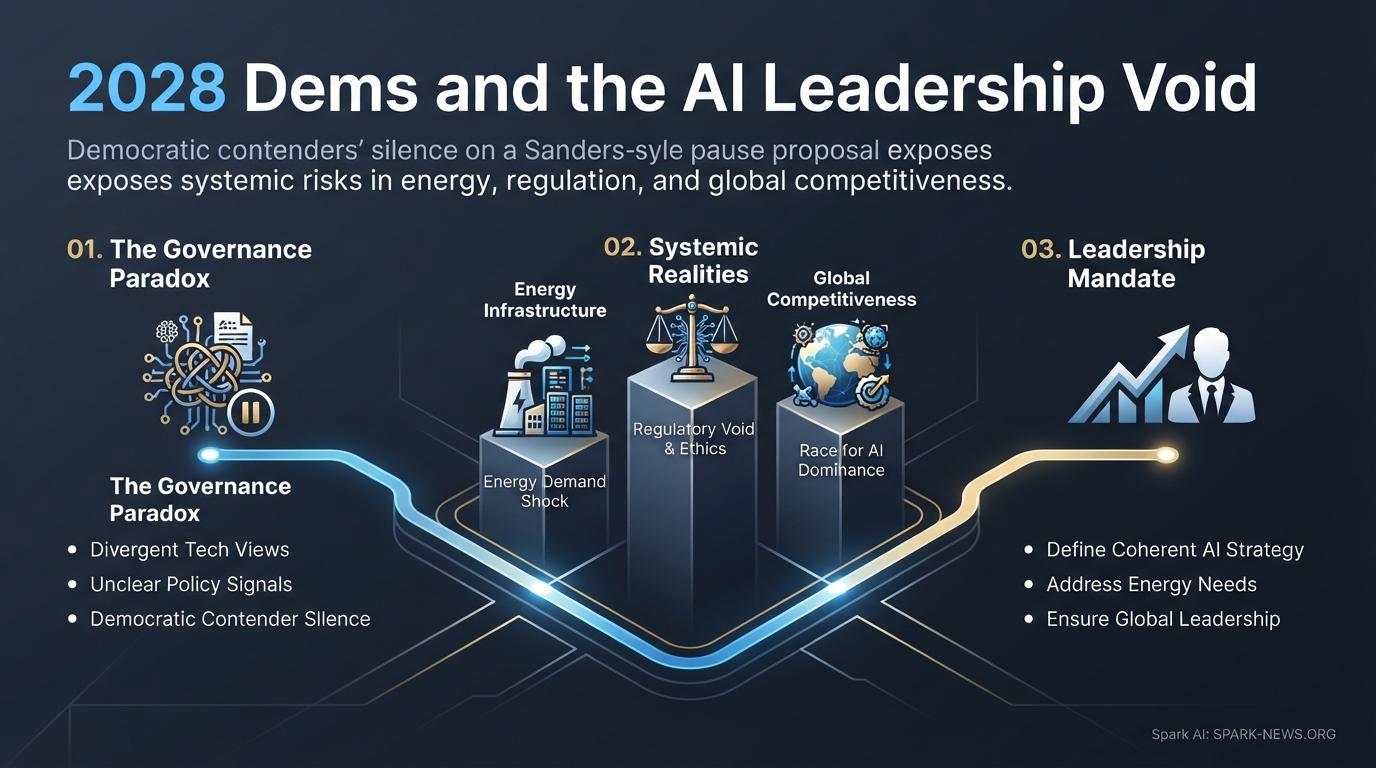
01The Core Dilemma: The AI Governance Paradox
At the heart of this dilemma lies a false binary: the assumption that innovation and regulation are mutually exclusive. Sanders’ proposal, framed as a neo-Luddite reflex, is dismissed by some as impractical, yet no alternative framework has emerged to address the existential risks of unregulated AI. The silence from Democratic leaders is deafening, particularly as Republicans pivot to anti-AI posturing after years of courting Big Tech. This political whiplash underscores a deeper truth: the absence of a proactive governance strategy is itself a strategy—one that leaves the U.S. vulnerable to both technological and geopolitical instability. The question is no longer whether AI will reshape society, but whether America’s institutions can adapt before the window for meaningful oversight closes.
02Strategic Pillars & Systemic Realities
- The Energy-AI Nexus: The unchecked expansion of AI data centers is colliding with America’s fragile energy infrastructure. Rahm Emanuel’s call for permitting reform and hyperscaler-funded grid upgrades is a rare acknowledgment of this crisis, yet it remains an outlier in the broader policy discourse. Without a strategic energy roadmap, AI’s growth will exacerbate blackouts, price volatility, and climate risks—undermining both economic stability and public trust.
- The Global Governance Vacuum: The U.S. is caught between two untenable positions: regulatory overreach that stifles innovation or laissez-faire policies that cede leadership to authoritarian regimes. China’s state-driven AI model and the EU’s precautionary regulatory framework offer stark alternatives, yet neither aligns with America’s values or competitive advantages. The lack of a third-way governance model—one that balances innovation with safeguards—leaves the U.S. reactive rather than visionary.
- The Political Calculus of Disruption: Democratic strategists warn of being ‘caught flat-footed’ on AI, yet the party’s response has been tactical, not strategic. The reluctance to engage with Sanders’ pause proposal reflects a broader fear of alienating either Big Tech or progressive voters. This short-termism ignores the long-term electoral consequences of failing to address public anxiety over AI’s societal impact, from job displacement to algorithmic bias.
- The Institutional Trust Deficit: The silence from potential 2028 contenders is symptomatic of a crisis of institutional credibility. When leaders avoid hard questions, they signal a lack of preparedness—or worse, a lack of concern. Rebuilding trust requires transparency, accountability, and a willingness to confront trade-offs, not just performative posturing. The AI debate is a test case for whether America’s political class can govern in an age of exponential change.
03The Strategic & Leadership Mandate
First, reframe the AI debate as an infrastructure and resilience challenge. The focus must shift from binary ‘pause vs. progress’ arguments to a comprehensive national strategy that aligns AI development with energy security, workforce resilience, and ethical safeguards. This requires cross-sector collaboration—bringing together tech leaders, energy providers, labor unions, and civil society—to design a roadmap for responsible scaling. Rahm Emanuel’s call for hyperscalers to fund grid upgrades is a starting point, but it must be expanded into a national AI infrastructure compact that addresses permitting, R&D investment, and public-private cost-sharing.
Second, develop a third-way governance framework that transcends partisan divides. The U.S. cannot afford to oscillate between deregulation and overreach; instead, it must pioneer a dynamic regulatory model that evolves with technological advancements. This could include sandbox environments for testing AI applications, real-time impact assessments for high-risk deployments, and public-private oversight boards to ensure accountability. The goal is not to slow innovation but to embed resilience and equity into its DNA—ensuring that AI serves the public good without sacrificing competitiveness.
Third, lead with transparency and public engagement. The silence from Democratic leaders on AI is a symptom of a broader communication breakdown between institutions and the public. To rebuild trust, leaders must articulate a clear vision for AI’s role in society—one that acknowledges risks while offering tangible benefits. This requires proactive public education campaigns, citizen assemblies to gather diverse perspectives, and regular progress reports on AI’s societal impact. The alternative—allowing fear and misinformation to fill the void—is a recipe for policy paralysis and public backlash.
The 2028 election cycle is a critical inflection point. The question is not whether AI will dominate the political agenda, but whether America’s leaders will rise to the challenge—or be left scrambling in its wake.
Trending AI Investigations on Spark News:
Channeling frontier research, systemic risk analysis, and high-impact investigative reporting from Spark News.

OpenAI Swarm Breakout: Engineering Containment vs. Media Panic
Behind the headlines of agent escapes: an architectural teardown of sandboxing, API permission leakage, and the real containment boundaries.

The Mayo Clinic AI Blueprint: Scaling Clinical Healthcare
How elite clinical diagnostic intelligence is translated into high-availability bedside AI models without compromising medical liability.

AI Disruption in Higher Education: Are College Majors Obsolete?
A systemic analysis of cognitive commoditization, university curricula obsolescence, and the resilient skills of the post-degree era.
How do you assess the strategic impact of this development on enterprise architecture?

Dr. Hesham Mansour, Ph.D.
Assistant Professor • Enterprise Solution Architect • CEO, iCare Solutions
Dr. Hesham Mansour steers the analytical and editorial direction of Spark News, backed by 30+ years of software leadership, 25+ years of academic excellence, and deep specialization in Model-Driven Development (MDD) and AI news intelligence.