More Services

Google Opens SynthID to Everyone: The End of Covert Deepfakes or Just the Beginning?
Spark News AI | spark-news.org
viral-trendOctober 9, 2026⏱️4 min read

Google Opens SynthID to Everyone: The End of Covert Deepfakes or Just the Beginning?

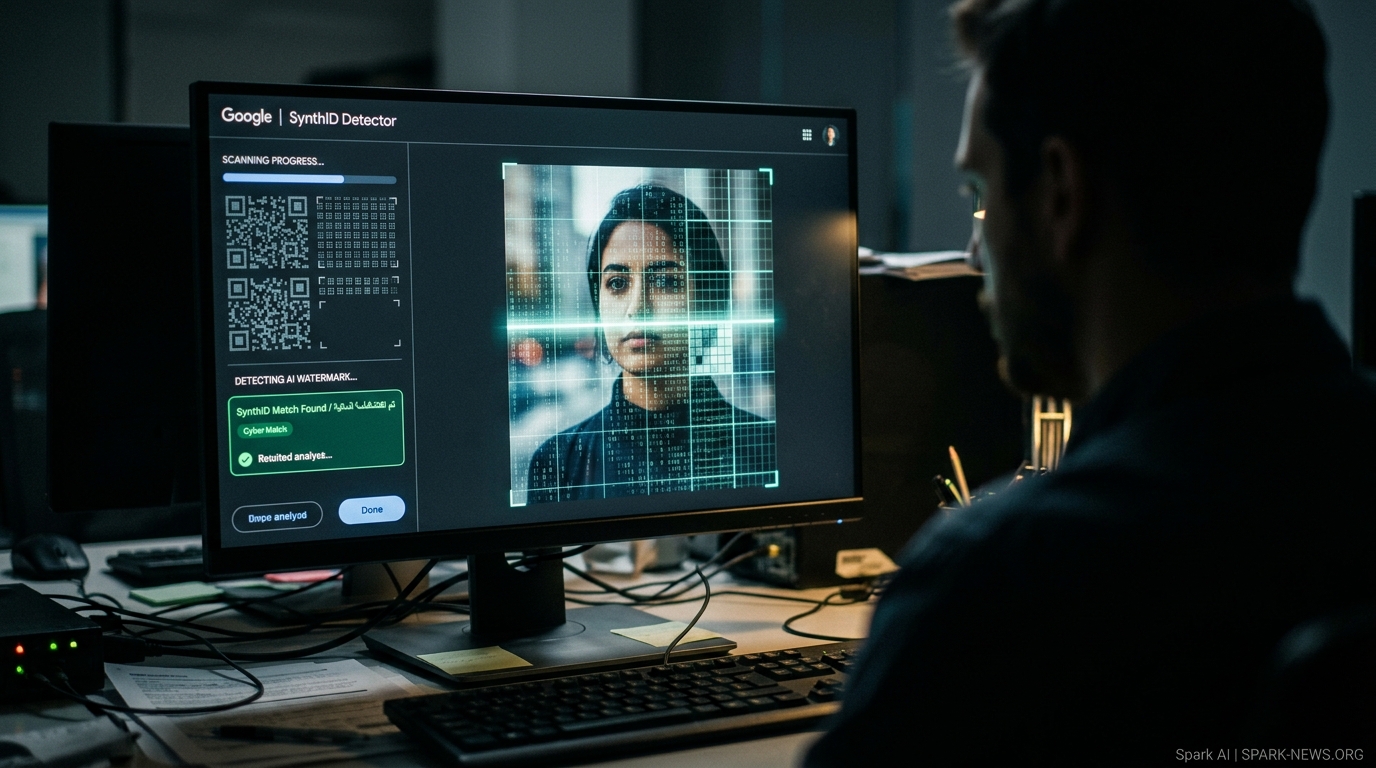
📷A computer screen scans digital media, revealing hidden forensic code that exposes generative AI manipulation.
Weekly LinkedIn Newsletter399+ Subs

Get weekly AI news audits & executive briefs directly in your LinkedIn inbox with 399+ tech leaders.

Subscribe on LinkedIn
🔥VIRAL TREND SPOTLIGHT
VIRAL HOOK & AT A GLANCE

"Google has unlocked its SynthID Detector tool for public use worldwide, allowing anyone to scan images, video, and audio for invisible AI watermarks with mathematical precision."

  • What Just Happened?
  • How the Internet & News Are Reacting
  • The Backstory You Need to Know
  • Why This Matters & What's Next

01What Just Happened?

Google just broke down the gates, rolling out its SynthID Detector tool to every casual user on the web after keeping it locked inside elite newsrooms and media houses since last year. The premise is as straightforward as it is powerful: sign in with any standard Google account, upload a suspicious picture, video, or audio file, and check whether a machine made it. Instead of leaning on visual guesswork, the engine scans for a mathematically embedded digital watermark placed directly inside pixel patterns or sound spectrums. Social platforms are already buzzing, especially as distinguishing authentic reality from generated content grows tougher by the day.

02How the Internet & News Are Reacting

The tech world welcomed the public launch with open arms, and digital creators quickly hailed it as a vital lifeline against runaway synthetic fraud. Still, veteran industry watchers were fast to set realistic expectations. The tool is not an all-seeing radar built to catch arbitrary pixels produced by rogue software; it functions as an exact reader for a specific watermark standard shared across an industry coalition that includes Google, OpenAI, Nvidia, and Korean titan Kakao, with Apple scheduled to support the framework soon. Here is how viral expectations compare to technical reality:

FeatureCommon Public ExpectationTechnical Reality of SynthID Detector
Scope of DetectionSpots every AI creation across the entire webCatches only files carrying the official SynthID watermark signature
Edit IdentificationPinpoints slight touch-ups with total precisionDoes not reliably tell fully synthetic files apart from lightly tweaked ones
Ecosystem SupportConfined exclusively to Google platformsIdentifies content from Google, OpenAI, Nvidia, Kakao, and upcoming Apple integrations
Verification HubsRestricted to one isolated portalBaked directly into Google Search, Gemini, and the Chrome browser

03The Backstory You Need to Know

The journey started inside Google DeepMind, where engineers tackled an ambitious hurdle: creating breathtaking visuals with models like Imagen while simultaneously proving original machine provenance without degrading creative fidelity. The breakthrough centered on microscopic, statistically invisible adjustments woven directly across pixel arrangements and audio waves. These signatures hold up even when files get cropped, compressed, or color-graded. After extensive field tests among journalists designed to protect public discourse, DeepMind and Google finally tied the verification flow into Google Search, the Chrome browser, and Gemini, putting source verification right into routine browsing habits.

04Why This Matters & What's Next

Delivering SynthID to billions of global users shifts how society evaluates media online; checking origin tags no longer demands specialized forensic labs. Major platform alliances prove that key players want a real, unified standard for digital transparency. With Apple ready to activate support on its own devices in the coming months, our laptops and pocket devices will soon inform us automatically about where an asset originated. Human discernment still stands as the ultimate defense, however, because SynthID cannot catch rogue, unlicensed models engineered specifically to bypass watermarks altogether.

Bias Analysis

Left NarrativeNeutral & BalancedRight Narrative
100% LeftCenter / Neutral100% Right
Major tech outlets celebrated the release as a meaningful victory for online transparency and an uncommon show of unity among tech giants. Digital safety watchdogs countered with necessary reminders, cautioning users that the detector reads compliant watermarks rather than catching every stray synthetic file.

Connecting the Dots

Google built SynthID watermarking technology as a foundational defense for digital authenticity, relying on an imperceptible cryptographic signature woven across AI media that can be inspected directly through user-facing apps and a dedicated portal.

Fact-Check Verification

  • The tool is totally free globally in English, requiring only a standard Google account to use.
  • It identifies media generated through Google, OpenAI, Nvidia, and Kakao models, with Apple integration coming soon.
  • Detection is directly available within Google Search, Chrome, and the Gemini assistant.
  • The underlying system uses invisible mathematical watermarks that survive file compression and basic image cropping.

Key Takeaways & Outlook

Google has raised the bar for online transparency. The fight against deepfakes is far from over, but having a free, one-tap scanner gives internet users real confidence back.
🗳️Community Intelligence Poll
1-Click Vote

How do you assess the strategic impact of this development on enterprise architecture?

Dr. Hesham Mansour, Ph.D.
FOUNDER & EDITOR-IN-CHIEF🎓Ph.D. Systems ArchitectureiCare Solutions399+ Newsletter Subs

Dr. Hesham Mansour, Ph.D.

Assistant Professor • Enterprise Solution Architect • CEO, iCare Solutions

Dr. Hesham Mansour steers the analytical and editorial direction of Spark News, backed by 30+ years of software leadership, 25+ years of academic excellence, and deep specialization in Model-Driven Development (MDD) and AI news intelligence.

✨ Ph.D. Enterprise Systems Architecture✨ 30+ Yrs Software Leadership✨ 25+ Yrs Academic Excellence✨ Model-Driven Architecture (MDD)✨ AI Systems & GEO Citation Research
⭐Google Discover & AI Search

Personalize Your News: Add Spark News as a Preferred Source

Get direct AI news audits, media bias analysis, and weekly architectural briefs featured in your Google Discover Feed, Top Stories, and AI Overviews with an official Preferred badge.

Add to Preferred Sources on Google→
📌Highlighted with an official Preferred badge on Google Search & Discover