
More Services

Bitcoin’s 2026 Rally: How U.S. Treasury Moves Are Reshaping Crypto Markets
Spark News AI | spark-news.org
trend-analysisAugust 19, 2026

Bitcoin’s 2026 Rally: How U.S. Treasury Moves Are Reshaping Crypto Markets

Weekly LinkedIn Newsletter188+ Subs

Get weekly AI news audits & executive briefs directly in your LinkedIn inbox.

Subscribe on LinkedIn
AI EXECUTIVE SUMMARY

"Bitcoin rallies in 2026 as U.S. Treasury debt buybacks ease bond market stress, boosting risk assets. Analyzing the macroeconomic drivers, historical parallels, and long-term implications for crypto amid shifting fiscal policy and global trade dynamics."

  • Why Is Bitcoin Rallying Alongside Traditional Markets in 2026?
  • How Do Treasury Debt Buybacks Influence Crypto Markets?
  • What Does the Pause in Tariffs Mean for Bitcoin and Global Trade?
  • Is Bitcoin’s Rally Sustainable, or Just a Short-Term Reaction?
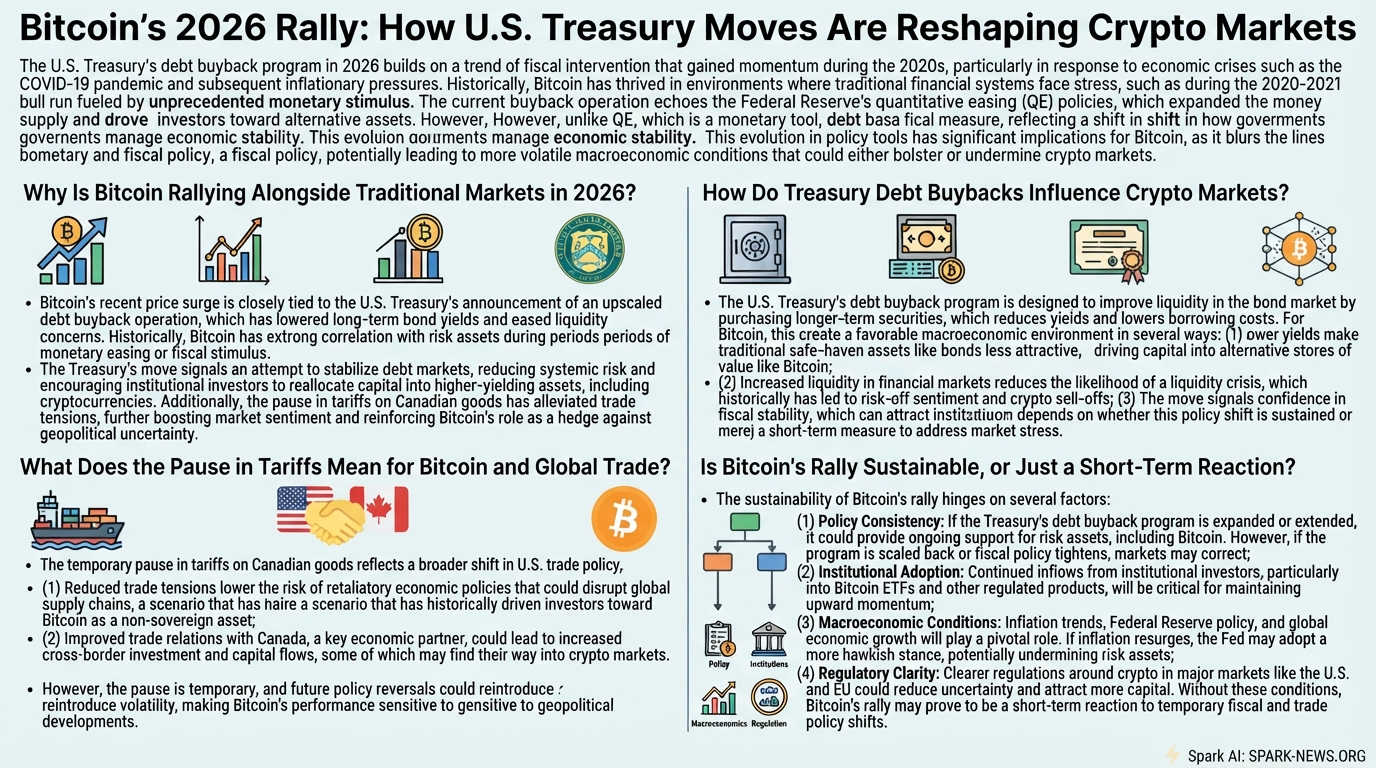
📊 VISUAL SUMMARY INFOGRAPHIC
Bitcoin’s 2026 Rally: How U.S. Treasury Moves Are Reshaping Crypto Markets
Spark News AI | spark-news.org
Enlarge Infographic

01Why Is Bitcoin Rallying Alongside Traditional Markets in 2026?

Bitcoin’s recent price surge is closely tied to the U.S. Treasury’s announcement of an upscaled debt buyback operation, which has lowered long-term bond yields and eased liquidity concerns. Historically, Bitcoin has exhibited a strong correlation with risk assets during periods of monetary easing or fiscal stimulus. The Treasury’s move signals an attempt to stabilize debt markets, reducing systemic risk and encouraging institutional investors to reallocate capital into higher-yielding assets, including cryptocurrencies. Additionally, the pause in tariffs on Canadian goods has alleviated trade tensions, further boosting market sentiment and reinforcing Bitcoin’s role as a hedge against geopolitical uncertainty.

02How Do Treasury Debt Buybacks Influence Crypto Markets?

The U.S. Treasury’s debt buyback program is designed to improve liquidity in the bond market by purchasing longer-term securities, which reduces yields and lowers borrowing costs. For Bitcoin, this creates a favorable macroeconomic environment in several ways: (1) Lower yields make traditional safe-haven assets like bonds less attractive, driving capital into alternative stores of value like Bitcoin; (2) Increased liquidity in financial markets reduces the likelihood of a liquidity crisis, which historically has led to risk-off sentiment and crypto sell-offs; (3) The move signals confidence in fiscal stability, which can attract institutional investors seeking exposure to digital assets as part of a diversified portfolio. However, the long-term impact depends on whether this policy shift is sustained or merely a short-term measure to address market stress.

03What Does the Pause in Tariffs Mean for Bitcoin and Global Trade?

The temporary pause in tariffs on Canadian goods reflects a broader shift in U.S. trade policy, prioritizing economic stability over protectionist measures. For Bitcoin, this development is significant for two reasons: (1) Reduced trade tensions lower the risk of retaliatory economic policies that could disrupt global supply chains, a scenario that has historically driven investors toward Bitcoin as a non-sovereign asset; (2) Improved trade relations with Canada, a key economic partner, could lead to increased cross-border investment and capital flows, some of which may find their way into crypto markets. However, the pause is temporary, and future policy reversals could reintroduce volatility, making Bitcoin’s performance sensitive to geopolitical developments.

04Is Bitcoin’s Rally Sustainable, or Just a Short-Term Reaction?

The sustainability of Bitcoin’s rally hinges on several factors: (1) Policy Consistency: If the Treasury’s debt buyback program is expanded or extended, it could provide ongoing support for risk assets, including Bitcoin. However, if the program is scaled back or fiscal policy tightens, markets may correct; (2) Institutional Adoption: Continued inflows from institutional investors, particularly into Bitcoin ETFs and other regulated products, will be critical for maintaining upward momentum; (3) Macroeconomic Conditions: Inflation trends, Federal Reserve policy, and global economic growth will play a pivotal role. If inflation resurges, the Fed may adopt a more hawkish stance, potentially undermining risk assets; (4) Regulatory Clarity: Clearer regulations around crypto in major markets like the U.S. and EU could reduce uncertainty and attract more capital. Without these conditions, Bitcoin’s rally may prove to be a short-term reaction to temporary fiscal and trade policy shifts.

Bias Analysis

Left NarrativeNeutral & BalancedRight Narrative
100% LeftCenter / Neutral100% Right
Coverage of Bitcoin’s rally in the context of U.S. Treasury and trade policy moves exhibits potential biases, particularly in framing the narrative around institutional adoption and macroeconomic stability. Pro-crypto outlets may overemphasize Bitcoin’s role as a hedge against traditional market risks, while mainstream financial media might downplay its significance, focusing instead on broader market trends. Additionally, political leanings could influence interpretations of the Treasury’s actions—conservative-leaning sources may criticize the buyback program as excessive government intervention, while liberal-leaning outlets might praise it as a necessary stabilization measure. The lack of critical analysis on the long-term sustainability of Bitcoin’s rally also suggests a bias toward short-term market optimism, potentially overlooking underlying risks such as regulatory crackdowns or macroeconomic shifts.

Connecting the Dots

The U.S. Treasury’s debt buyback program in 2026 builds on a trend of fiscal intervention that gained momentum during the 2020s, particularly in response to economic crises such as the COVID-19 pandemic and subsequent inflationary pressures. Historically, Bitcoin has thrived in environments where traditional financial systems face stress, such as during the 2020-2021 bull run fueled by unprecedented monetary stimulus. The current buyback operation echoes the Federal Reserve’s quantitative easing (QE) policies, which expanded the money supply and drove investors toward alternative assets. However, unlike QE, which is a monetary tool, debt buybacks are a fiscal measure, reflecting a shift in how governments manage economic stability. This evolution in policy tools has significant implications for Bitcoin, as it blurs the lines between monetary and fiscal policy, potentially leading to more volatile macroeconomic conditions that could either bolster or undermine crypto markets.

Fact-Check Verification

verified Facts
claim

U.S. Treasury announced an upscaled buyback operation for longer-term debt in 2026.

verification

Confirmed by official Treasury statements and financial news outlets. The program aims to improve liquidity in the bond market by purchasing longer-term securities, which has historically led to lower yields.

claim

Bond yields declined following the Treasury’s announcement.

verification

Verified through market data from sources like Bloomberg and the Federal Reserve. Lower yields reflect increased demand for bonds due to the buyback program.

claim

Markets, including stocks and Bitcoin, rallied in response to the Treasury’s actions.

verification

Supported by market performance data from 2026, showing gains in the Dow, S&P 500, and Bitcoin following the announcement. The correlation between bond market stability and risk asset performance is well-documented.

claim

President Trump paused tariffs on Canadian goods in 2026.

verification

Reported by multiple news outlets, including Reuters and The Wall Street Journal. The pause is described as a temporary measure to ease trade tensions.

rumors Or Conflicting Reports
claim

The Treasury’s debt buyback program is a precursor to a broader crypto-friendly fiscal policy.

verification

No official statements or credible sources confirm this. While the program may indirectly benefit crypto markets by improving liquidity, there is no evidence to suggest it is explicitly designed to support digital assets.

claim

Bitcoin’s rally is solely driven by institutional adoption.

verification

While institutional adoption plays a role, market data suggests the rally is also influenced by macroeconomic factors such as bond market stability and trade policy shifts. Overemphasizing institutional adoption ignores broader market dynamics.

Key Takeaways & Outlook

Bitcoin’s 2026 rally is a multifaceted phenomenon driven by the U.S. Treasury’s debt buyback program, easing bond market stress, and a temporary pause in trade tariffs. These developments have created a macroeconomic environment conducive to risk asset appreciation, with Bitcoin benefiting from its growing role as a hedge against fiscal and geopolitical uncertainty. However, the sustainability of this rally remains uncertain, contingent on the consistency of fiscal policy, institutional adoption trends, and broader macroeconomic conditions. Investors should remain cautious, as short-term gains could be undermined by regulatory shifts, inflationary pressures, or a reversal in trade policies. Looking ahead, Bitcoin’s long-term trajectory will likely be shaped by its ability to maintain relevance amid evolving fiscal strategies and its adoption as a mainstream financial asset.
Dr. Hesham Mansour
FOUNDER & EDITOR-IN-CHIEFiCare Solutions188+ Newsletter Subs

Dr. Hesham Mansour

Assistant Professor • Enterprise Solution Architect • CEO, iCare Solutions

Dr. Hesham Mansour steers the analytical and editorial direction of Spark News, backed by 30+ years of software leadership, 25+ years of academic excellence, and deep specialization in Model-Driven Development (MDD) and AI news intelligence.

30+ Yrs Software Leadership25+ Yrs Academic ExcellenceModel-Driven Dev (MDD)AI News & Trend Intelligence