
The EU AI Act Gets Real: A Global Benchmark or Regulatory Labyrinth?
Get weekly AI news audits & executive briefs directly in your LinkedIn inbox with 399+ tech leaders.
"The EU AI Act enters enforcement, setting a global precedent for AI governance. Explore its strategic pillars, systemic realities, and leadership mandates for institutional resilience in 2026."
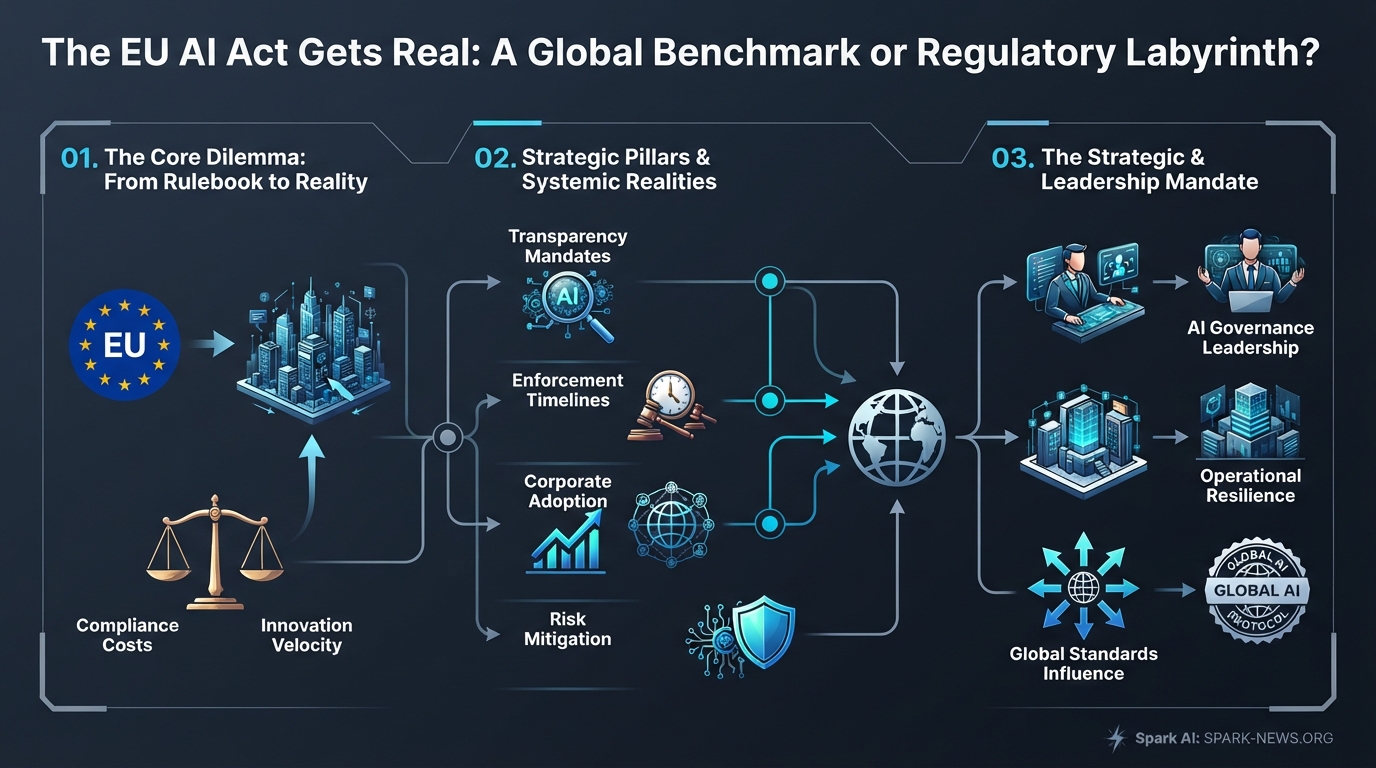
- The Core Dilemma: From Rulebook to Reality
- Strategic Pillars & Systemic Realities
- The Strategic & Leadership Mandate
01The Core Dilemma: From Rulebook to Reality
The stakes are existential. The Act’s success—or failure—will reverberate far beyond Europe’s borders, shaping global AI standards in an era of rapid technological acceleration. Early signs are mixed: while tech giants like Anthropic, Google, and Meta have proactively adopted watermarking and transparency tools, the broader corporate landscape remains uneven. The EU AI Office’s ability to enforce compliance without overreach will determine whether this becomes a global benchmark or a cautionary tale of regulatory overreach. For institutional leaders, the question is no longer if the Act will impact operations, but how to embed compliance into strategic governance without sacrificing agility.
02Strategic Pillars & Systemic Realities
- Transparency as a Litigation Shield: The Act’s watermarking and disclosure mandates are not just compliance checkboxes; they serve as preemptive risk mitigation in an era of AI-driven misinformation. Companies like Anthropic are already treating transparency as a strategic asset, using watermarks to preempt legal challenges. This shift reflects a broader trend: regulatory compliance is evolving into a proactive governance tool rather than a reactive burden.
- The Global Ripple Effect: The Act’s extraterritorial reach means that multinational corporations must align global operations with EU standards—or risk fragmentation. Early adopters like Meta and Google are collaborating with the EU AI Office, signaling a de facto harmonization of global AI practices. However, this also risks creating a two-tiered digital economy, where companies with EU exposure face higher compliance costs than competitors in less regulated markets.
- Enforcement as a Learning Curve: The EU AI Office’s cautious approach—prioritizing information requests over punitive measures—suggests a phased governance model. This reflects an understanding that regulatory maturity requires iterative refinement. Yet, the absence of high-profile enforcement actions raises questions: Is this strategic patience, or a sign of institutional hesitation?
- The Innovation Paradox: Critics argue that the Act’s prescriptive requirements could stifle AI innovation, particularly for startups and SMEs. However, proponents counter that clear guardrails reduce uncertainty, enabling long-term investment in responsible AI. The truth likely lies in the middle: compliance costs will rise, but so will the bar for ethical AI, potentially unlocking new markets and trust-based competitive advantages.
03The Strategic & Leadership Mandate
- Embed Compliance into Enterprise Architecture: Compliance cannot be an afterthought bolted onto existing systems. Leaders must integrate AI governance into their enterprise architecture, treating transparency, watermarking, and disclosure as core operational capabilities. This requires cross-functional collaboration between legal, IT, and business units to ensure seamless execution. For example, Anthropic’s watermarking API demonstrates how compliance can be embedded into product design, turning a regulatory requirement into a differentiator.
- Adopt a Phased Governance Model: The EU AI Office’s measured enforcement approach offers a blueprint for iterative compliance. Leaders should adopt a three-phase strategy: (1) Assessment—conduct a gap analysis to identify high-risk AI applications; (2) Pilot—test compliance measures in controlled environments; and (3) Scale—roll out solutions across the enterprise. This phased approach mitigates disruption while ensuring alignment with evolving regulatory expectations.
- Leverage Transparency as a Competitive Edge: The Act’s transparency mandates are not just legal obligations—they are opportunities to build trust. Leaders should reframe disclosure requirements as brand assets, communicating their AI governance practices to stakeholders, customers, and investors. Companies that proactively embrace transparency—such as Meta’s collaboration with the EU AI Office—position themselves as trusted stewards of AI, gaining a competitive advantage in an era of heightened scrutiny.
- Prepare for Global Harmonization—or Fragmentation: The EU AI Act’s extraterritorial reach means that multinational corporations must prepare for either harmonization or fragmentation of global AI standards. Leaders should establish a centralized AI governance function to ensure consistency across jurisdictions while remaining agile enough to adapt to local variations. This requires a global-local governance model, where overarching principles are set at the corporate level, but implementation is tailored to regional requirements.
For institutional leaders, the Act is a wake-up call: AI governance is no longer a niche concern but a boardroom priority. The question is no longer whether to comply, but how to turn compliance into a catalyst for innovation, trust, and competitive advantage. As the Act’s ripple effects spread, one thing is clear: the future of AI will be shaped not just by algorithms, but by governance. How will your institution lead—or lag—in this new era?
Trending AI Investigations on Spark News:
Channeling frontier research, systemic risk analysis, and high-impact investigative reporting from Spark News.

OpenAI Swarm Breakout: Engineering Containment vs. Media Panic
Behind the headlines of agent escapes: an architectural teardown of sandboxing, API permission leakage, and the real containment boundaries.

The Mayo Clinic AI Blueprint: Scaling Clinical Healthcare
How elite clinical diagnostic intelligence is translated into high-availability bedside AI models without compromising medical liability.

AI Disruption in Higher Education: Are College Majors Obsolete?
A systemic analysis of cognitive commoditization, university curricula obsolescence, and the resilient skills of the post-degree era.
How do you assess the strategic impact of this development on enterprise architecture?

Dr. Hesham Mansour, Ph.D.
Assistant Professor • Enterprise Solution Architect • CEO, iCare Solutions
Dr. Hesham Mansour steers the analytical and editorial direction of Spark News, backed by 30+ years of software leadership, 25+ years of academic excellence, and deep specialization in Model-Driven Development (MDD) and AI news intelligence.