
America’s Data Center Era: The $750B Buildout Reshaping the Nation
Featured in the weekly "Spark News: AI Media Brief" newsletter series on LinkedIn.
"Explore how the $750B data center buildout is reshaping America’s economy, energy grid, and political landscape. Strategic insights for leaders navigating this historic capital shift in 2026."
- The Core Dilemma: The Unseen Engine of the AI Race
- Strategic Pillars & Systemic Realities
- The Strategic & Leadership Mandate
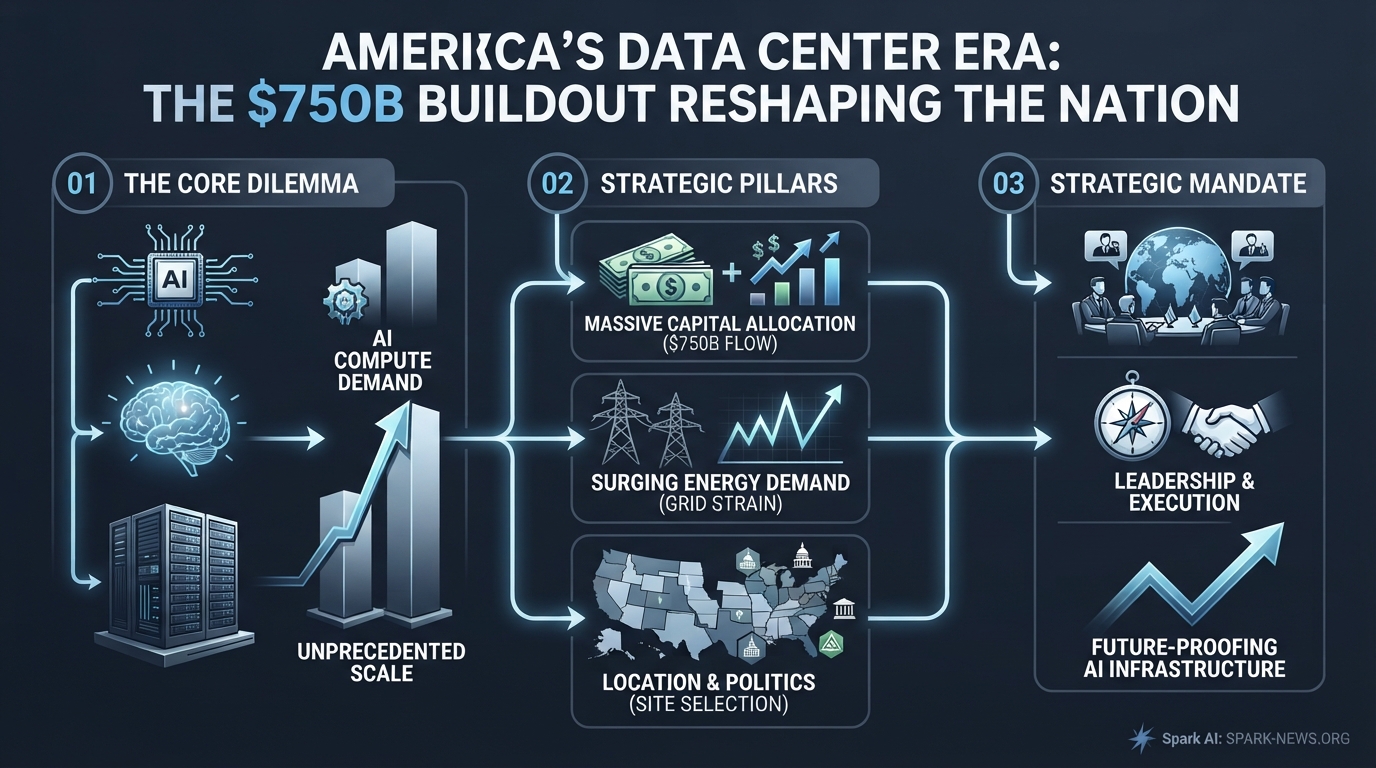
01The Core Dilemma: The Unseen Engine of the AI Race
The stakes are existential for institutions across sectors. Energy grids, already straining under aging infrastructure, now face a sixfold increase in peak demand projections by 2030—a revision so drastic it has upended utility forecasts and state-level energy policies. Land use, once a local concern, has become a national battleground as hyperscalers compete with communities, agriculture, and even renewable energy projects for scarce resources. And political sentiment, once a peripheral factor, has now crystallized into a bipartisan populist backlash, with federal and state legislatures debating outright bans on data center construction. This is not a transient challenge; it is a systemic reordering of America’s economic and operational priorities.
02Strategic Pillars & Systemic Realities
- The Capital Tsunami and Its Governance Void
The sheer scale of investment—$750 billion in 2026 alone, a 67% year-over-year increase—demands a rethinking of fiscal governance. Unlike public infrastructure projects, this capital surge is privately directed, yet its externalities (energy demand, land use, labor markets) are publicly borne. The absence of coordinated planning frameworks risks creating bottlenecks in supply chains, from cooling systems to high-voltage transformers, while inflating costs for non-tech sectors. For institutional leaders, the question is not whether to engage, but how to shape the rules of engagement—through public-private partnerships, regulatory sandboxes, or sector-specific resilience funds.
- Energy as the New Geopolitical Fault Line
The sixfold revision in peak demand forecasts is not a forecasting error; it is a structural shock to America’s energy systems. Data centers now account for 4-6% of U.S. electricity consumption, a figure projected to rise to 15-20% by 2030. The implications are twofold: operational resilience for hyperscalers hinges on diversifying energy sources (nuclear micro-reactors, hydrogen-ready turbines, and AI-optimized grids), while public institutions must reconcile decarbonization goals with the reality of fossil-fuel-based backup generation. The energy transition is no longer a long-term aspiration—it is a near-term constraint on economic growth.
- The Land Use Paradox: Scarcity in the Age of Abundance
Hyperscalers are not just competing with each other; they are outbidding municipalities, farmers, and renewable energy developers for land, water rights, and industrial supply chains. The result is a geographic arbitrage that favors regions with loose zoning laws, cheap energy, and political acquiescence—often at the expense of equitable development. For state and local leaders, this presents a strategic dilemma: attract data centers for short-term economic gains, or preserve land for long-term resilience (housing, agriculture, and decentralized energy). The answer lies not in binary choices, but in regional master planning that aligns infrastructure investment with sustainable growth metrics.
- The Political Backlash and Its Institutional Risks
The populist backlash against data centers is not merely a NIMBY (Not In My Backyard) phenomenon; it reflects a deeper distrust of concentrated economic power. Both parties are capitalizing on this sentiment, with federal moratoriums, state-level bans, and punitive taxation emerging as policy tools. For hyperscalers, this is an existential threat to their growth models. For public institutions, it is an opportunity to redefine the social contract around digital infrastructure—through community benefit agreements, revenue-sharing models, and transparency mandates that ensure data centers are not just consumers of resources, but contributors to local economies.
03The Strategic & Leadership Mandate
- Institutional Resilience Through Systems Thinking
The first mandate is to rethink resilience beyond traditional risk management. For hyperscalers, this means diversifying supply chains (e.g., modular data centers, edge computing) to mitigate geographic and political risks. For utilities, it requires accelerating grid modernization through AI-driven demand forecasting, microgrids, and next-generation storage. For policymakers, it demands regional coordination to prevent a race to the bottom in land use and energy policies. The goal is not to resist the data center boom, but to design systems that can absorb its shocks while capturing its benefits.
- Public-Private Governance for Shared Prosperity
The second mandate is to redefine the relationship between capital and community. Hyperscalers must move beyond transactional engagement (tax incentives, job promises) and embrace structural partnerships—such as co-investing in local energy infrastructure, workforce development, and digital inclusion programs. Public institutions, in turn, must modernize regulatory frameworks to balance speed and scrutiny, using tools like fast-track permitting for sustainable projects and performance-based incentives for community impact. The era of extractive capitalism is over; the future belongs to collaborative governance.
- Strategic Communication as a Leadership Imperative
The third mandate is to reframe the narrative around data centers. For too long, the conversation has been dominated by technical metrics (PUE, latency, GPU utilization) or political rhetoric (big tech vs. local communities). Leaders must elevate the discourse to focus on shared outcomes: economic diversification, energy innovation, and digital equity. This requires transparent reporting on data center impacts (energy use, water consumption, tax contributions) and proactive engagement with communities to co-create benefit-sharing models. The most successful leaders will be those who can translate infrastructure into opportunity—for workers, for businesses, and for the nation.
Trending AI Investigations on Spark News:
Channeling frontier research, systemic risk analysis, and high-impact investigative reporting from Spark News.

OpenAI Swarm Breakout: Engineering Containment vs. Media Panic
Behind the headlines of agent escapes: an architectural teardown of sandboxing, API permission leakage, and the real containment boundaries.

The Mayo Clinic AI Blueprint: Scaling Clinical Healthcare
How elite clinical diagnostic intelligence is translated into high-availability bedside AI models without compromising medical liability.

AI Disruption in Higher Education: Are College Majors Obsolete?
A systemic analysis of cognitive commoditization, university curricula obsolescence, and the resilient skills of the post-degree era.
How do you assess the strategic impact of this development on enterprise architecture?

Dr. Hesham Mansour, Ph.D.
Assistant Professor • Enterprise Solution Architect • CEO, iCare Solutions
Dr. Hesham Mansour steers the analytical and editorial direction of Spark News, backed by 30+ years of software leadership, 25+ years of academic excellence, and deep specialization in Model-Driven Development (MDD) and AI news intelligence.