
The Digital Dollar’s Unstoppable Momentum
Get weekly AI news audits & executive briefs directly in your LinkedIn inbox with 399+ tech leaders.
"Explore how digitalization, stablecoins, and tokenized assets are reinforcing the U.S. dollar's dominance in global finance despite rising debt and geopolitical pressures. Strategic implications for institutions and policymakers."
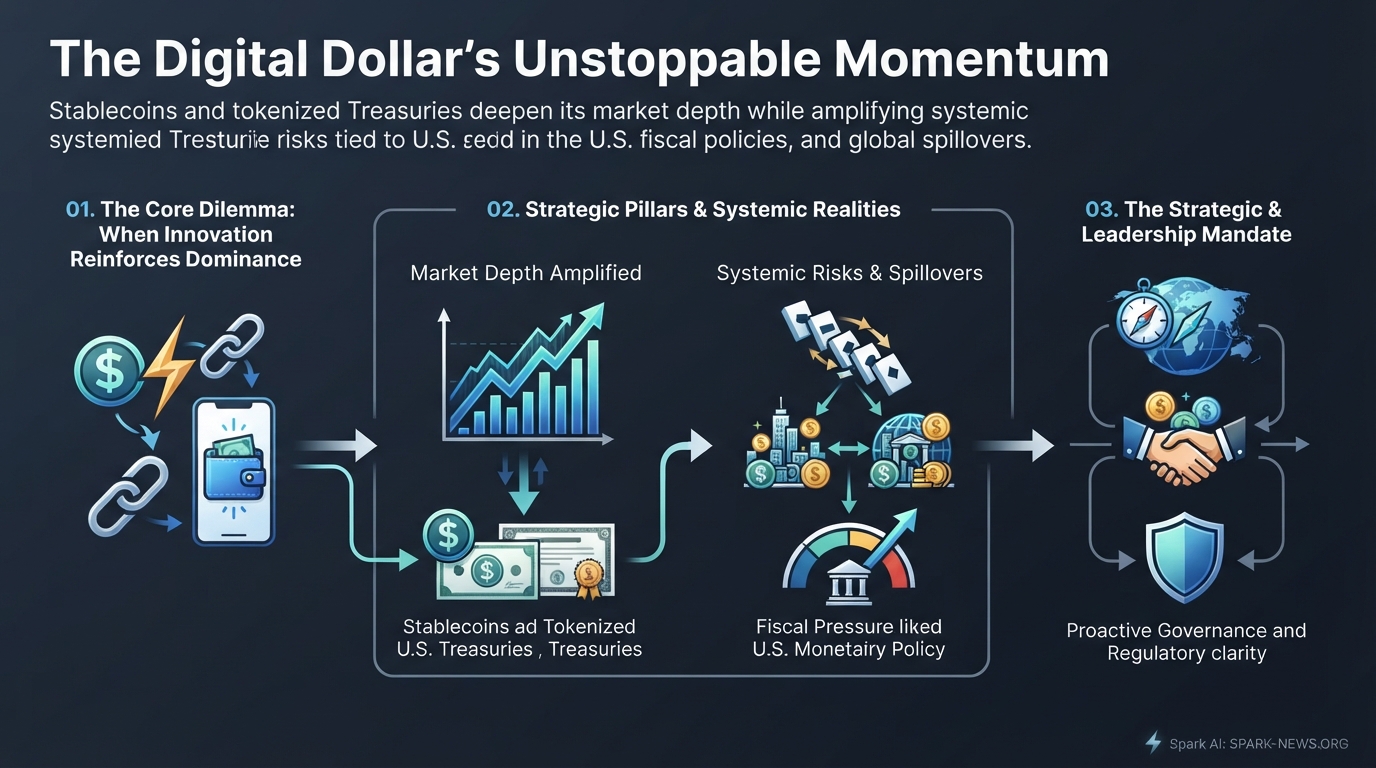
- The Core Dilemma: When Innovation Reinforces Dominance
- Strategic Pillars & Systemic Realities
- The Strategic & Leadership Mandate
01The Core Dilemma: When Innovation Reinforces Dominance
This dilemma is not merely academic. With the dollar on one side of 90% of foreign-exchange transactions and stablecoins like USDC gaining institutional traction, the systemic stakes are existential. Rising U.S. debt and geopolitical tensions already test the dollar’s foundations, yet digitalization could concentrate risk further—exposing other nations to greater spillovers from U.S. policies and potentially degrading fiscal discipline in Washington. The question is no longer whether technology will reshape finance, but whether institutions are prepared for a world where the dollar’s digital edge becomes an inescapable reality—one that demands proactive governance and strategic foresight.
02Strategic Pillars & Systemic Realities
- The Reinforcement of Network Effects: Digitalization does not level the playing field; it amplifies existing asymmetries. Stablecoins and tokenized assets, by lowering friction and broadening access, steer financial activity toward dominant currencies—like the dollar—whose markets are already deep, liquid, and trusted. This creates a winner-takes-all dynamic, where the dollar’s dominance becomes a self-fulfilling prophecy.
- The Paradox of Fiscal Discipline: While deeper dollar markets attract borrowers and investors, they also reduce incentives for fiscal restraint in the U.S. The authors warn that greater demand for tokenized Treasuries could lead to less fiscal discipline, as the cost of borrowing remains artificially low. This tension between market depth and governance rigor presents a critical challenge for policymakers, who must balance innovation with accountability.
- The Global Spillover Risk: A more dollar-reliant world is not without peril. Countries increasingly exposed to dollar-denominated debt face heightened vulnerability to U.S. policy shifts, from interest rate hikes to sanctions. This interdependence—while stabilizing in some contexts—creates systemic fragility, where shocks in Washington reverberate globally. The rise of tokenized assets only deepens this exposure, concentrating risk in interconnected financial hubs.
These realities underscore a stark truth: the dollar’s digital edge is not a passing trend but a fundamental shift in the global monetary order. Institutions that ignore this transformation do so at their peril.
03The Strategic & Leadership Mandate
First, institutionalize digital risk frameworks. The concentration of dollar-denominated assets in tokenized markets requires stress-testing protocols to assess liquidity shocks, counterparty risks, and spillover effects. Central banks and financial regulators must collaborate to establish standardized oversight for stablecoins, tokenized Treasuries, and cross-border payment rails, ensuring transparency and accountability in this evolving ecosystem.
Second, prioritize fiscal discipline and policy coherence. The paradox of deep markets and weak governance is unsustainable. Policymakers must reinforce fiscal guardrails, from debt ceilings to transparent budgeting, to prevent the dollar’s digital edge from eroding trust. This includes exploring mechanisms to internalize the costs of fiscal imprudence, such as dynamic interest rate adjustments or sovereign wealth funds to buffer against future shocks.
Finally, leverage digitalization for strategic advantage. Institutions that proactively adopt digital payment infrastructures—from central bank digital currencies (CBDCs) to interoperable stablecoin rails—can enhance operational resilience and gain first-mover advantages in global trade and investment. The key is to align innovation with governance, ensuring that digitalization serves long-term stability rather than short-term speculation.
Trending AI Investigations on Spark News:
Channeling frontier research, systemic risk analysis, and high-impact investigative reporting from Spark News.

OpenAI Swarm Breakout: Engineering Containment vs. Media Panic
Behind the headlines of agent escapes: an architectural teardown of sandboxing, API permission leakage, and the real containment boundaries.

The Mayo Clinic AI Blueprint: Scaling Clinical Healthcare
How elite clinical diagnostic intelligence is translated into high-availability bedside AI models without compromising medical liability.

AI Disruption in Higher Education: Are College Majors Obsolete?
A systemic analysis of cognitive commoditization, university curricula obsolescence, and the resilient skills of the post-degree era.
How do you assess the strategic impact of this development on enterprise architecture?

Dr. Hesham Mansour, Ph.D.
Assistant Professor • Enterprise Solution Architect • CEO, iCare Solutions
Dr. Hesham Mansour steers the analytical and editorial direction of Spark News, backed by 30+ years of software leadership, 25+ years of academic excellence, and deep specialization in Model-Driven Development (MDD) and AI news intelligence.