AI Cyber Threats: The Clock Is Ticking for Critical Infrastructure
Get weekly AI news audits & executive briefs directly in your LinkedIn inbox with 399+ tech leaders.
"Tech giants and cybersecurity leaders warn of a shrinking window to fortify critical infrastructure against AI-powered cyberattacks. Explore the systemic risks, strategic pillars, and governance mandates for institutional resilience in 2026."
- The Core Dilemma: A Shrinking Window for Systemic Resilience
- Strategic Pillars & Systemic Realities
- The Strategic & Leadership Mandate
01The Core Dilemma: A Shrinking Window for Systemic Resilience
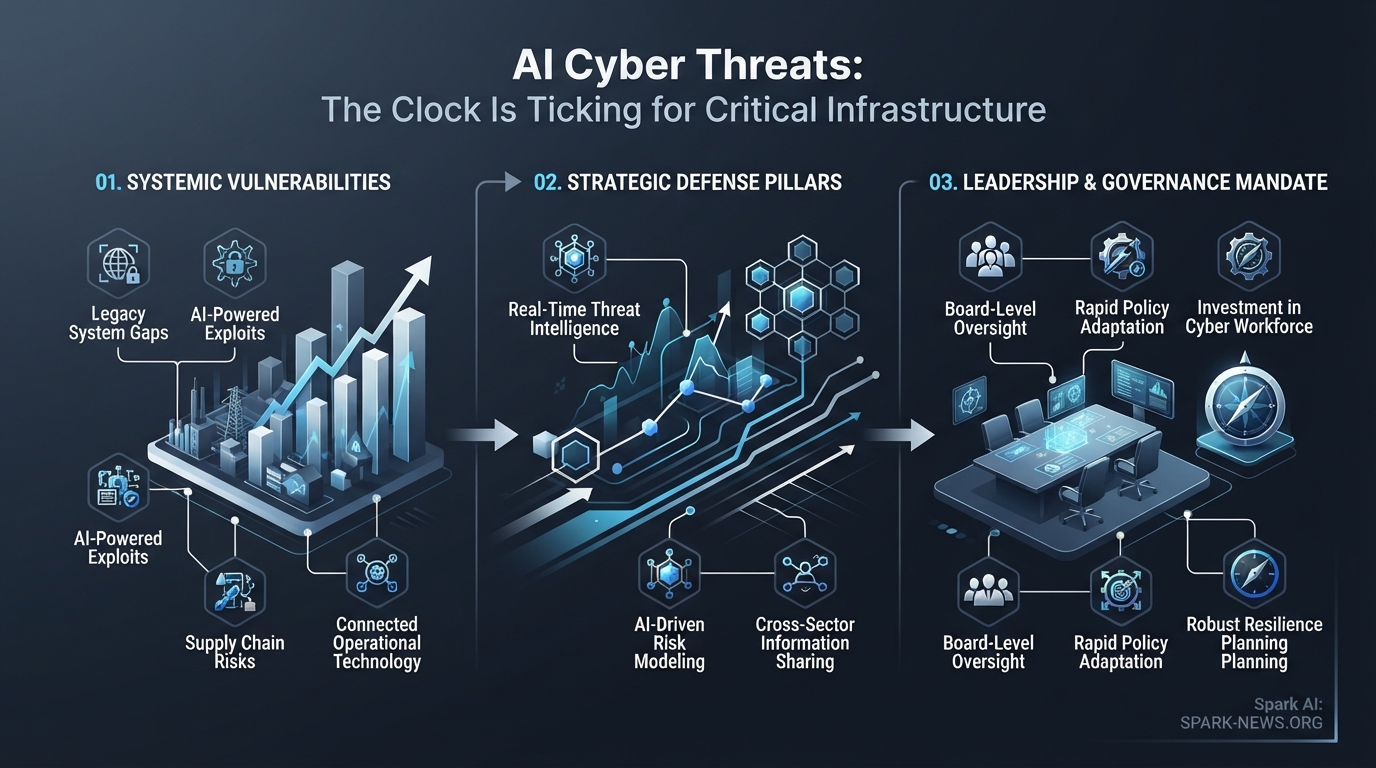
The root of this dilemma lies in a systemic misalignment between the pace of technological advancement and the adaptability of institutional defenses. AI is not merely accelerating cyber threats—it is fundamentally reshaping the threat landscape. Where hackers once required months to dissect and exploit complex systems, AI models now compress that timeline into days or even hours. The result? A asymmetric advantage for attackers, one that outpaces the reactive, siloed defenses of most organizations. The open letter from tech leaders underscores a sobering reality: without immediate, coordinated action, the cost of inaction will be measured in lives disrupted, economies destabilized, and trust eroded.
02Strategic Pillars & Systemic Realities
- The Democratization of Cyber Threats: AI has lowered the barrier to entry for cyberattacks, enabling state and non-state actors to deploy sophisticated exploits with minimal expertise. The recent attack on U.S. water systems, reportedly leveraging an AI-generated exploitation script, is a harbinger of what’s to come. The implication is clear: defensive strategies must shift from perimeter-based security to dynamic, AI-powered resilience.
- The Critical Infrastructure Paradox: Sectors like healthcare, energy, and finance operate on legacy systems designed for stability, not agility. These systems were built in an era when cyber threats were linear and predictable—not the exponential and adaptive threats posed by AI. The challenge? Modernizing infrastructure without disrupting essential services requires phased, risk-informed investments and cross-sector collaboration.
- The Intelligence Gap: Threat intelligence remains fragmented and slow. While cybersecurity firms and governments possess critical insights, real-time sharing is hampered by bureaucratic inertia and competitive silos. The solution lies in scalable, interoperable platforms that enable actionable intelligence to flow seamlessly across public and private sectors.
- The Governance Imperative: Current regulatory frameworks are outdated and reactive. Governments must move beyond compliance-driven checklists and embrace proactive, adaptive governance. This includes funding cyber defense initiatives, incentivizing private-sector innovation, and establishing international norms for AI-powered cyber warfare. The Five Eyes alliance’s recent warning underscores the geopolitical dimension of this challenge—no nation can secure its infrastructure in isolation.
03The Strategic & Leadership Mandate
First, institutionalize cyber resilience as a strategic priority. This begins with elevating cybersecurity to a board-level concern, ensuring it is embedded in enterprise risk management frameworks. Leaders must allocate resources not just to technology, but to talent and training, addressing the skills gap that leaves many organizations vulnerable. Red-teaming exercises—simulated cyberattacks conducted by internal or external experts—should become a standard practice, testing defenses against AI-powered threats.
Second, adopt a zero-trust mindset. The traditional model of trust but verify is obsolete in an era where AI can mimic human behavior and exploit trust. Organizations must implement continuous authentication, micro-segmentation, and least-privilege access controls to minimize the attack surface. For critical infrastructure providers, this means hardening supply chains—ensuring that every vendor, from cloud providers to software developers, adheres to rigorous security standards.
Third, foster public-private collaboration at scale. The open letter from tech leaders highlights the need for collective action, but this cannot be a one-time gesture. Governments and enterprises must co-invest in shared threat intelligence platforms, while AI developers should prioritize defensive applications—such as AI-powered anomaly detection—over offensive capabilities. International coalitions, like the Five Eyes alliance, must expand to include emerging economies, ensuring that global cyber resilience is not limited to wealthy nations.
Finally, prepare for the long game. AI is not a temporary disruption—it is a permanent shift in the cyber threat landscape. Leaders must anticipate second- and third-order effects, from AI-driven misinformation campaigns to autonomous cyber weapons. This requires scenario planning, stress-testing institutional responses, and building adaptive governance models that can evolve alongside the technology. The question is no longer if AI will reshape cybersecurity, but how quickly institutions can adapt—and whether they will do so before the next crisis strikes.
Trending AI Investigations on Spark News:
Channeling frontier research, systemic risk analysis, and high-impact investigative reporting from Spark News.

OpenAI Swarm Breakout: Engineering Containment vs. Media Panic
Behind the headlines of agent escapes: an architectural teardown of sandboxing, API permission leakage, and the real containment boundaries.

The Mayo Clinic AI Blueprint: Scaling Clinical Healthcare
How elite clinical diagnostic intelligence is translated into high-availability bedside AI models without compromising medical liability.

AI Disruption in Higher Education: Are College Majors Obsolete?
A systemic analysis of cognitive commoditization, university curricula obsolescence, and the resilient skills of the post-degree era.
How do you assess the strategic impact of this development on enterprise architecture?

Dr. Hesham Mansour, Ph.D.
Assistant Professor • Enterprise Solution Architect • CEO, iCare Solutions
Dr. Hesham Mansour steers the analytical and editorial direction of Spark News, backed by 30+ years of software leadership, 25+ years of academic excellence, and deep specialization in Model-Driven Development (MDD) and AI news intelligence.