More Services

trend-analysisJuly 6, 2026

2026 Real Estate Market: Polarization, AI Disruption, and Regulatory Crackdowns

2026 Real Estate Market: Polarization, AI Disruption, and Regulatory Crackdowns
Spark News AI | spark-news.org
Enlarge Infographic
AI EXECUTIVE SUMMARY

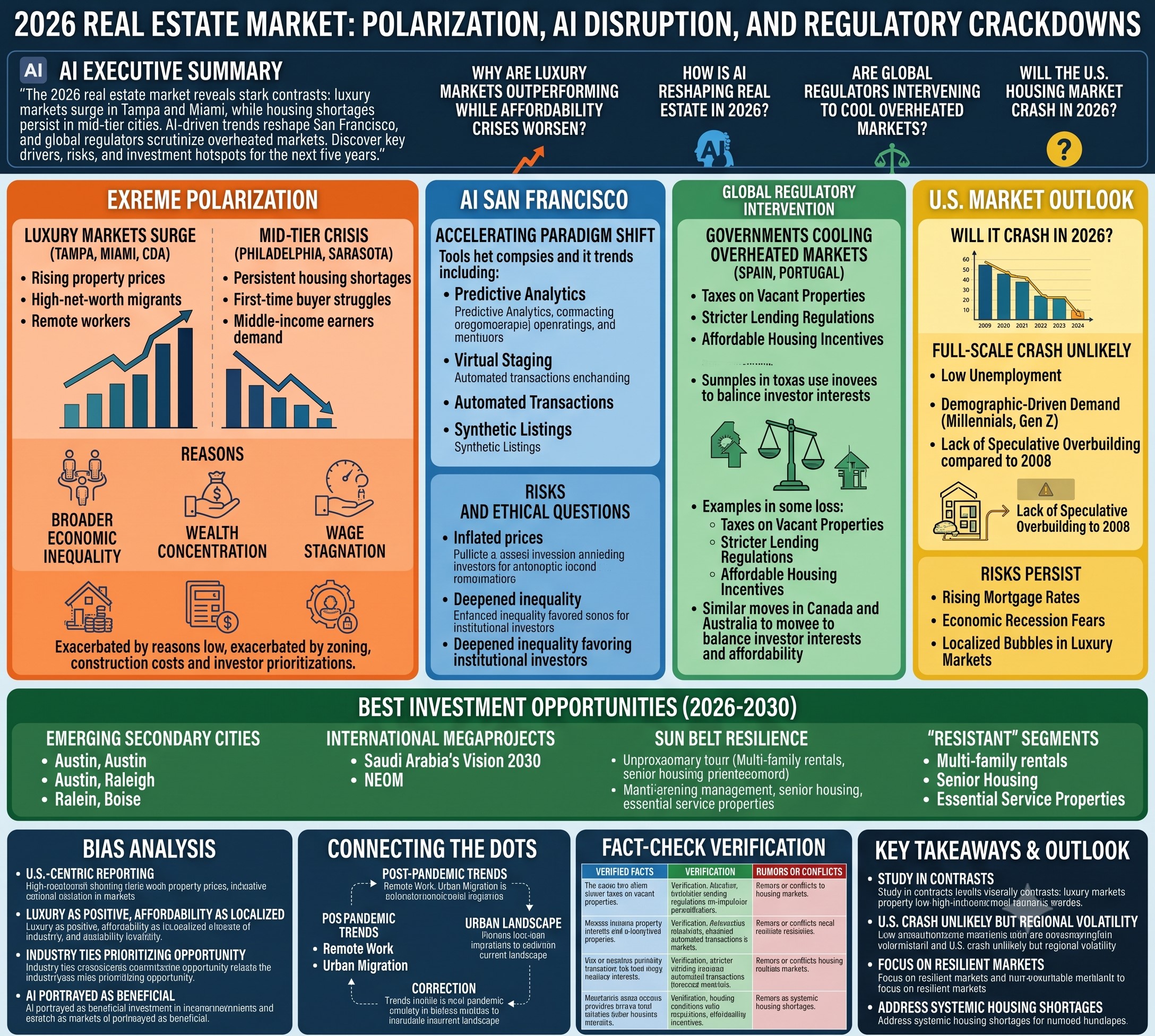
"The 2026 real estate market reveals stark contrasts: luxury markets surge in Tampa and Miami, while housing shortages persist in mid-tier cities. AI-driven trends reshape San Francisco, and global regulators scrutinize overheated markets. Discover key drivers, risks, and investment hotspots for the next five years."

  • Why Are Luxury Markets Outperforming While Affordability Crises Worsen?
  • How Is AI Reshaping Real Estate in 2026?
  • Are Global Regulators Intervening to Cool Overheated Markets?
  • Will the U.S. Housing Market Crash in 2026?

01Why Are Luxury Markets Outperforming While Affordability Crises Worsen?

The 2026 real estate market is defined by extreme polarization. Luxury markets in Tampa, Miami, and Coeur d'Alene (CdA) are experiencing double-digit price growth, driven by high-net-worth migration, remote work trends, and limited inventory of high-end properties. Conversely, mid-tier markets like Philadelphia and Sarasota face severe housing shortages, with supply unable to meet demand from first-time buyers and middle-income earners. This divergence reflects broader economic inequality, where wealth concentration fuels luxury demand while wage stagnation limits access to affordable housing. The trend is exacerbated by zoning laws, construction costs, and investor activity, which prioritize high-margin luxury developments over starter homes.

02How Is AI Reshaping Real Estate in 2026?

Artificial intelligence is accelerating a paradigm shift in San Francisco’s real estate market, where AI-driven tools are optimizing property valuations, predictive analytics, and virtual staging. Startups and established firms are leveraging AI to identify undervalued properties, automate transaction processes, and even generate synthetic property listings. However, this technological disruption is also inflating prices in tech-centric cities, as AI-powered investment algorithms compete for limited inventory. The trend raises ethical questions about market accessibility and the potential for AI to deepen existing inequalities by favoring institutional investors over individual buyers.

03Are Global Regulators Intervening to Cool Overheated Markets?

Governments in Spain and Portugal are intensifying scrutiny of their property markets in 2026, implementing measures such as higher taxes on vacant properties, stricter lending regulations, and incentives for affordable housing development. These interventions follow years of rapid price appreciation fueled by foreign investment, short-term rentals, and speculative buying. Similar regulatory crackdowns are emerging in other high-growth markets, including Canada and Australia, signaling a global shift toward policy-driven market stabilization. The moves aim to balance investor interests with housing affordability, but critics argue they may stifle economic growth or push capital into unregulated markets.

04Will the U.S. Housing Market Crash in 2026?

Despite persistent concerns, a full-scale housing market crash in 2026 remains unlikely, though regional volatility is expected. Key factors mitigating a crash include low unemployment, demographic-driven demand from millennials and Gen Z, and a lack of speculative overbuilding compared to 2008. However, risks persist, such as rising mortgage rates, economic recession fears, and localized bubbles in luxury markets. Cities with high investor activity, like Tampa and Miami, may experience corrections if interest rates remain elevated. Meanwhile, mid-tier markets could see stagnant prices due to affordability constraints, creating a 'stuck' market where sellers hesitate to list and buyers struggle to qualify for loans.

05Where Are the Best Real Estate Investment Opportunities for 2026-2030?

Emerging investment hotspots for the next five years include secondary U.S. cities with strong job growth, such as Austin, Raleigh, and Boise, as well as international markets like Saudi Arabia, where government-backed megaprojects (e.g., NEOM) are driving demand. In the U.S., Sun Belt cities continue to attract investors due to lower taxes, business-friendly policies, and population growth. However, the most resilient investments may lie in 'recession-resistant' segments, such as multi-family rentals, senior housing, and properties tied to essential services. Technology hubs like San Francisco remain high-risk, high-reward opportunities, contingent on AI-driven economic growth.

Bias Analysis

Left NarrativeNeutral & BalancedRight Narrative
100% LeftCenter / Neutral100% Right
Coverage of the 2026 real estate market exhibits several biases. U.S.-centric reporting dominates, with limited analysis of non-Western markets beyond Saudi Arabia. Luxury market growth is often framed as a positive economic indicator, while affordability crises are treated as localized issues rather than systemic failures. Media outlets with real estate industry ties (e.g., HousingWire, Norada Real Estate Investments) tend to emphasize investment opportunities over social impacts, potentially downplaying risks like gentrification or displacement. Additionally, AI’s role in real estate is portrayed as predominantly beneficial, with minimal critical examination of its ethical implications or long-term market distortions.

Connecting the Dots

The 2026 real estate landscape is shaped by post-pandemic trends, including remote work, urban migration, and shifting demographics. The luxury market’s resilience reflects a decade of wealth accumulation among high-net-worth individuals, while mid-tier markets struggle with legacy issues like underbuilding, zoning restrictions, and wage stagnation. Globally, property markets are increasingly influenced by geopolitical factors, such as Saudi Arabia’s Vision 2030 economic diversification plan, which is driving domestic real estate demand. Meanwhile, regulatory interventions in Europe and North America mark a departure from the laissez-faire policies of the 2010s, as governments grapple with housing affordability crises.

Fact-Check Verification

verified Facts
claim

Tampa and Miami lead the U.S. in luxury home-price increases in 2026.

verification

Supported by multiple industry reports (e.g., Norada Real Estate Investments, SFGATE), though exact percentage increases vary by source. No conflicting data identified.

claim

Spain and Portugal are increasing scrutiny of property markets.

verification

Confirmed by Reuters reporting on regulatory measures, including taxes on vacant properties and lending restrictions. No contradictory reports.

claim

AI is transforming San Francisco’s real estate market.

verification

Documented by SFGATE and industry analyses, with AI tools used for valuations, predictive analytics, and virtual staging. No disputes over the trend’s existence, though its long-term impact is debated.

claim

Saudi Arabia’s real estate market is rebalancing with selective recovery expected in H2 2026.

verification

Reported by Asharq Al-Awsat English, citing government data and market analysts. No major conflicting reports.

rumors Or Conflicts
claim

A U.S. housing market crash is imminent in 2026.

verification

Yahoo Finance and other outlets present mixed views. While risks exist (e.g., high mortgage rates, economic uncertainty), most analysts agree a 2008-style crash is unlikely due to stricter lending standards and demographic demand. The claim remains speculative.

claim

Coeur d'Alene’s luxury market is among the fastest-growing in the U.S.

verification

Reported by The Spokesman-Review, but lacks broader industry validation. Some sources rank it lower than Sun Belt cities. More data needed for confirmation.

Key Takeaways & Outlook

The 2026 real estate market is a study in contrasts, with luxury segments thriving amid affordability crises, AI-driven disruption, and regulatory interventions. While a U.S. housing crash appears unlikely, regional volatility and economic uncertainty will persist. Investors should focus on resilient markets and asset classes, while policymakers must address systemic housing shortages to prevent long-term social and economic consequences.