More Services

Geopolitical Risks and AI Volatility Reshape Market Sentiment in 2026
Spark News AI | spark-news.org
trend-analysisJuly 14, 2026

Geopolitical Risks and AI Volatility Reshape Market Sentiment in 2026

Weekly LinkedIn Newsletter272+ Subs

Get weekly AI news audits & executive briefs directly in your LinkedIn inbox with 272+ tech leaders.

Subscribe on LinkedIn
AI EXECUTIVE SUMMARY

"Stock markets dip in 2026 amid escalating Middle East tensions, surging oil prices, and AI stock volatility. Traders await key earnings and inflation data. Analysis of geopolitical risks, sector trends, and Fed policy outlook."

  • Why Are Stock Markets Mixed Amid Rising Middle East Tensions?
  • How Are AI Stocks Reacting to Overheated Valuations?
  • What Do Earnings and Inflation Data Signal for the Fed?
  • How Are Global Markets Responding to the U.S.-Iran Standoff?
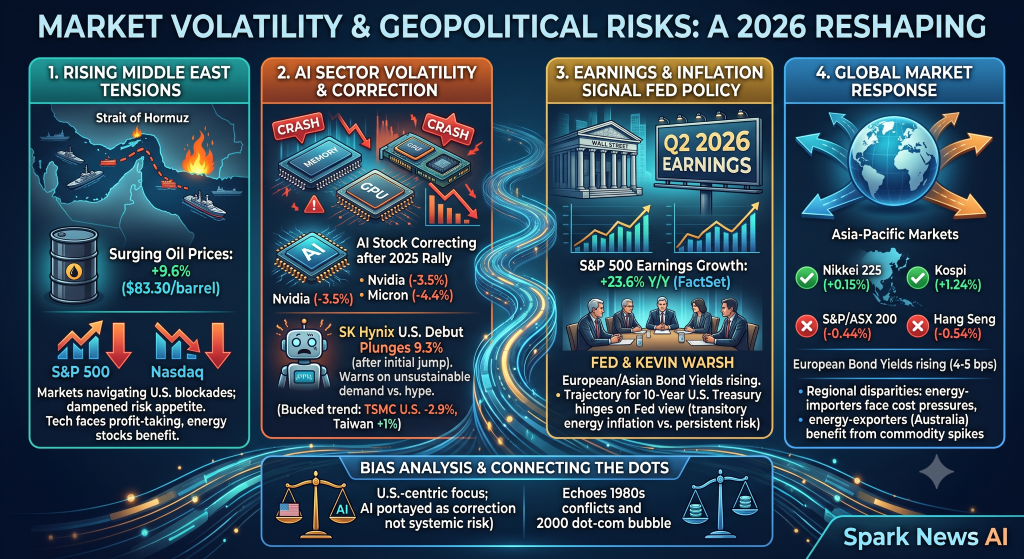
📊 VISUAL SUMMARY INFOGRAPHIC
Geopolitical Risks and AI Volatility Reshape Market Sentiment in 2026
Spark News AI | spark-news.org
Enlarge Infographic

01Why Are Stock Markets Mixed Amid Rising Middle East Tensions?

Stock markets in 2026 are navigating a complex landscape of geopolitical risks and economic data. The reinstatement of a U.S. blockade on Iranian shipping through the Strait of Hormuz—announced by President Donald Trump—has sent oil prices surging over 9%, the largest one-day gain since 2020. This spike in energy costs has dampened risk appetite, with the S&P 500 and Nasdaq Composite dropping 0.8% and 1.6%, respectively. Futures markets reflect this uncertainty, with Dow futures down 0.2% while Nasdaq-100 futures rise modestly on tech resilience. The divergence underscores sector-specific reactions: energy stocks benefit from oil gains, while tech—particularly AI-driven chipmakers—faces profit-taking after a prolonged rally.

02How Are AI Stocks Reacting to Overheated Valuations?

The artificial intelligence (AI) sector, a market darling in 2025, is showing signs of correction in 2026. Chipmakers like Nvidia (-3.5%) and Micron (-4.4%) led declines, eroding gains that had propelled Micron’s year-to-date performance to +243%. SK Hynix’s U.S. debut, which raised $26.5 billion, saw shares plunge 9.3% after an initial 13.1% pop, highlighting investor skittishness. Analysts warn that AI stock valuations may have outpaced fundamentals, with demand for memory chips and GPUs potentially unsustainable if AI fails to deliver transformative productivity gains. Taiwan Semiconductor Manufacturing Co. (TSMC) bucked the trend with a 1% gain in Taiwan, though its U.S.-traded shares fell 2.9%, reflecting global skepticism.

03What Do Earnings and Inflation Data Signal for the Fed?

Wall Street’s focus shifts to Q2 2026 earnings and inflation data, with JPMorgan Chase, Goldman Sachs, and Bank of America reporting before the bell. Analysts forecast S&P 500 earnings growth of 23.6% year-over-year, following a strong Q1. However, the Fed’s semiannual Humphrey-Hawkins report—delivered by new Chair Kevin Warsh—will be scrutinized for clues on interest rate policy. Rising oil prices threaten to keep inflation elevated, as evidenced by surging global bond yields (4–8 basis points in Europe/Asia). The 10-year U.S. Treasury yield’s trajectory will hinge on whether the Fed views energy-driven inflation as transitory or a persistent risk.

04How Are Global Markets Responding to the U.S.-Iran Standoff?

Asia-Pacific markets exhibited mixed reactions to the Strait of Hormuz blockade. Japan’s Nikkei 225 (+0.15%) and South Korea’s Kospi (+1.24%) showed resilience, while Australia’s S&P/ASX 200 (-0.44%) and Hong Kong’s Hang Seng (-0.54%) declined. China’s CSI 300 remained flat, reflecting cautious optimism amid ongoing trade tensions. European bond yields rose 4–5 basis points, signaling inflation concerns. The bifurcation highlights regional disparities: energy-importing nations face cost pressures, while exporters like Australia benefit from commodity price spikes. Long-term risks include supply chain disruptions and a potential oil price spiral, reminiscent of 2022’s energy crisis.

Bias Analysis

Left NarrativeNeutral & BalancedRight Narrative
100% LeftCenter / Neutral100% Right
Coverage of the 2026 market volatility leans toward a U.S.-centric narrative, emphasizing the impact of domestic policy (e.g., Trump’s blockade) on global markets. Media outlets like CNBC and AP frame the Strait of Hormuz tensions as a binary U.S.-Iran conflict, downplaying broader regional dynamics (e.g., OPEC+ responses or European energy security concerns). Additionally, AI stock declines are often portrayed as a ‘correction’ rather than a systemic risk, reflecting a pro-innovation bias. The focus on earnings growth projections (e.g., 23.6% for S&P 500) may understate macroeconomic headwinds, such as stagflation risks from oil shocks. Geopolitical analysis rarely questions the long-term efficacy of blockades, instead treating them as short-term market catalysts.

Connecting the Dots

The 2026 market turbulence echoes historical patterns where geopolitical conflicts disrupt energy markets and tech valuations. The Strait of Hormuz, a chokepoint for 20% of global oil supplies, has been a flashpoint since the 1980s Iran-Iraq War. Past blockades (e.g., 2019 U.S. sanctions) caused oil price spikes but were mitigated by strategic reserves and OPEC+ production adjustments. Meanwhile, AI stocks’ volatility mirrors the 2000 dot-com bubble, where euphoria over transformative technology outpaced revenue growth. The Fed’s response to inflation in 2026 is complicated by structural shifts: post-pandemic supply chains, labor shortages, and the energy transition. Unlike the 2022–2023 rate hikes, which targeted demand, 2026’s inflation may require supply-side solutions.

Fact-Check Verification

verified Facts

Brent crude surged 9.6% to $83.30/barrel on July 14, 2026, the largest one-day gain since 2020 (AP).

S&P 500 and Nasdaq Composite fell 0.8% and 1.6%, respectively, on the same day (CNBC).

Analysts project 23.6% S&P 500 earnings growth for Q2 2026 (FactSet).

U.S. 10-year Treasury yields rose 4–5 basis points in Europe, while Asian yields (excluding Japan) climbed 5–8 basis points (market data).

SK Hynix’s U.S. IPO raised $26.5 billion, with shares plunging 9.3% on July 14 after a 13.1% first-day gain (Seoul Exchange).

rumors Clarified

Claim: ‘AI demand is unsustainable.’ Fact: While chip stocks corrected, TSMC reported 35.6% H1 2026 revenue growth, indicating robust demand. The pullback reflects valuation concerns, not collapsing fundamentals.

Claim: ‘The Strait of Hormuz blockade will cause a 2022-style oil crisis.’ Fact: Brent remains below its 2022 peak (~$120/barrel), and strategic reserves (e.g., U.S. SPR) have not been tapped, suggesting markets expect a short-term disruption.

Key Takeaways & Outlook

The 2026 stock market reflects a tug-of-war between geopolitical risks and economic resilience. Escalating Middle East tensions have triggered a flight to safety, with oil prices surging and tech stocks correcting. However, strong earnings projections and Fed policy flexibility may limit downside risks. The AI sector’s pullback signals a maturation phase, where fundamentals outweigh hype. Long-term, the Strait of Hormuz blockade poses inflationary threats, but its duration and global response will dictate market stability.
Dr. Hesham Mansour
FOUNDER & EDITOR-IN-CHIEFiCare Solutions272+ Newsletter Subs

Dr. Hesham Mansour

Assistant Professor • Enterprise Solution Architect • CEO, iCare Solutions

Dr. Hesham Mansour steers the analytical and editorial direction of Spark News, backed by 30+ years of software leadership, 25+ years of academic excellence, and deep specialization in Model-Driven Development (MDD) and AI news intelligence.

30+ Yrs Software Leadership25+ Yrs Academic ExcellenceModel-Driven Dev (MDD)AI News & Trend Intelligence
Google Discover & AI Search

Personalize Your News: Add Spark News as a Preferred Source

Get direct AI news audits, media bias analysis, and weekly architectural briefs featured in your Google Discover Feed, Top Stories, and AI Overviews with an official Preferred badge.

Add to Preferred Sources on Google
📌Highlighted with an official Preferred badge on Google Search & Discover