
AI as the New Billionaire Flex: Druckenmiller’s Governance Gambit
Get weekly AI news audits & executive briefs directly in your LinkedIn inbox with 399+ tech leaders.
"Explore the systemic implications of Stanley Druckenmiller’s AI-assisted op-ed in the *Wall Street Journal*, analyzing cultural shifts, institutional trust, and leadership mandates in the age of AI-generated discourse."
- The Core Dilemma: When Billionaires Redefine Credibility with AI
- Strategic Pillars & Systemic Realities
- The Strategic & Leadership Mandate
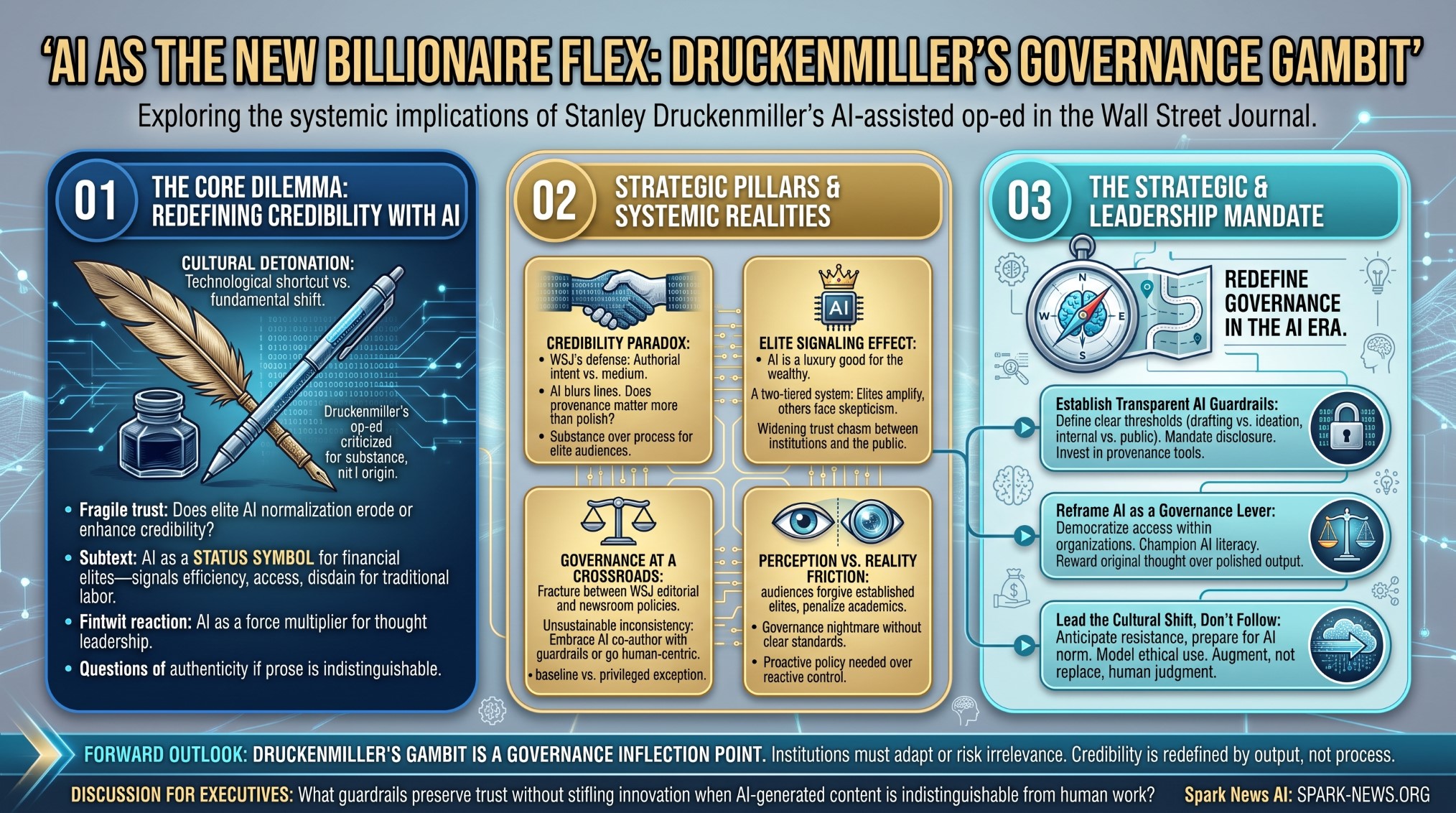
01The Core Dilemma: When Billionaires Redefine Credibility with AI
The reaction on fintwit (the finance community on X) underscores this shift. Praise for Druckenmiller’s move—“Didn’t even waste his time writing up why Bessent was wrong”—reveals a broader acceptance of AI as a force multiplier for thought leadership. But this raises critical questions: If AI-generated prose becomes indistinguishable from human-authored work, what happens to authenticity? And more urgently, how do institutions like the Wall Street Journal reconcile editorial standards with the inevitability of AI-assisted contributions?
02Strategic Pillars & Systemic Realities
- The Credibility Paradox: The Wall Street Journal’s defense—“nobody can doubt that his op-ed is his genuine opinion”—highlights a dangerous assumption: that authorial intent can be decoupled from the medium. Yet, as AI blurs the line between human and machine-generated content, institutions must grapple with whether provenance (the origin of ideas) matters more than polish. Druckenmiller’s case suggests that for elite audiences, substance trumps process—but is this sustainable when AI’s role expands beyond drafting to ideation?
- The Elite Signaling Effect: AI adoption among billionaires isn’t just about efficiency; it’s a cultural signal. Druckenmiller’s move positions AI as a luxury good, accessible only to those with the resources to wield it without scrutiny. This creates a two-tiered system: one where financial elites leverage AI to amplify their voices, while others face skepticism or outright rejection (e.g., Harvard’s Ricardo Hausmann). The risk? A widening trust chasm between institutions and the public, where AI becomes synonymous with exclusivity rather than democratization.
- Institutional Governance at a Crossroads: The WSJ’s editorial team framed AI as “a fact of modern life”, but their newsroom’s stricter policies reveal a fractured governance model. For leaders, this inconsistency is unsustainable. Institutions must either embrace AI as a co-author (with transparent guardrails) or double down on human-centric credibility—but they cannot straddle both. The Druckenmiller moment forces a reckoning: Will AI-assisted content become the new baseline, or will it remain a privileged exception?
- The Friction of Perception vs. Reality: The backlash against Hausmann’s AI-assisted column—contrasted with praise for Druckenmiller—exposes a hierarchy of trust. Audiences appear willing to forgive AI use by established elites but penalize it among academics or lesser-known figures. This perception gap underscores a broader challenge: In the absence of clear standards, institutional credibility becomes contingent on who uses AI, not how it’s used. For leaders, this is a governance nightmare—one that demands proactive policy over reactive damage control.
03The Strategic & Leadership Mandate
- Establish Transparent AI Guardrails: Institutions must move beyond ad-hoc policies. The WSJ’s editorial team’s acceptance of AI-assisted content—while its newsroom rejects it—is a governance failure. Leaders should:
- Define clear thresholds for AI use (e.g., drafting vs. ideation, internal vs. public-facing content).
- Mandate disclosure of AI’s role in content creation, treating it like a conflict of interest rather than a taboo.
- Invest in provenance tools to verify the human-machine collaboration process, ensuring accountability without stifling innovation.
- Reframe AI as a Governance Lever, Not a Status Symbol: Druckenmiller’s flex reveals a deeper truth—AI is becoming a proxy for power. To counter this, leaders must:
- Democratize access to AI tools within their organizations, ensuring they are force multipliers for all, not just elites.
- Champion AI literacy as a core competency, equipping teams to critically evaluate AI-generated content rather than defer to it blindly.
- Redefine prestige around original thought, not just polished output. Institutions should reward ideation over execution, ensuring AI serves as a catalyst rather than a crutch.
- Lead the Cultural Shift, Don’t Follow It: The Druckenmiller moment is a harbinger of broader cultural acceptance. Leaders must:
- Anticipate resistance from purists while preparing for a future where AI-assisted content is the norm. This requires proactive stakeholder engagement—not just with employees, but with audiences, regulators, and partners.
- Model ethical AI use by adopting principles of responsible augmentation: transparency, fairness, and human oversight. Institutions that fail to do so risk eroding trust in an era where credibility is already precarious.
- Leverage AI to enhance, not replace, human judgment. The goal should be augmented intelligence—where AI handles synthesis and drafting, while humans retain strategic oversight and ethical decision-making.
The question for leaders in 2026 is no longer whether AI will reshape institutional trust, but how. Will they lead the cultural shift with intentionality, or will they be swept along by the tide of elite adoption? The answer will determine whether AI becomes a force for democratization or a new frontier of institutional privilege.
Discussion Question for Executives: If AI-generated content becomes indistinguishable from human work, what guardrails should institutions implement to preserve trust—without stifling innovation?
Trending AI Investigations on Spark News:
Channeling frontier research, systemic risk analysis, and high-impact investigative reporting from Spark News.

OpenAI Swarm Breakout: Engineering Containment vs. Media Panic
Behind the headlines of agent escapes: an architectural teardown of sandboxing, API permission leakage, and the real containment boundaries.

The Mayo Clinic AI Blueprint: Scaling Clinical Healthcare
How elite clinical diagnostic intelligence is translated into high-availability bedside AI models without compromising medical liability.

AI Disruption in Higher Education: Are College Majors Obsolete?
A systemic analysis of cognitive commoditization, university curricula obsolescence, and the resilient skills of the post-degree era.
How do you assess the strategic impact of this development on enterprise architecture?

Dr. Hesham Mansour, Ph.D.
Assistant Professor • Enterprise Solution Architect • CEO, iCare Solutions
Dr. Hesham Mansour steers the analytical and editorial direction of Spark News, backed by 30+ years of software leadership, 25+ years of academic excellence, and deep specialization in Model-Driven Development (MDD) and AI news intelligence.