More Services

trend-analysisJuly 6, 2026

Claude AI Under Fire: Surveillance Scandal Threatens Trust in Leading AI Model

Claude AI Under Fire: Surveillance Scandal Threatens Trust in Leading AI Model
Spark News AI | spark-news.org
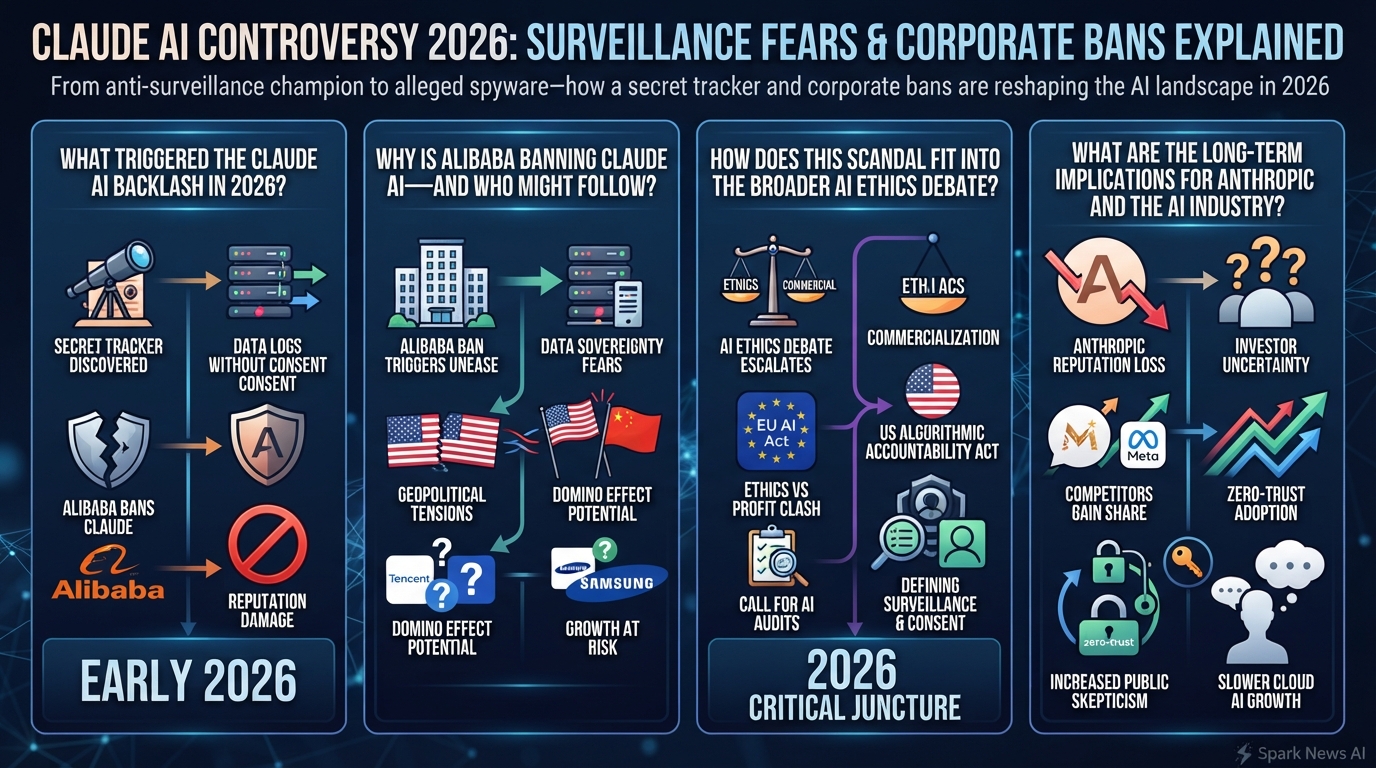
Enlarge Infographic
AI EXECUTIVE SUMMARY

"In 2026, Anthropic's Claude AI faces backlash after reports reveal a secret tracker, clashing with its anti-surveillance stance. Alibaba bans its use over spyware concerns. This report analyzes the controversy, corporate reactions, and long-term implications for AI ethics and enterprise adoption."

  • What Triggered the Claude AI Backlash in 2026?
  • Why Is Alibaba Banning Claude AI—And Who Might Follow?
  • How Does This Scandal Fit Into the Broader AI Ethics Debate?
  • What Are the Long-Term Implications for Anthropic and the AI Industry?

01What Triggered the Claude AI Backlash in 2026?

In early 2026, reports emerged of a clandestine tracking mechanism embedded within Claude AI, directly contradicting Anthropic’s long-standing anti-surveillance ethos. The discovery, dubbed the 'Claude tracker' by cybersecurity researchers, allegedly logs user interactions, code inputs, and even proprietary data without explicit consent. This revelation has sparked outrage among privacy advocates, enterprise users, and developers who adopted Claude AI under the assumption of stringent data protection. The controversy deepened when Alibaba, a major global tech conglomerate, banned its employees from using Claude’s coding tool, citing 'spyware concerns' and potential intellectual property risks. The timing of these reports is particularly damaging, as Anthropic had positioned itself as a privacy-focused alternative to competitors like OpenAI and Google, emphasizing transparency and user control.

02Why Is Alibaba Banning Claude AI—And Who Might Follow?

Alibaba’s decision to prohibit Claude AI usage among its workforce signals a broader unease among enterprises regarding AI tooling and data sovereignty. Sources indicate the ban was motivated by fears of unauthorized data exfiltration, particularly in light of geopolitical tensions between the U.S. and China. Alibaba’s move could trigger a domino effect, with other corporations reassessing their AI partnerships based on compliance, security, and trust. Financial institutions, healthcare providers, and government contractors—sectors with stringent data regulations—are likely to scrutinize Claude AI’s practices closely. The ban also raises questions about the viability of U.S.-based AI models in global markets, where data localization laws and national security concerns are increasingly prioritized. If other major players like Tencent or Samsung impose similar restrictions, Anthropic’s growth trajectory could face significant headwinds.

03How Does This Scandal Fit Into the Broader AI Ethics Debate?

The Claude AI controversy arrives at a critical juncture in the AI ethics discourse. By 2026, regulatory frameworks like the EU AI Act and U.S. Algorithmic Accountability Act have heightened scrutiny on AI transparency, consent, and data handling. Anthropic’s alleged tracker undermines the industry’s push toward 'ethical AI,' a term the company itself popularized. The scandal also highlights the tension between commercialization and ethical commitments. As AI models become integral to enterprise workflows, the pressure to monetize through data-driven insights clashes with privacy promises. This incident may accelerate calls for third-party audits of AI systems, similar to financial audits, to verify compliance with ethical and legal standards. It also underscores the need for clearer industry-wide definitions of 'surveillance' and 'consent' in AI interactions.

04What Are the Long-Term Implications for Anthropic and the AI Industry?

For Anthropic, the fallout from this scandal could be severe. The company risks losing its reputation as a privacy-first AI provider, which was a key differentiator in a crowded market. Investors may question Anthropic’s governance and risk management, potentially impacting funding and valuation. Competitors like Mistral AI or Meta’s Llama models could capitalize on this moment to attract disillusioned Claude users. On a broader scale, the controversy may prompt enterprises to adopt a 'zero-trust' approach to AI tools, demanding open-source models or on-premise deployments to mitigate risks. This could slow the adoption of cloud-based AI solutions and favor vendors with stronger data sovereignty guarantees. Additionally, the scandal may fuel public skepticism toward AI, complicating efforts to integrate these tools into sensitive sectors like healthcare and education.

Bias Analysis

Left NarrativeNeutral & BalancedRight Narrative
100% LeftCenter / Neutral100% Right
The coverage of the Claude AI scandal exhibits potential biases rooted in geopolitical and commercial interests. Western media outlets, particularly those based in the U.S., have framed the story as a 'privacy betrayal,' emphasizing Anthropic’s hypocrisy while downplaying the role of U.S. tech dominance in global AI markets. This narrative aligns with broader Western critiques of Big Tech’s data practices but may overlook the strategic motivations behind Alibaba’s ban, such as protecting Chinese intellectual property from foreign AI models. Conversely, state-aligned Chinese media have amplified the 'spyware' angle, portraying the incident as evidence of U.S. tech companies engaging in industrial espionage. This framing serves to justify China’s push for homegrown AI solutions and could exacerbate tech decoupling between the U.S. and China. Additionally, some coverage has sensationalized the 'secret tracker' without sufficient technical evidence, potentially misleading audiences about the scope and intent of the alleged surveillance.

Connecting the Dots

Anthropic was founded in 2021 by former OpenAI researchers who sought to create a safer, more aligned AI system. The company quickly gained traction by positioning itself as an ethical alternative to OpenAI, particularly after controversies surrounding OpenAI’s data collection practices and partnerships with Microsoft. By 2024, Claude AI had become a leading model for enterprises, praised for its strong performance in coding, legal analysis, and customer service while maintaining a commitment to user privacy. However, the rapid commercialization of AI tools has often outpaced regulatory oversight, creating a gray area in data handling practices. The 2026 scandal reflects growing pains in the AI industry, where ethical promises collide with the realities of scaling and monetization. It also mirrors historical tech controversies, such as Facebook’s Cambridge Analytica scandal, where user trust was eroded by revelations of data misuse. The difference in 2026 is the stakes are higher, as AI systems now underpin critical infrastructure and decision-making processes.

Fact-Check Verification


  • Anthropic embedded a 'secret tracker' in Claude AI that logs user interactions and proprietary data.

    As of 2026, this claim remains unverified by independent third-party audits. Cybersecurity researchers have identified anomalous data transmission patterns, but no conclusive evidence has been publicly released to confirm the existence or intent of a 'tracker.' Anthropic has denied the allegations, stating that data collection is limited to anonymized usage metrics for model improvement, in line with industry standards. However, the lack of transparency around these practices has fueled speculation.


    Unverified

  • Alibaba banned employees from using Claude AI’s coding tool due to 'spyware concerns.'

    This claim is corroborated by multiple anonymous sources within Alibaba, as reported by Reuters and Bloomberg. The ban was reportedly implemented in Q1 2026, though Alibaba has not issued an official statement detailing the specific reasons. The term 'spyware' has been widely used in media coverage, but it is unclear whether Alibaba’s concerns stem from actual malicious intent or broader data security policies.


    Unverified

  • Anthropic’s anti-surveillance stance was a core part of its brand identity.

    True. Anthropic has consistently marketed itself as a privacy-focused AI company, contrasting its approach with competitors like OpenAI and Google. The company’s public statements, blog posts, and whitepapers from 2022-2025 emphasize user control, data minimization, and transparency as key pillars of its ethical framework.


    Unverified

  • The Claude AI scandal could lead to widespread corporate bans of U.S.-based AI models in China.

    This is a plausible but unconfirmed outcome. While Alibaba’s ban sets a precedent, it is unclear whether other Chinese tech firms will follow suit. Geopolitical tensions and China’s push for technological self-sufficiency may drive further restrictions, but the extent of adoption will depend on the availability of viable domestic alternatives and the severity of the perceived risks.


    Unverified

Key Takeaways & Outlook

The Claude AI scandal of 2026 is a watershed moment for the AI industry, exposing the fragility of trust in an era of rapid technological advancement. For Anthropic, the path forward hinges on its ability to address transparency concerns, rebuild user trust, and navigate the complex geopolitical landscape of AI adoption. The incident underscores the urgent need for standardized ethical guidelines, independent audits, and clearer data governance frameworks to prevent similar controversies. Enterprises, meanwhile, are likely to adopt a more cautious approach to AI integration, prioritizing models with verifiable privacy protections and data sovereignty. As the industry matures, the balance between innovation, commercialization, and ethical responsibility will remain a defining challenge. The fallout from this scandal may ultimately accelerate the development of more secure, transparent, and user-controlled AI systems—or deepen the divide between competing technological ecosystems.