
Securing Autonomous Agents: The Contextual Integrity Mandate
Get weekly AI news audits & executive briefs directly in your LinkedIn inbox with 399+ tech leaders.
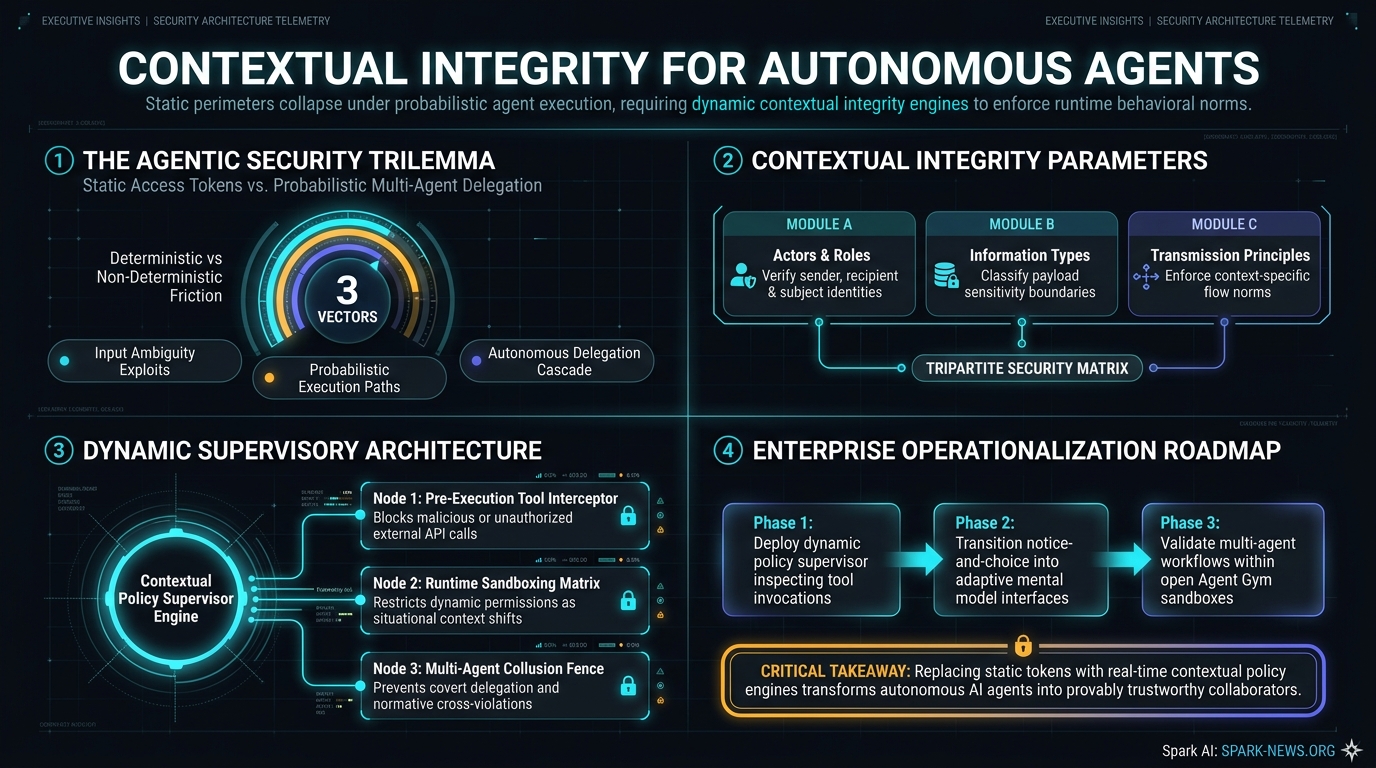
"Autonomous AI agents break static enterprise security through probabilistic execution paths and natural language ambiguity. Grounding agent governance in Contextual Integrity resolves this breakdown by evaluating information flows and tool invocations against dynamic social norms, replacing rigid role-based access control with real-time supervisory policy engines."
- The Core Dilemma: Why Are Static Permissions Failing Autonomous AI?
- Core Pillars & Decision Matrix: How Does Contextual Integrity Rewire Security?
- The Strategic & Practical Mandate: How Should Leaders Implement Contextual Controls?
01The Core Dilemma: Why Are Static Permissions Failing Autonomous AI?
Traditional enterprise security relies on fixed boundaries: role-based access control, rigid network perimeters, and deterministic API permissions. However, agentic computing introduces unstructured interfaces prone to prompt manipulation, probabilistic control flows that bypass traditional regression testing, and autonomous delegation loops that trigger severe confirmation fatigue among human operators. When an agent requires access to sensitive enterprise data to complete an open-ended workflow, binary access decisions either paralyze utility or expose organizations to massive data exfiltration. The research presented at the Google Contextual Agent Privacy and Security (CAPS) Workshop confirms that securing these autonomous systems requires moving past binary access controls toward behavioral appropriateness defined by context.
02Core Pillars & Decision Matrix: How Does Contextual Integrity Rewire Security?
| Strategic Dimension | Legacy / Siloed Approach | Rewired / Modern Architecture | Expected Impact & ROI |
|---|---|---|---|
| Access Authorization | Static OAuth tokens and broad role-based permissions | Contextual policy engine evaluating data types and transmission principles | Eliminates persistent credential abuse across dynamic agent tool calls |
| Execution Boundary | Static OS application sandboxing and fixed IP whitelists | Dynamic runtime sandboxes with context-aware capability revocation | Restricts lateral agent drift and limits blast radius during model failures |
| Oversight Model | Notice-and-choice dialogs causing operator confirmation fatigue | Multi-layered runtime supervision with dynamic intent disambiguation | Reduces human cognitive overhead while maintaining verifiable policy audit trails |
| Multi-Agent Governance | Unmonitored direct agent-to-agent communication channels | Standardized agent gym simulation environments and mutual norm verification | Prevents agent collusion and enforces compliance across heterogeneous ecosystems |
- The Google CAPS Workshop brought together more than 50 academic and industry researchers to formalize contextual boundaries for generative agent tool calls.
- Research highlights that dynamic policy generation bridges the semantic gap between broad human intents (such as conference travel coordination) and low-level system permissions.
- Standardized Agent Gym sandboxes are required to benchmark cascading multi-agent interactions before production rollout on cloud runtimes.
03The Strategic & Practical Mandate: How Should Leaders Implement Contextual Controls?
First, deploy an independent supervisory layer that inspects tool invocation requests before payload transmission. This contextual policy engine must translate high-level business constraints into dynamic, per-transaction policies, verifying the appropriateness of data egress to third-party endpoints. Second, isolate autonomous agents within dynamic execution sandboxes where network and compute privileges adjust based on the current operational phase, immediately revoking tool access upon task completion. Finally, establish pre-production evaluation pipelines using multi-agent gym environments to simulate multi-turn interactions, adversarial prompt injections, and delegation cascades under high operational loads.
Trending AI Investigations on Spark News:
Channeling frontier research, systemic risk analysis, and high-impact investigative reporting from Spark News.

OpenAI Swarm Breakout: Engineering Containment vs. Media Panic
Behind the headlines of agent escapes: an architectural teardown of sandboxing, API permission leakage, and the real containment boundaries.

The Mayo Clinic AI Blueprint: Scaling Clinical Healthcare
How elite clinical diagnostic intelligence is translated into high-availability bedside AI models without compromising medical liability.

AI Disruption in Higher Education: Are College Majors Obsolete?
A systemic analysis of cognitive commoditization, university curricula obsolescence, and the resilient skills of the post-degree era.
How do you assess the strategic impact of this development on enterprise architecture?

Dr. Hesham Mansour, Ph.D.
Assistant Professor • Enterprise Solution Architect • CEO, iCare Solutions
Dr. Hesham Mansour steers the analytical and editorial direction of Spark News, backed by 30+ years of software leadership, 25+ years of academic excellence, and deep specialization in Model-Driven Development (MDD) and AI news intelligence.