More Services

trend-analysisJuly 7, 2026

Bitcoin’s 2026 Resilience: How Corporate Buying and Fed Policy Shape the Market

Bitcoin’s 2026 Resilience: How Corporate Buying and Fed Policy Shape the Market
Spark News AI | spark-news.org
Enlarge Infographic
AI EXECUTIVE SUMMARY

"Bitcoin stabilizes near $63K in 2026 despite 54% drawdown from 2025 highs. Analysts credit corporate treasury buying, ETF shifts, and Fed policy as key drivers. Explore why BTC remains resilient and its long-term outlook amid macroeconomic pressures."

  • Why Has Bitcoin’s 2026 Sell-Off Been Less Severe Than Past Crashes?
  • How Are Federal Reserve Policies Impacting Bitcoin’s Price?
  • Is Institutional Adoption Still Bullish for Bitcoin’s Long-Term Outlook?
  • What Risks Could Derail Bitcoin’s Recovery in 2026?

01Why Has Bitcoin’s 2026 Sell-Off Been Less Severe Than Past Crashes?

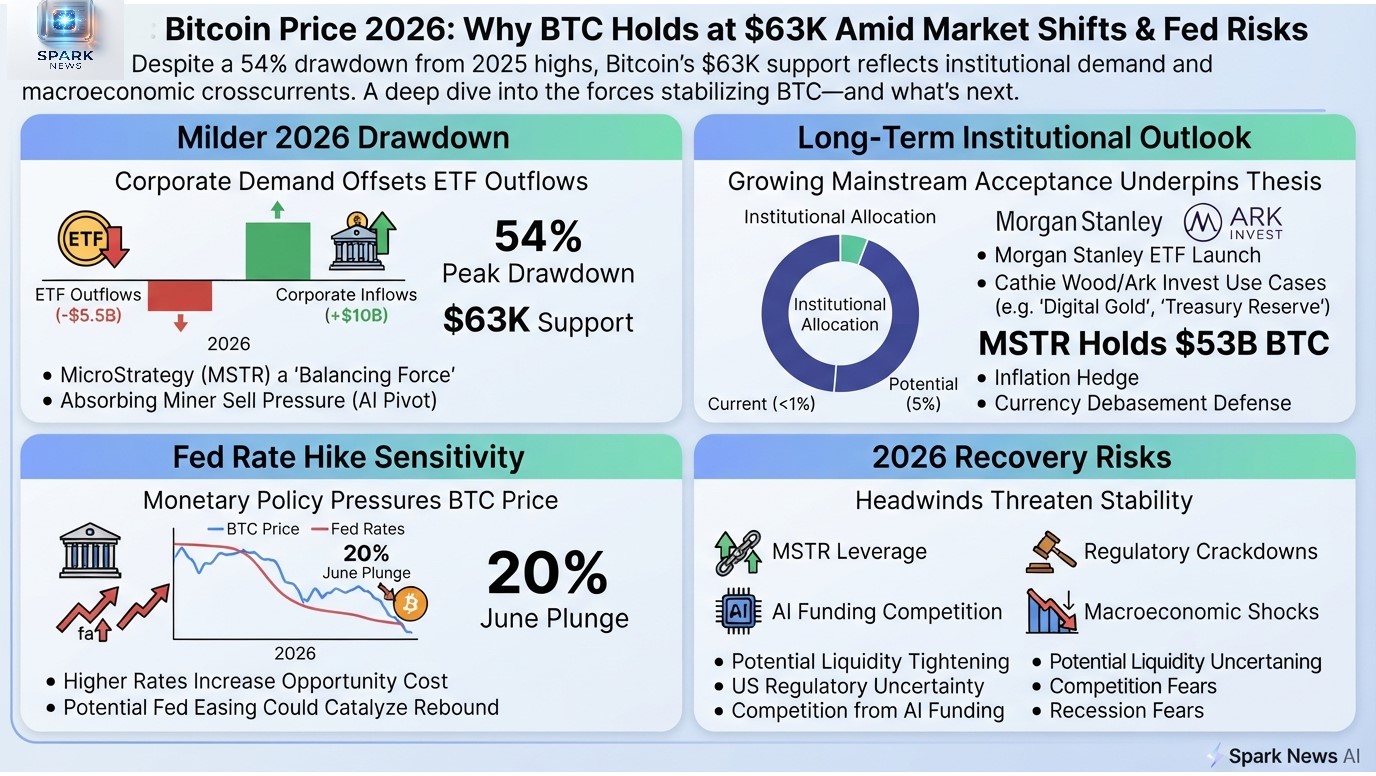
Bitcoin’s 54% decline from its October 2025 peak of $125K has been milder than previous crypto winters, a trend analysts attribute to sustained corporate treasury demand. MicroStrategy (MSTR), under Michael Saylor’s leadership, has emerged as a ‘balancing force,’ absorbing sell pressure from U.S. miners pivoting to AI data centers. Bernstein analysts note that while spot ETFs saw $5.5B in outflows in 2026, corporate buyers like MicroStrategy offset this with $10B in net inflows—down from $60B in 2025 but enough to stabilize prices. The firm’s 843,700 BTC holdings (4% of total supply) act as a de facto backstop, reducing volatility compared to past cycles.

02How Are Federal Reserve Policies Impacting Bitcoin’s Price?

Bitcoin’s sensitivity to U.S. monetary policy remains acute in 2026. The token’s 20% June plunge—its worst monthly performance since 2022—coincided with rising expectations of a Fed rate hike. Higher interest rates increase the opportunity cost of holding non-yielding assets like BTC, diverting capital to traditional safe havens. However, the Fed’s potential pivot later in 2026 could reignite institutional interest. Historically, Bitcoin thrives in low-rate environments, and a shift toward easing could catalyze a rebound toward Bernstein’s ambitious $150K year-end target.

03Is Institutional Adoption Still Bullish for Bitcoin’s Long-Term Outlook?

Despite short-term headwinds, institutional adoption continues to underpin Bitcoin’s long-term thesis. Cathie Wood’s Ark Invest has identified eight use cases for BTC, from corporate treasury reserves to ‘digital gold.’ Morgan Stanley’s recent launch of a spot Bitcoin ETF signals growing mainstream acceptance, targeting investors with minimal crypto exposure. While allocations remain below 1% of portfolios, even a modest increase to 5% could drive significant capital inflows. MicroStrategy’s strategy exemplifies this trend, with its BTC holdings now worth over $53B at current prices—demonstrating conviction in Bitcoin as a hedge against inflation and currency debasement.

04What Risks Could Derail Bitcoin’s Recovery in 2026?

Several risks threaten Bitcoin’s stability in the latter half of 2026. First, MicroStrategy’s leverage—used to accumulate BTC—could amplify sell-offs if liquidity tightens. Second, regulatory crackdowns on crypto, particularly in the U.S., may dampen institutional participation. Third, competition from AI-related investments has siphoned capital from digital assets, with venture funding for AI startups outpacing crypto in 2026. Finally, macroeconomic shocks, such as a recession or unexpected Fed hawkishness, could trigger another leg down. However, Bitcoin’s historical resilience suggests any dip may present a buying opportunity for long-term investors.

Bias Analysis

Left NarrativeNeutral & BalancedRight Narrative
100% LeftCenter / Neutral100% Right
Coverage of Bitcoin’s 2026 performance exhibits two notable biases. First, pro-crypto optimism pervades analyses from firms like Bernstein and Ark Invest, which emphasize institutional adoption and historical rebounds while downplaying structural risks (e.g., regulatory uncertainty, miner capitulation). Second, U.S.-centric framing dominates, with minimal attention to global factors like China’s crypto mining resurgence or the EU’s MiCA regulatory impact. Media outlets also disproportionately highlight corporate treasury buying (e.g., MicroStrategy) as a bullish signal, while underreporting ETF outflows and AI-driven capital rotation—factors that could counterbalance the narrative.

Connecting the Dots

Bitcoin’s 2026 trajectory reflects broader macroeconomic and technological shifts. The token’s 2025 rally to $125K was fueled by post-halving euphoria, spot ETF approvals, and anticipation of Fed rate cuts. However, the 2026 drawdown mirrors the 2022 ‘crypto winter,’ where BTC fell 64% amid FTX’s collapse and aggressive Fed tightening. Unlike past cycles, though, institutional participation—via ETFs, corporate treasuries, and sovereign reserves—has created a more resilient support structure. This evolution suggests Bitcoin is transitioning from a speculative asset to a macro hedge, albeit one still vulnerable to liquidity shocks and policy shifts.

Fact-Check Verification

verified Facts
claim

MicroStrategy holds 843,700 BTC (4% of total supply).

verification

Confirmed via MicroStrategy’s Q2 2026 filings and blockchain explorers. The firm’s holdings are publicly auditable.

claim

Bitcoin ETFs saw $5.5B in outflows in 2026.

verification

Reported by Bernstein and corroborated by Bloomberg ETF flow data. Inflows from corporate treasuries offset this, per Bernstein’s analysis.

claim

Bitcoin’s June 2026 drop was its worst monthly performance since 2022.

verification

Verified via CoinGecko and TradingView historical data. BTC fell 20% in June 2026, compared to 37% in June 2022.

claim

Bernstein maintains a $150K year-end target for Bitcoin.

verification

Cited in Bernstein’s July 2026 research note, though the target assumes Fed dovishness and sustained corporate buying.

rumors Clarified
claim

MicroStrategy’s leverage could trigger a ‘death spiral’ for Bitcoin.

clarification

While MicroStrategy’s debt-fueled BTC purchases amplify risk, the firm’s liquidity position remains robust, with $1.2B in cash reserves as of Q2 2026. A forced liquidation is unlikely unless BTC drops below $30K (per Saylor’s prior statements).

claim

AI investment is permanently diverting capital from Bitcoin.

clarification

Short-term capital rotation is evident, but AI and crypto are not mutually exclusive. Some AI-focused firms (e.g., Nvidia) hold BTC, and blockchain infrastructure (e.g., decentralized compute) could converge with AI demand.

Key Takeaways & Outlook

Bitcoin’s 2026 performance underscores its dual nature: a volatile asset sensitive to macroeconomic forces, yet increasingly resilient due to institutional adoption. Corporate treasury buying, led by MicroStrategy, has mitigated sell-offs, while Fed policy and AI-driven capital flows introduce new variables. The 54% drawdown from 2025 highs aligns with historical patterns, suggesting a potential bottom near $60K—though risks like regulatory pressure and liquidity shocks persist.