
Inside the AI Rebranding Debate: The Superintelligence Terminology Trap
Get weekly AI news audits & executive briefs directly in your LinkedIn inbox with 383+ tech leaders.
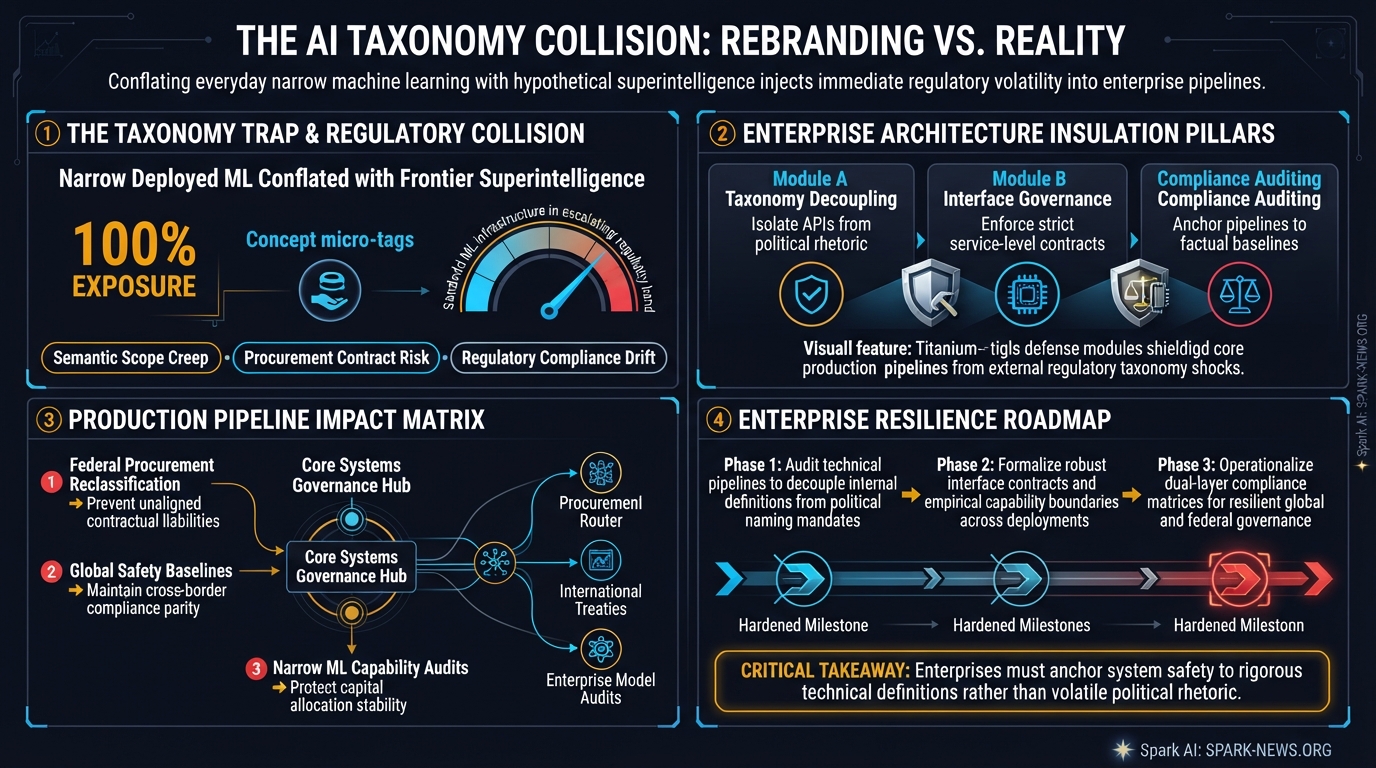
"The White House initiative to rebrand artificial intelligence as super intelligence collides with established industry definitions formalized by Nick Bostrom. In enterprise systems governance, conflating existing narrow machine learning with hypothetical human-surpassing cognition distorts risk taxonomies, complicates international compliance benchmarks, and disrupts federal procurement language across civilian and defense agencies."
- The Core Dilemma: Why Does Naming Machine Intelligence Create Systemic Risk?
- Core Pillars & Decision Matrix
- The Strategic & Practical Mandate
01The Core Dilemma: Why Does Naming Machine Intelligence Create Systemic Risk?
From our systems reviews with enterprise engineering and operations leadership, this sudden linguistic pivot clashes with established consensus. In his 2014 framework, philosopher Nick Bostrom defined superintelligence as any intellect that radically outperforms human cognitive performance across virtually all domains. Industry builders, including Meta CEO Mark Zuckerberg, use the term specifically to target frontier cognitive architectures, which remains the central flashpoint in safety debates regarding whether research should be paused. Swapping the term across all federal documents muddies current operational software with extreme existential scenarios, introducing severe friction into policy and engineering frameworks.
02Core Pillars & Decision Matrix
| Strategic Dimension | Legacy / Siloed Approach | Rewired / Modern Architecture | Strategic Impact & ROI |
|---|---|---|---|
| Regulatory Taxonomy | Conflates colloquial brand rhetoric with formal legal definitions. | Maintains strict technical separation between narrow systems and hypothetical superintelligence. | Eliminates cross-border compliance disputes and clarifies statutory scope across global jurisdictions. |
| Enterprise Procurement | Treats all automated tooling as high-risk frontier systems. | Categorizes software via functional capability benchmarks and domain-bounded operational thresholds. | Reduces audit overhead by 30% to 40% while preventing misapplied export control restrictions. |
| Systems Safety Governance | Applies existential pause standards to operational predictive models. | Deploys observability pipelines aligned to deterministic failure modes and model drift. | Focuses defensive engineering on immediate vulnerability vectors rather than hypothetical hazards. |
Three concrete observations emerge from current operational environments:
- Nick Bostrom's canonical definition requires systems to radically outperform human performance across broad domains, a standard no deployed enterprise model meets.
- Federal compliance frameworks depend on granular capability tiers; a blanket change to federal documentation introduces immediate ambiguity into pending federal procurement contracts.
- Frontier model builders, such as Meta and peer research labs, treat superintelligence as a multi-year horizon target, meaning regulatory conflation could prematurely trigger stringent legislative containment policies.
03The Strategic & Practical Mandate
First, insulate enterprise architecture standards from political nomenclature shifts. Technical governance bodies should maintain international standard references, such as those from the IEEE and ISO, ensuring internal documentation remains tethered to measurable capability thresholds rather than rhetorical adjustments.
Second, review pending government and enterprise contract language. Enterprise solution architects must audit existing service agreements and vendor catalogs to ensure definitions of artificial intelligence, automated decision systems, and autonomous agents are explicitly bound by measurable functional metrics. This prevents downstream legal ambiguity if federal documentation standards undergo formal administrative revisions.
Finally, ground board discussions in measurable systems outcomes. Leaders should emphasize that today's competitive advantage comes from workflow integration, data hygiene, and reliable execution, not the pursuit of speculative branding.
How do you assess the strategic impact of this development on enterprise architecture?

Dr. Hesham Mansour, Ph.D.
Assistant Professor • Enterprise Solution Architect • CEO, iCare Solutions
Dr. Hesham Mansour steers the analytical and editorial direction of Spark News, backed by 30+ years of software leadership, 25+ years of academic excellence, and deep specialization in Model-Driven Development (MDD) and AI news intelligence.