
Inside China's AI Mindset: The Industrial Architecture of State Control
Get weekly AI news audits & executive briefs directly in your LinkedIn inbox with 383+ tech leaders.
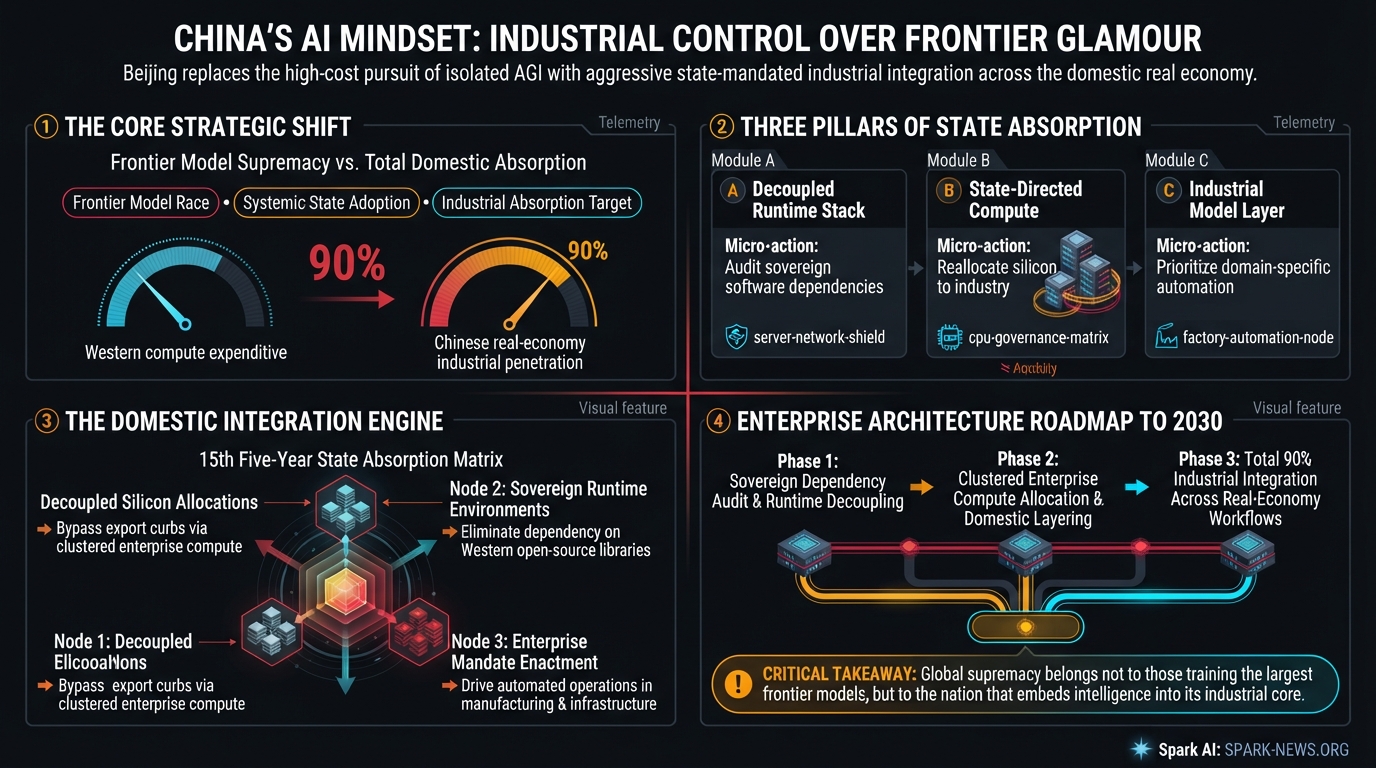
"China prioritizes state-directed economic integration over solitary frontier model breakthroughs. Outlined in its 15th Five-Year Plan, Beijing targets 90% AI integration across domestic industries by 2030. Rather than chasing unconstrained super-intelligence, its architecture focuses on offsetting acute demographic contraction, securing cognitive infrastructure, and embedding applied intelligence into industrial robotics and state governance."
- The Core Dilemma: Is Supremacy Built on Frontier Capability or Systemic Adoption?
- Core Pillars & Decision Matrix: Frontier Race vs. State Absorption
- The Strategic & Practical Mandate: Systems Guidance for Global Enterprise Leaders
01The Core Dilemma: Is Supremacy Built on Frontier Capability or Systemic Adoption?
China operates under a fundamentally distinct thesis. While the American ecosystem races toward speculative super-intelligence, Beijing executes a comprehensive strategy rooted in industrial integration and strict political oversight. China's 15th Five-Year Plan underscores this deliberate divergence. Mentioning artificial intelligence 52 times, five times more than its previous iteration, the document dedicates an entire independent chapter to computing infrastructure. The explicit objective is not unconstrained algorithmic autonomy, but embedding applied AI across 90% of the domestic economy by 2030.
This architecture is shaped directly by structural pressures. Chinese leadership confronts four consecutive years of demographic population shrinkage alongside persistent youth unemployment. As an aging society with nearly as many citizens over 60 as the entire United States population, China does not view automation through the lens of white-collar redundancy. Instead, automation serves as an operational backstop. Concurrently, state security leadership, highlighted by public warnings from intelligence chief Chen Yixin regarding cognitive warfare and ideological security, views rogue intelligence and unmonitored information flows as primary existential risks. The resulting doctrine enforces total state control over algorithmic pipelines.
02Core Pillars & Decision Matrix: Frontier Race vs. State Absorption
| Strategic Dimension | Legacy Frontier Race (US / Western Tech) | Rewired State Absorption (China 15th Plan) | Expected Impact & ROI |
|---|---|---|---|
| Core Strategic North Star | Attaining frontier super-intelligence and foundational dominance | 90% domestic economic integration and state-monitored utility | Western models lead benchmarks; China closes implementation latency |
| Architectural Bottleneck | Energy grid constraints, data wall, and capital expenditure ROI | Demographic aging, chip export controls, and ideological alignment | Bifurcation of hardware architectures and sovereign software runtimes |
| Risk Governance Focus | Existential alignment, safety evaluations, copyright exposure | Regime survival, institutional security, and cognitive narrative control | Highly filtered national model hubs paired with rapid industrial deployment |
| Applied Infrastructure | Cloud hyperscaler APIs (AWS, Azure) and private model weights | State-backed compute fabrics, industrial edge devices, BrainCo wearables | Pervasive factory robotics, domestic healthcare scale, and applied automation |
What we observe across production deployments reveals three crucial realities regarding China's technological calculus:
- Industrial Ingestion Over Benchmark Chasing: The state apparatus directs compute toward tangible economic bottlenecks, accelerating physical automation, domestic healthcare delivery, and 300-character-per-minute brain-computer interface clinical decoding rather than open-ended conversational agents.
- Cognitive Security as System Constraint: China treats AI model outputs as direct matters of institutional security. Algorithmic architectures are engineered from the baseline to resist adversarial information flows and prevent autonomous institutional disruption.
- Demographic Mitigation via Physical Robotics: Faced with severe labor contraction, capital flows directly into embodied robotics and automated healthcare infrastructure to sustain manufacturing output without traditional demographic replenishment.
03The Strategic & Practical Mandate: Systems Guidance for Global Enterprise Leaders
First, audit sovereign supply chain dependencies. Global organizations can no longer assume a unified open-source software layer. With China decoupling runtime environments and engineering domestic platforms to absorb computing resources independently, enterprise stacks operating across Asian markets must isolate local dependencies from Western cloud backbones like AWS and Microsoft Azure. Establish dual-stack modular architectures to prevent sudden regulatory or trade severance.
Second, balance foundational model experimentation with adoption velocity. Western enterprises frequently stall in endless proof-of-concept cycles, testing cutting-edge frontier checkpoints without modernizing operational pipelines. Follow the pragmatic insight of China's absorption focus: measure artificial intelligence value by the percentage of internal workflows successfully rewired, rather than the raw parameter count of the models you license. Emphasize operational tooling, proprietary data pipelines, and edge integration over pure speculative compute.
Finally, institute rigorous data provenance and boundary controls. As cognitive defense policies harden globally, data pipelines entering or exiting sovereign jurisdictions face unprecedented algorithmic scrutiny. Ensure enterprise data fabrics maintain strict lineage, verifiable sanitization layers, and local compliance telemetry. True technological resilience lies not in chasing frontier benchmarks, but in building systems capable of sustained, reliable execution within an increasingly fractured global reality.
How do you assess the strategic impact of this development on enterprise architecture?

Dr. Hesham Mansour, Ph.D.
Assistant Professor • Enterprise Solution Architect • CEO, iCare Solutions
Dr. Hesham Mansour steers the analytical and editorial direction of Spark News, backed by 30+ years of software leadership, 25+ years of academic excellence, and deep specialization in Model-Driven Development (MDD) and AI news intelligence.