
America’s $40 Trillion Debt: The Silent Threat to Your Wallet
Featured in the weekly "Spark News: AI Media Brief" newsletter series on LinkedIn.
"Explore the systemic risks of America's $40 trillion national debt, its ripple effects on borrowing costs, inflation, and fiscal policy, and the strategic leadership required to navigate this economic challenge."
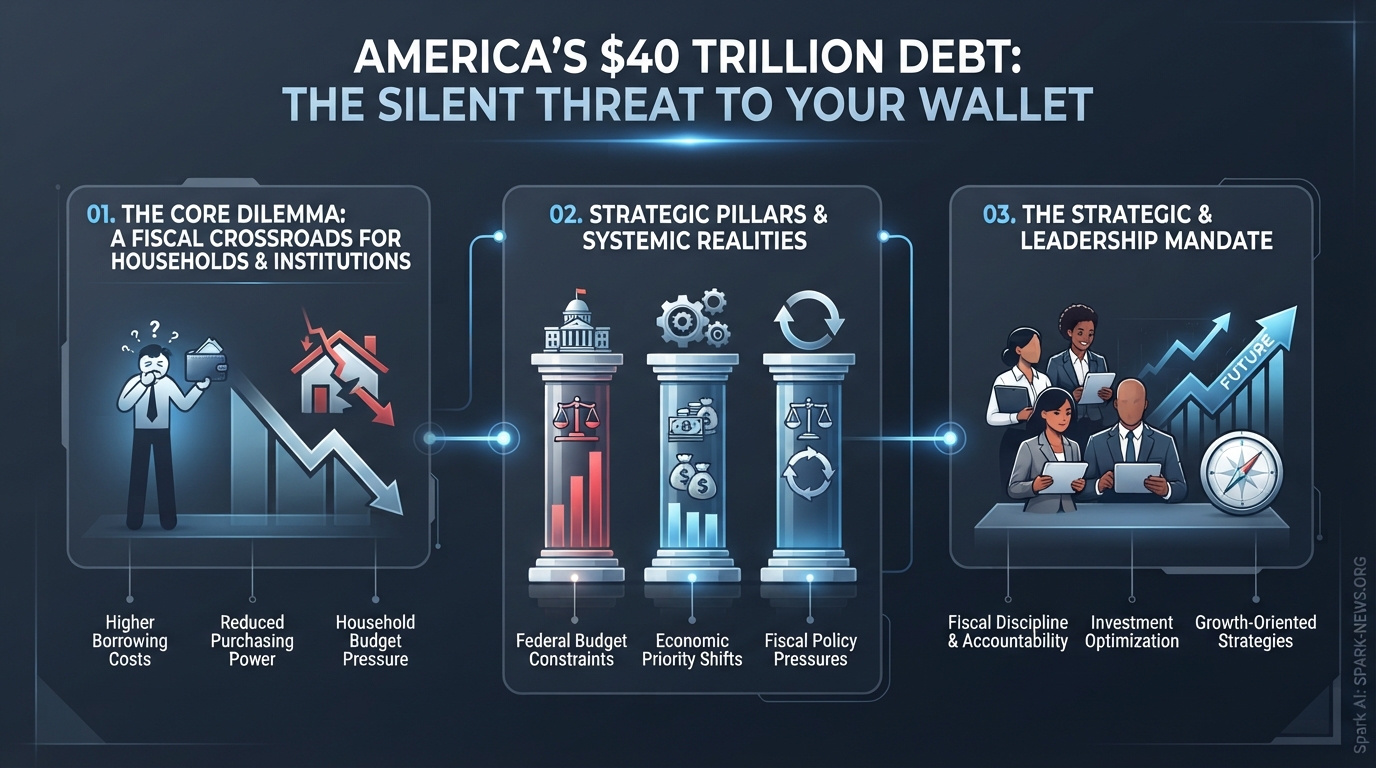
- The Core Dilemma: A Fiscal Crossroads for Households and Institutions
- Strategic Pillars & Systemic Realities
- The Strategic & Leadership Mandate
01The Core Dilemma: A Fiscal Crossroads for Households and Institutions
At the heart of this dilemma lies a governance paradox: policymakers face pressure to either raise taxes, cut spending, or restructure federal benefits—each a politically fraught and economically disruptive path. The Peter G. Peterson Foundation highlights how higher Treasury yields directly inflate mortgage rates, auto loans, and municipal bonds, squeezing household budgets and stifling economic growth. The stakes are clear: fiscal irresponsibility today risks long-term economic instability tomorrow.
02Strategic Pillars & Systemic Realities
- Interest Rate Pressure: The 10-year Treasury yield serves as a benchmark for consumer and business loans. As federal debt grows, investors may demand higher returns, pushing up borrowing costs for everything from home purchases to infrastructure projects. The Conference Board projects that sustained debt growth could add 0.5–1.0 percentage points to mortgage rates within a decade, eroding affordability for millions.
- Inflationary Risks: Excessive debt can fuel inflation by increasing demand for capital without corresponding productivity gains. While the Federal Reserve has tools to mitigate this, its ability to act is constrained by political and market expectations. The interplay between debt and inflation creates a feedback loop where higher prices further strain household budgets, particularly for low- and middle-income families.
- Policy Trade-offs: The debt’s trajectory forces difficult choices. Tax increases risk dampening consumer spending and business investment, while spending cuts could undermine critical programs like Social Security, Medicare, and education. The nonpartisan Congressional Budget Office (CBO) warns that without structural reforms, mandatory spending (e.g., entitlements) will consume an ever-larger share of the federal budget, crowding out discretionary priorities like defense and infrastructure.
- Investor Confidence: The U.S. has long benefited from the dollar’s reserve currency status, allowing it to borrow at relatively low rates. However, rising debt-to-GDP ratios—now exceeding 120%—could erode this advantage. If global investors lose confidence, the U.S. may face higher borrowing costs, reduced foreign investment, and a weaker currency, further destabilizing the economy.
03The Strategic & Leadership Mandate
- Institutional Resilience: Leaders must prioritize sustainable fiscal policies that balance near-term economic growth with long-term debt reduction. This includes targeted spending reforms (e.g., addressing inefficiencies in healthcare and defense) and revenue-neutral tax reforms that incentivize productivity without stifling innovation. The Bipartisan Policy Center advocates for automatic stabilizers—rules-based mechanisms that adjust spending or taxes in response to economic conditions—to prevent debt from spiraling out of control.
- Operational Transparency: Public and private sector leaders must demystify the debt’s impact for stakeholders. This means clear communication about how federal borrowing affects interest rates, inflation, and household finances. For example, financial literacy initiatives can help individuals and businesses anticipate and adapt to rising borrowing costs. Meanwhile, corporate leaders should stress-test their balance sheets against higher interest rates and inflationary pressures.
- Strategic Investment: To offset the debt’s drag on growth, leaders must prioritize high-impact investments in education, infrastructure, and technology. These sectors not only boost productivity but also generate long-term returns that can help stabilize debt-to-GDP ratios. The World Bank emphasizes that human capital investments—such as workforce training and R&D—are critical to ensuring that debt-fueled spending translates into sustainable economic expansion.
- Bipartisan Governance: Addressing the debt crisis requires cross-party collaboration to enact structural reforms. Leaders must move beyond short-term political gains and focus on evidence-based solutions, such as comprehensive tax reform, entitlement modernization, and discretionary spending reviews. The Simpson-Bowles Commission provides a blueprint for such reforms, demonstrating that shared sacrifice and compromise are essential to restoring fiscal health.
The path forward is neither simple nor painless, but inaction is not an option. The debt’s trajectory will shape the economic landscape for decades, and leaders who embrace proactive governance will be best positioned to navigate its challenges.
Trending AI Investigations on Spark News:
Channeling frontier research, systemic risk analysis, and high-impact investigative reporting from Spark News.

OpenAI Swarm Breakout: Engineering Containment vs. Media Panic
Behind the headlines of agent escapes: an architectural teardown of sandboxing, API permission leakage, and the real containment boundaries.

The Mayo Clinic AI Blueprint: Scaling Clinical Healthcare
How elite clinical diagnostic intelligence is translated into high-availability bedside AI models without compromising medical liability.

AI Disruption in Higher Education: Are College Majors Obsolete?
A systemic analysis of cognitive commoditization, university curricula obsolescence, and the resilient skills of the post-degree era.
How do you assess the strategic impact of this development on enterprise architecture?

Dr. Hesham Mansour, Ph.D.
Assistant Professor • Enterprise Solution Architect • CEO, iCare Solutions
Dr. Hesham Mansour steers the analytical and editorial direction of Spark News, backed by 30+ years of software leadership, 25+ years of academic excellence, and deep specialization in Model-Driven Development (MDD) and AI news intelligence.