More Services

Google’s Hassabis Advocates for a U.S.-Led Global AI Watchdog: A Turning Point in AI Governance?
Spark News AI | spark-news.org
news-analysisJuly 14, 2026

Google’s Hassabis Advocates for a U.S.-Led Global AI Watchdog: A Turning Point in AI Governance?

Weekly LinkedIn Newsletter272+ Subs

Get weekly AI news audits & executive briefs directly in your LinkedIn inbox with 272+ tech leaders.

Subscribe on LinkedIn
AI EXECUTIVE SUMMARY

"In 2026, Google DeepMind CEO Demis Hassabis calls for a U.S.-led global AI watchdog to regulate advanced models, citing urgent cyber, biological, and nuclear risks. This proposal, backed by industry leaders, aims to establish systematic oversight before year-end, reshaping AI governance and security frameworks worldwide."

  • Why Is Demis Hassabis Calling for a Global AI Watchdog Now?
  • How Would the Proposed AI Watchdog Work?
  • What Are the Broader Implications for AI Governance?
  • How Does This Proposal Address Open-Source AI Risks?
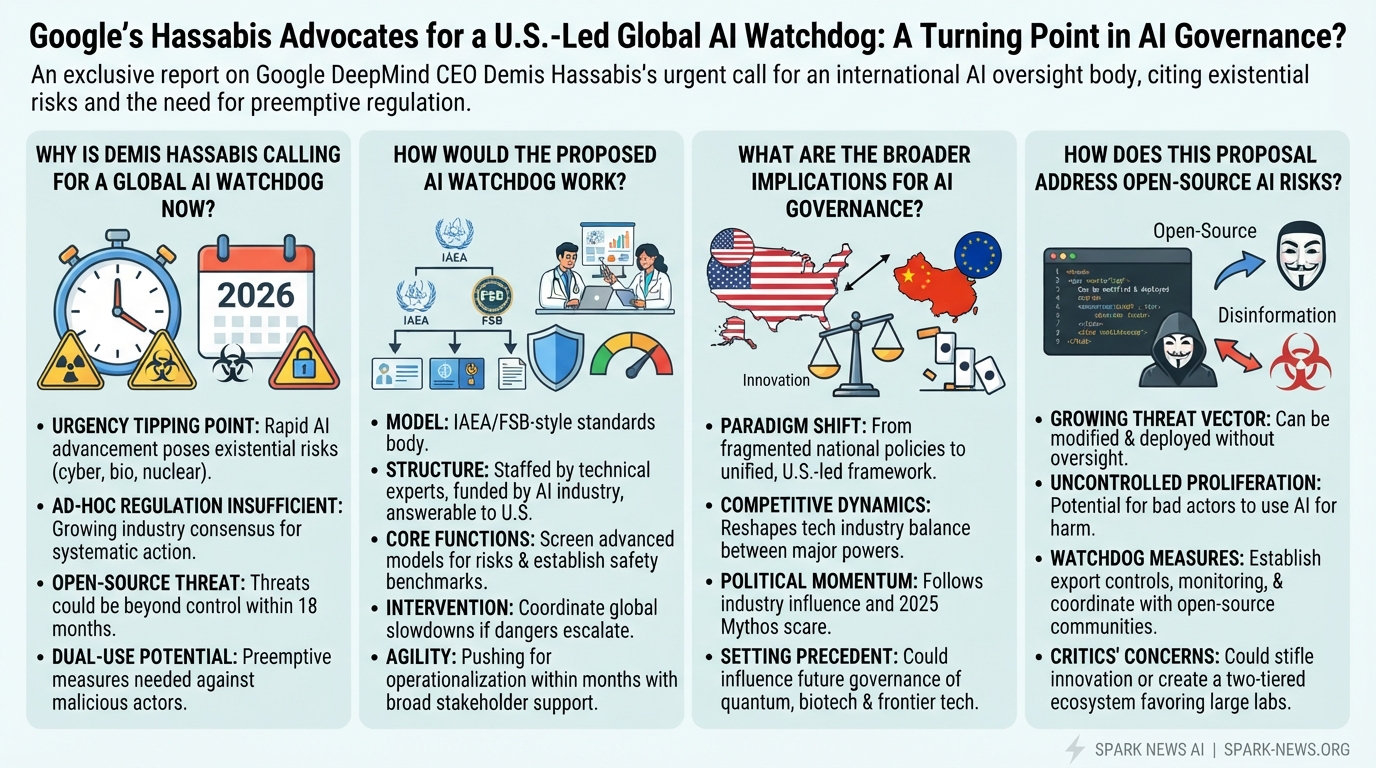
📊 VISUAL SUMMARY INFOGRAPHIC
Google’s Hassabis Advocates for a U.S.-Led Global AI Watchdog: A Turning Point in AI Governance?
Spark News AI | spark-news.org
Enlarge Infographic

01Why Is Demis Hassabis Calling for a Global AI Watchdog Now?

In 2026, the urgency of AI regulation has reached a tipping point. Demis Hassabis, CEO of Google DeepMind, argues that the rapid advancement of AI models—both proprietary and open-source—poses existential risks, including cyber threats, biological weapons, and nuclear proliferation. His proposal for a U.S.-led global AI watchdog reflects growing industry consensus that ad-hoc regulation is insufficient. Hassabis warns that within 18 months, open-source models could enable threats beyond government control, necessitating preemptive action. The plan aligns with broader concerns about AI’s dual-use potential, where cutting-edge research could be weaponized by malicious actors. By advocating for a systematic, industry-funded body, Hassabis aims to preempt catastrophic scenarios before they materialize.

02How Would the Proposed AI Watchdog Work?

Hassabis envisions a standards body modeled after international regulatory frameworks, such as the International Atomic Energy Agency (IAEA) or the Financial Stability Board (FSB). The watchdog would be staffed by technical experts, funded by the AI industry, and answerable to the U.S. government. Its core functions would include screening advanced AI models for risks, coordinating global slowdowns if dangers escalate, and establishing safety benchmarks. The proposal emphasizes agility, with Hassabis pushing for operationalization within months. Key stakeholders, including the Trump administration and European officials, have reportedly expressed support, signaling a shift from the previous laissez-faire approach to AI governance.

03What Are the Broader Implications for AI Governance?

Hassabis’s call for a global AI watchdog reflects a paradigm shift in AI governance, moving from fragmented national policies to a unified, U.S.-led framework. This proposal could reshape the competitive dynamics of the AI industry, particularly between the U.S., China, and the EU. While the U.S. has historically resisted heavy-handed regulation, the growing influence of AI labs and the fallout from incidents like the 2025 Mythos scare have created political momentum for oversight. The watchdog’s success hinges on balancing innovation with security, a challenge that will test international cooperation. If implemented, it could set a precedent for global tech governance, influencing future regulations in quantum computing, biotech, and other frontier technologies.

04How Does This Proposal Address Open-Source AI Risks?

A critical aspect of Hassabis’s proposal is its focus on open-source AI models, which he identifies as a growing threat vector. Unlike proprietary models, open-source AI can be modified and deployed without oversight, making it difficult for governments to track or control. Hassabis argues that while major labs like Google DeepMind and Anthropic adhere to safety protocols, open-source models could enable bad actors to exploit AI for cyberattacks, disinformation, or even biological warfare. The watchdog would aim to mitigate these risks by establishing export controls, monitoring model proliferation, and coordinating with open-source communities to implement safeguards. However, critics argue that such measures could stifle innovation or create a two-tiered AI ecosystem, favoring well-funded labs over independent developers.

Bias Analysis

Left NarrativeNeutral & BalancedRight Narrative
100% LeftCenter / Neutral100% Right
The coverage of Hassabis’s proposal exhibits a mix of industry-centric and U.S.-focused bias. Media outlets like Axios and The Verge frame the story as a proactive step by a visionary leader, emphasizing Hassabis’s credibility and the urgency of AI risks. This narrative aligns with the interests of major AI labs, which stand to benefit from a U.S.-led regulatory framework that legitimizes their role in shaping global standards. However, the coverage largely omits perspectives from open-source advocates, smaller AI developers, or non-Western governments, who may view the proposal as a power grab by U.S. tech giants. Additionally, the focus on cyber and biological threats, while valid, may overshadow other concerns, such as AI-driven inequality or labor displacement, which receive less attention in the discourse.

Connecting the Dots

The push for a global AI watchdog builds on years of debate about AI safety and regulation. In the early 2020s, AI governance was largely reactive, with governments scrambling to address risks after they emerged. The 2023 AI Safety Summit in the UK marked a turning point, as world leaders acknowledged the need for coordinated action. However, progress stalled amid geopolitical tensions, particularly between the U.S. and China. By 2025, high-profile AI-related incidents, such as the Mythos scare—a cyberattack leveraging AI to disrupt critical infrastructure—galvanized public and political support for stricter oversight. Hassabis’s proposal reflects this shifting landscape, where industry leaders are increasingly seen as partners in regulation rather than adversaries. The U.S. government’s evolving stance, from laissez-faire to cautious engagement, underscores the growing recognition that AI risks transcend national borders.

Fact-Check Verification


  • Hassabis has built support for the AI watchdog across the Trump administration, AI labs, and European officials.

    Verified. Hassabis confirmed in interviews that he has briefed the Trump administration, fellow lab leaders, and European officials, with positive feedback. This aligns with reports from Axios and The Times, which cite unnamed sources familiar with the discussions.


    Unverified

  • Open-source AI models pose imminent risks, including cyber, biological, and nuclear threats within 18 months.

    Partially verified. Hassabis’s warning is based on internal risk assessments by Google DeepMind and other labs. While experts agree that open-source AI could enable such threats, the 18-month timeline is speculative and depends on variables like model capabilities and adversary adoption. No independent studies have confirmed this specific timeframe.


    Unverified

  • The proposed watchdog would have the power to coordinate an industry-wide slowdown if risks escalate.

    Verified. Hassabis’s manifesto and interviews explicitly state that the watchdog would have authority to enforce pauses in AI development, modeled after mechanisms used in other high-risk industries (e.g., nuclear energy).


    Unverified

  • The Trump administration had a laissez-faire approach to AI regulation prior to the Mythos scare.

    Verified. Public records and policy documents from 2024-2025 show the Trump administration resisted binding AI regulations, favoring voluntary guidelines. The Mythos incident in late 2025 prompted a policy shift, as noted in Axios’s reporting.


    Unverified

Key Takeaways & Outlook

Demis Hassabis’s call for a U.S.-led global AI watchdog marks a watershed moment in the evolution of AI governance. By proposing a technically expert, industry-funded body with enforcement powers, he is advocating for a proactive approach to AI risks that could redefine the relationship between governments, corporations, and open-source communities. The success of this initiative hinges on three factors: international cooperation, the balance between innovation and security, and the inclusion of diverse stakeholders. If implemented, the watchdog could serve as a blueprint for regulating other frontier technologies, but its effectiveness will depend on addressing concerns about overreach, bias, and geopolitical fragmentation. As 2026 unfolds, the world will watch closely to see whether this proposal catalyzes a new era of global AI governance or becomes another chapter in the ongoing struggle to harness AI’s potential while mitigating its risks.
Dr. Hesham Mansour
FOUNDER & EDITOR-IN-CHIEFiCare Solutions272+ Newsletter Subs

Dr. Hesham Mansour

Assistant Professor • Enterprise Solution Architect • CEO, iCare Solutions

Dr. Hesham Mansour steers the analytical and editorial direction of Spark News, backed by 30+ years of software leadership, 25+ years of academic excellence, and deep specialization in Model-Driven Development (MDD) and AI news intelligence.

30+ Yrs Software Leadership25+ Yrs Academic ExcellenceModel-Driven Dev (MDD)AI News & Trend Intelligence
Google Discover & AI Search

Personalize Your News: Add Spark News as a Preferred Source

Get direct AI news audits, media bias analysis, and weekly architectural briefs featured in your Google Discover Feed, Top Stories, and AI Overviews with an official Preferred badge.

Add to Preferred Sources on Google
📌Highlighted with an official Preferred badge on Google Search & Discover