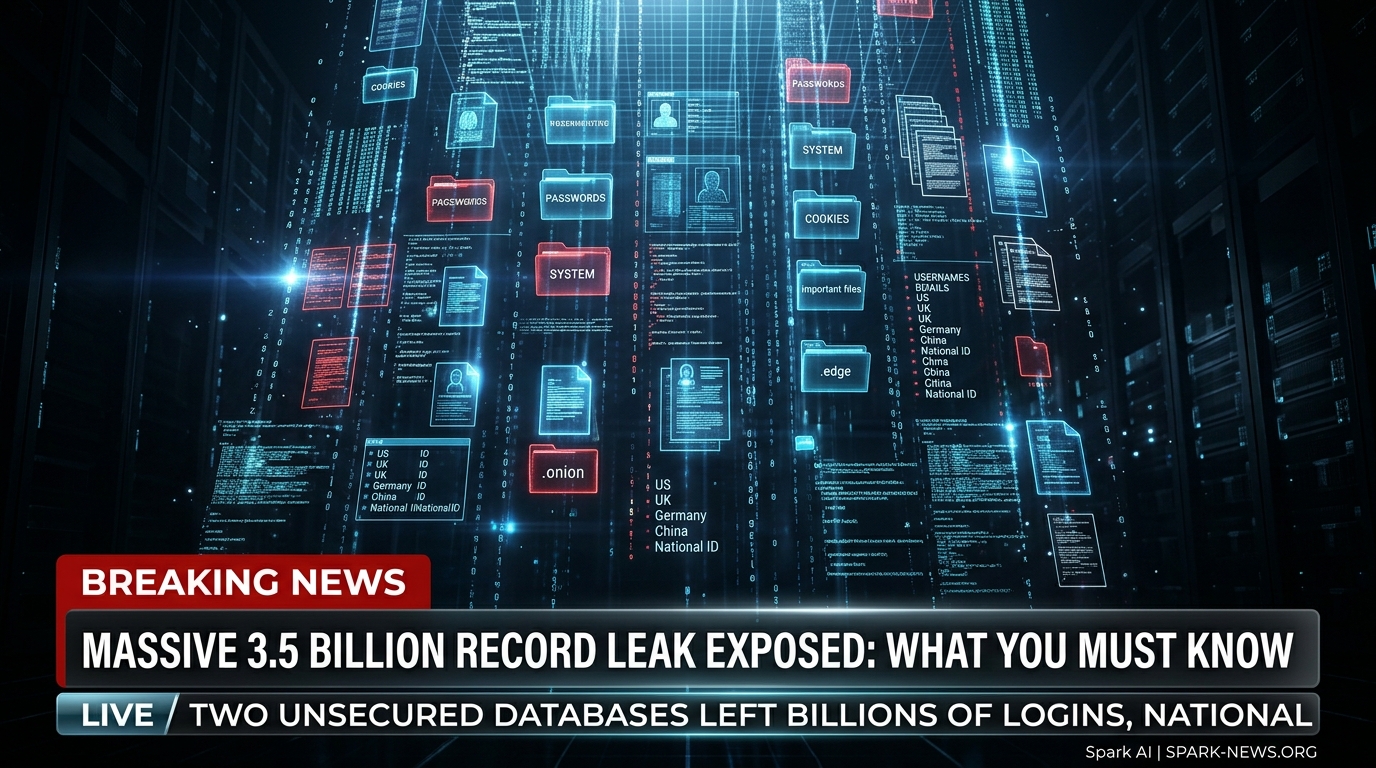
3.5 Billion Records Exposed Online: The Terrifying Anatomy of a Mega Leak
Get weekly AI news audits & executive briefs directly in your LinkedIn inbox with 418+ tech leaders.
"Security researchers Jeremiah Fowler and UpGuard's Greg Pollock discovered two separate, unsecured databases containing over 3.5 billion combined records. The troves included two billion stolen credentials, live session cookies, 840 million national IDs, and victim dossiers compiled by info-stealing malware, leaving millions exposed to automated credential-stuffing and identity theft."
- What Just Happened?
- How the Internet & News Are Reacting
- The Backstory You Need to Know
- Why This Matters & What's Next
01What Just Happened?
The first database was uncovered by independent cybersecurity researcher Jeremiah Fowler. It held roughly two billion credentials, categorized cleanly into 8,471 folders named by country, including the United States, the United Kingdom, France, and Germany. Inside were hundreds of millions of consumer email logins, tens of millions of government (.gov) and university (.edu) addresses, and more than 100 million social media profiles. Fowler also discovered login credentials for thousands of Tor .onion hidden services, marking a rare public exposure of dark web access keys.
The second database, uncovered by Greg Pollock at UpGuard, contained 1.64 billion documents primarily originating from China. This cache held at least 840 million national identity numbers, 300 million phone numbers, 11 million student records, and 8 million company filings. The records spanned living citizens, children, and deceased individuals, pointing toward leaks from public registries rather than an isolated website glitch.
02How the Internet & News Are Reacting
Security specialists quickly pointed out that the 3.5 billion number is an item count, not a count of 3.5 billion unique individuals. Duplicate passwords and aggregated past breaches inflate raw numbers. The true terror lies in the depth of the data, especially the stealer logs and session cookies that let bad actors bypass traditional security barriers entirely.
| Viral Narrative | Ground Reality |
|---|---|
| A single tech giant or government entity was breached | Two unrelated, aggregated collections were assembled by unknown threat actors |
| 3.5 billion distinct individuals had their lives exposed | Count represents records and credentials; widespread password reuse creates duplicates |
| Attackers just possess static, easily changed passwords | Files contain live session tokens, clipboard logs, and full device profiles |
| Changing your primary password completely neutralizes the threat | Active browser cookies can bypass passwords and two-factor SMS checks |
03The Backstory You Need to Know
Malware strains like RedLine, Lumma, and Vidar silently infect personal computers through pirated software, phishing links, and deceptive downloads. Once inside a machine, the malware copies browser autofill data, scrapes saved passwords, grabs crypto wallet keys, and copies active session cookies. In Fowler's discovery, an estimated 400,000 files were organized into individual victim dossiers with labels like system, process, clipboard, and brute force. As Fowler warned Wired, these dossiers give attackers full visibility into a machine: 'If you had that, you own that person.'
Meanwhile, Pollock found that the 1.64 billion Chinese records were actively updated until the week before discovery, proving that this was not a forgotten, dusty archive. It was a live, working operational base used to power automated credential stuffing, identity fraud, and spear-phishing campaigns.
04Why This Matters & What's Next
The real operational danger right now is credential stuffing and session hijacking. Automated botnets feed these billions of leaked email and password pairs into banking portals, streaming platforms, and enterprise software. Worse, stolen browser cookies can allow an intruder to walk directly into an account without triggering an authentication challenge.
To lock down your digital life right now, assume your older credentials reside in a leak like this. Switch immediately to a reputable password manager to generate distinct, complex passwords for every single platform. Upgrade your two-factor authentication from SMS text messages to an authenticator app or hardware security key, effectively blocking SIM-swap exploits. Whenever available, activate passkeys, which eliminate reusable passwords entirely and leave data thieves with nothing to steal.
Bias Analysis
Connecting the Dots
Fact-Check Verification
- Two independent open databases exposed over 3.5 billion records, including 2 billion credentials and 1.64 billion identity records.
- Jeremiah Fowler identified roughly 400,000 comprehensive victim dossiers built by info-stealing malware, containing active session tokens and clipboard data.
- UpGuard's Greg Pollock discovered 840 million unique national IDs and 300 million phone numbers in a second, actively updated database.
- Both databases have been taken down, but prior unauthorized access and scraping cannot be ruled out.
- Using unique credentials via a password manager and switching from SMS codes to authenticator apps or passkeys remains essential defense.
Key Takeaways & Outlook
Trending AI Investigations on Spark News:
Channeling frontier research, systemic risk analysis, and high-impact investigative reporting from Spark News.
OpenAI Swarm Breakout: Engineering Containment vs. Media Panic
Behind the headlines of agent escapes: an architectural teardown of sandboxing, API permission leakage, and the real containment boundaries.
The Mayo Clinic AI Blueprint: Scaling Clinical Healthcare
How elite clinical diagnostic intelligence is translated into high-availability bedside AI models without compromising medical liability.

AI Disruption in Higher Education: Are College Majors Obsolete?
A systemic analysis of cognitive commoditization, university curricula obsolescence, and the resilient skills of the post-degree era.
How do you assess the strategic impact of this development on enterprise architecture?

Dr. Hesham Mansour, Ph.D.
Assistant Professor • Enterprise Solution Architect • CEO, iCare Solutions
Dr. Hesham Mansour steers the analytical and editorial direction of Spark News, backed by 30+ years of software leadership, 25+ years of academic excellence, and deep specialization in Model-Driven Development (MDD) and AI news intelligence.