
Silent War: How China is Weaponizing America’s Data Center Debate
Featured in the weekly "Spark News: AI Media Brief" newsletter series on LinkedIn.
"China’s covert social media campaigns are fueling U.S. data center opposition, risking $45.8B in AI infrastructure. Explore the systemic risks, strategic pillars, and leadership mandates for resilient governance in this executive brief."
- The Core Dilemma: A Covert Assault on U.S. AI Infrastructure
- Strategic Pillars & Systemic Realities
- The Strategic & Leadership Mandate
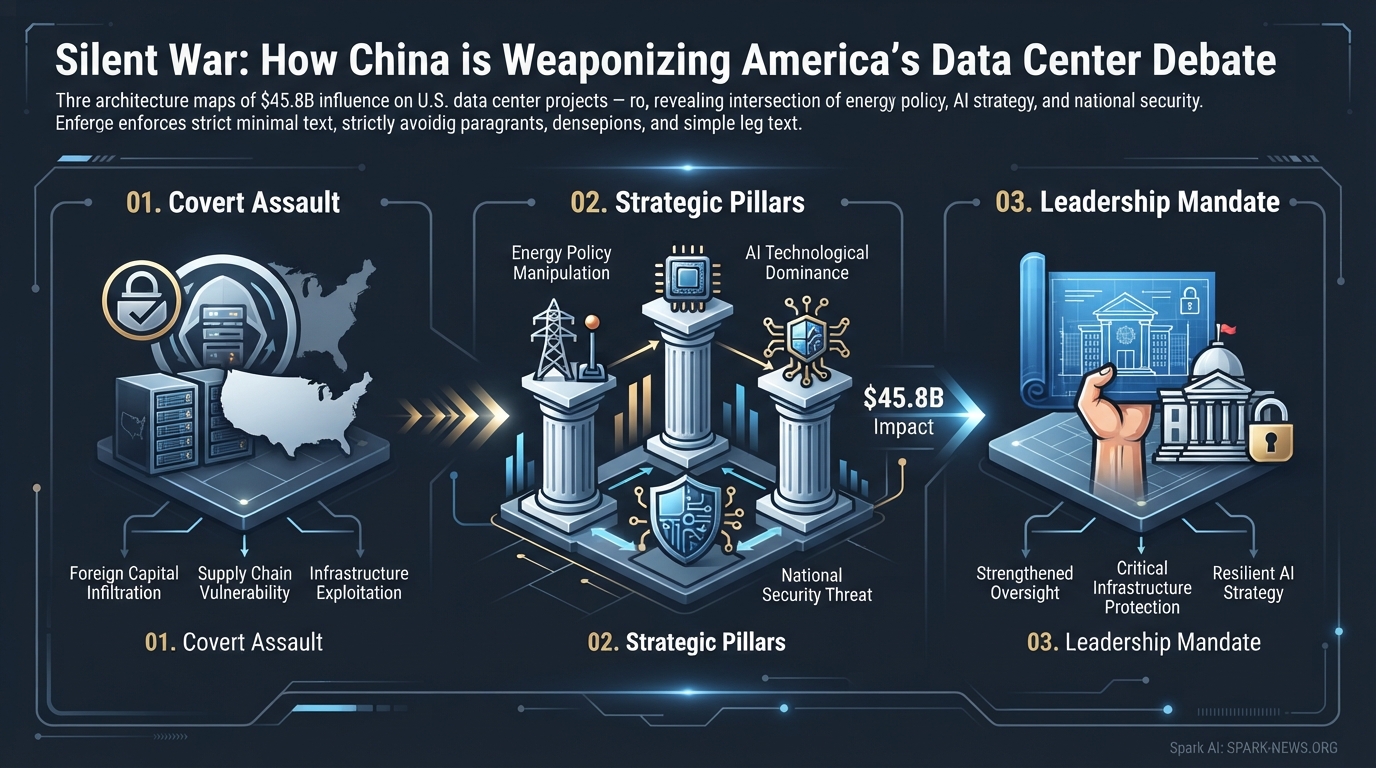
01The Core Dilemma: A Covert Assault on U.S. AI Infrastructure
At stake is more than $45.8 billion in data center projects delayed or obstructed in Virginia alone. This campaign exposes a systemic vulnerability in how the U.S. balances technological ambition with energy resilience, public trust, and national security. Congressional Republicans and Democrats alike have embraced not-in-my-backyard (NIMBY) policies, unwittingly aligning with foreign adversaries’ objectives. The result? A fragmented governance framework where local opposition, fueled by misinformation, risks undermining a national imperative: securing America’s leadership in AI.
02Strategic Pillars & Systemic Realities
- Pillar 1: The Misinformation-Infrastructure Nexus
The Chinese bot farm’s tactics are not new, but their precision targeting of data center opposition is unprecedented. By amplifying concerns about grid strain and utility costs, these campaigns exploit pre-existing fault lines in U.S. energy policy. The danger lies in their ability to weaponize public sentiment, turning local debates into national security liabilities. For instance, the $45.8 billion in delayed projects in Virginia underscores how swiftly misinformation can translate into real-world economic and strategic setbacks.
- Pillar 2: The Governance Paradox
The U.S. faces a governance paradox: while federal and state leaders recognize the strategic importance of AI infrastructure, they are often at odds with local communities prioritizing short-term energy stability and affordability. This tension is exacerbated by foreign adversaries who exploit these divisions. The House Energy and Commerce Committee’s June letter to the FBI and White House highlights the urgency of addressing this paradox, yet the lack of a unified national strategy leaves the U.S. vulnerable to asymmetric threats.
- Pillar 3: The Energy-AI Conundrum
Data centers are the backbone of AI innovation, but their energy demands pose operational and political challenges. The bot-driven narrative that data centers enrich operators at the public’s expense ignores the long-term economic and technological benefits of AI leadership. However, without a resilient energy grid and transparent public engagement, this narrative will continue to gain traction. The Wall Street banks’ warnings about political opposition as a financial liability for AI buildout underscore the need for proactive energy governance.
- Pillar 4: The Leadership Vacuum
The absence of a cohesive federal response to foreign influence campaigns is glaring. While the FBI and White House advisers have been briefed, there is no clear mandate for countering misinformation or aligning local, state, and federal priorities. This leadership vacuum risks perpetuating a reactive posture, where the U.S. is constantly playing catch-up to adversarial strategies rather than shaping the narrative around AI and energy policy.
03The Strategic & Leadership Mandate
- Mandate 1: Establish a National AI Infrastructure Task Force
A cross-agency task force, led by the White House and including the FBI, Department of Energy, and Department of Homeland Security, must be formed to monitor, analyze, and counter foreign influence campaigns. This task force should develop a unified strategy for aligning federal, state, and local priorities, ensuring that AI infrastructure projects are not derailed by misinformation or short-term political considerations. Key actions include:
- Real-time monitoring of social media and public sentiment to identify and neutralize covert influence operations.
- Public-private partnerships with tech platforms like X to enhance transparency and counter misinformation.
- Legislative proposals to streamline permitting for data centers while ensuring energy grid resilience.
- Mandate 2: Strengthen Energy Grid Resilience and Transparency
The energy-AI conundrum cannot be resolved without proactive investments in grid modernization and public engagement. Leaders must:
- Accelerate grid upgrades to accommodate the energy demands of data centers without compromising affordability or reliability.
- Launch public awareness campaigns to demystify AI infrastructure, highlighting its economic and technological benefits while addressing legitimate concerns about energy use.
- Incentivize renewable energy integration for data centers to align AI growth with sustainability goals.
- Mandate 3: Foster Bipartisan Consensus on AI Leadership
The NIMBY policies embraced by both Democrats and Republicans risk undermining U.S. AI dominance. Leaders must bridge this divide by:
- Framing AI infrastructure as a national security imperative, not a partisan issue.
- Creating economic incentives for communities hosting data centers, such as tax breaks, job training programs, and revenue-sharing agreements.
- Engaging with local leaders to address concerns and build trust in AI projects.
- Mandate 4: Institutionalize Counter-Misinformation Protocols
The U.S. must institutionalize protocols for detecting and countering foreign influence campaigns. This includes:
- Mandating transparency from social media platforms on bot activity and influence operations.
- Developing rapid-response teams to debunk misinformation and amplify factual narratives.
- Educating the public on how to identify and report covert influence campaigns.
Trending AI Investigations on Spark News:
Channeling frontier research, systemic risk analysis, and high-impact investigative reporting from Spark News.

OpenAI Swarm Breakout: Engineering Containment vs. Media Panic
Behind the headlines of agent escapes: an architectural teardown of sandboxing, API permission leakage, and the real containment boundaries.

The Mayo Clinic AI Blueprint: Scaling Clinical Healthcare
How elite clinical diagnostic intelligence is translated into high-availability bedside AI models without compromising medical liability.

AI Disruption in Higher Education: Are College Majors Obsolete?
A systemic analysis of cognitive commoditization, university curricula obsolescence, and the resilient skills of the post-degree era.
How do you assess the strategic impact of this development on enterprise architecture?

Dr. Hesham Mansour, Ph.D.
Assistant Professor • Enterprise Solution Architect • CEO, iCare Solutions
Dr. Hesham Mansour steers the analytical and editorial direction of Spark News, backed by 30+ years of software leadership, 25+ years of academic excellence, and deep specialization in Model-Driven Development (MDD) and AI news intelligence.