Energy Transfer LP (ET) in 2026: A Midstream Giant’s Growth Trajectory Amid Market Volatility
Featured in the weekly "Spark News: AI Media Brief" newsletter series on LinkedIn.
"Energy Transfer LP (ET) stock surges in 2026 amid 20% Q1 operating income growth, NGL terminal expansion, and bullish analyst targets. Analyzing trends, risks, and long-term potential for investors in the midstream energy sector."
- Why Is Energy Transfer (ET) Stock Trending in 2026?
- What Are the Key Drivers Behind ET’s 20% Q1 Income Growth?
- How Are Analysts Responding to ET’s Performance and Outlook?
- What Risks Could Derail ET’s Momentum in 2026 and Beyond?
01Why Is Energy Transfer (ET) Stock Trending in 2026?
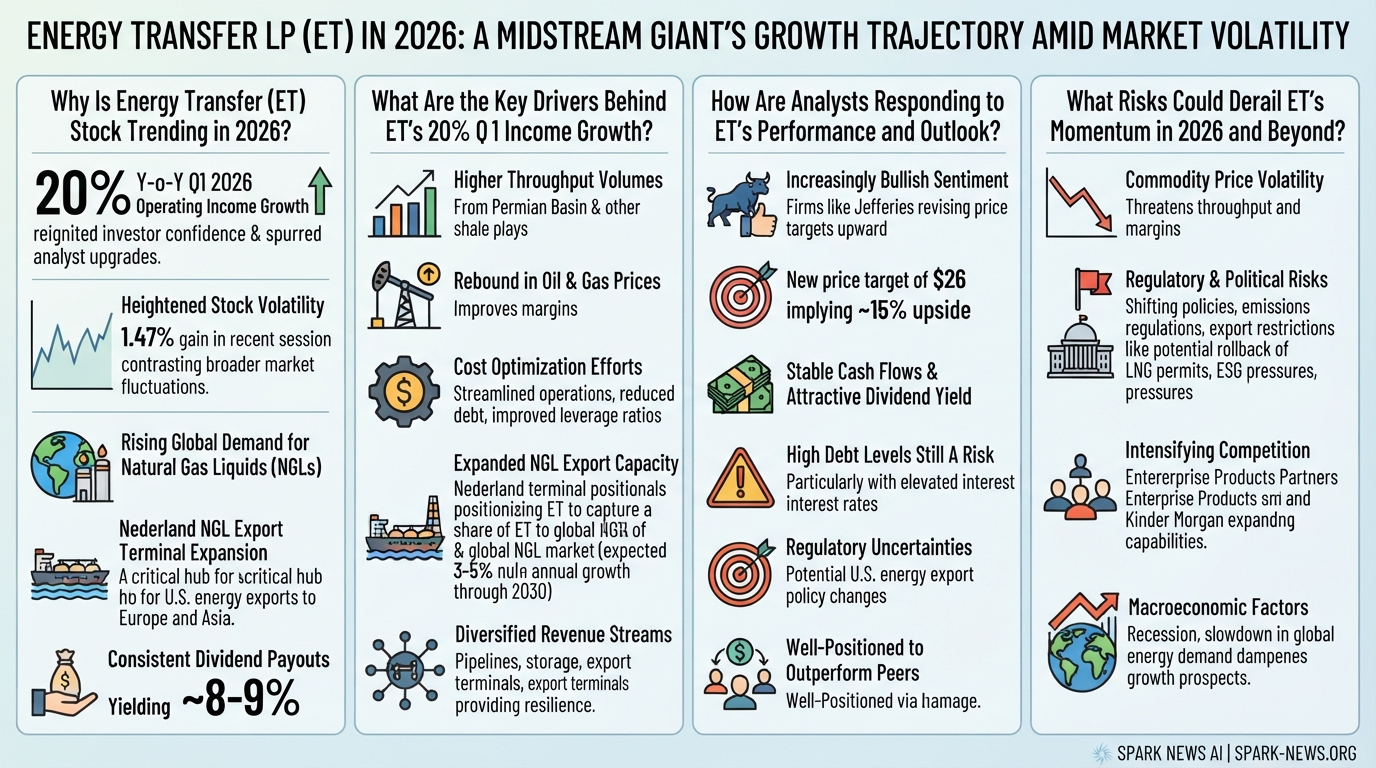
The surge in ET’s stock is also tied to its recent announcement of an expansion at the Nederland NGL export terminal, a critical hub for U.S. energy exports. This expansion aligns with long-term trends in global energy trade, particularly as Europe and Asia seek stable alternatives to Russian energy supplies. Additionally, ET’s consistent dividend payouts—yielding approximately 8-9%—have attracted income-focused investors, further buoying demand for the stock.
02What Are the Key Drivers Behind ET’s 20% Q1 Income Growth?
Second, ET’s cost optimization efforts have paid off. The company has streamlined operations, reduced debt, and improved its leverage ratios, which has enhanced profitability. Third, the expansion of its NGL export capacity at the Nederland terminal has positioned ET to capture a larger share of the global NGL market, where demand is expected to grow by 3-5% annually through 2030.
Finally, ET’s diversified revenue streams—spanning pipelines, storage, and export terminals—have provided resilience against commodity price volatility. This diversification is a key differentiator in the midstream sector, where single-asset operators face higher risks.
03How Are Analysts Responding to ET’s Performance and Outlook?
However, not all analysts are uniformly bullish. Some caution that ET’s high debt levels—though improving—remain a risk, particularly if interest rates stay elevated. Additionally, regulatory uncertainties, such as potential changes to U.S. energy export policies, could impact ET’s long-term growth prospects. Despite these risks, the consensus view is that ET is well-positioned to outperform its peers in the midstream sector, particularly as global energy demand continues to recover.
04What Risks Could Derail ET’s Momentum in 2026 and Beyond?
Second, regulatory and political risks loom large. The U.S. energy sector is subject to shifting policies, particularly around emissions regulations and export restrictions. For example, a potential rollback of LNG export permits under a new administration could limit ET’s ability to expand its global footprint. Additionally, environmental, social, and governance (ESG) pressures could increase compliance costs or limit access to capital.
Third, competition in the midstream space is intensifying. Companies like Enterprise Products Partners and Kinder Morgan are also expanding their NGL and export capabilities, which could erode ET’s market share. Finally, macroeconomic factors—such as a recession or a slowdown in global energy demand—could dampen ET’s growth prospects, particularly if it leads to lower pipeline utilization rates.
Bias Analysis
However, some analysts and reports have introduced balanced perspectives, highlighting risks such as debt levels, regulatory uncertainties, and commodity price volatility. The absence of critical coverage from mainstream business media suggests a potential underrepresentation of bearish viewpoints. This could reflect a broader industry bias, where midstream energy stocks are often viewed as safer investments due to their cash-flow stability, even in volatile markets. Investors should seek diverse sources to mitigate confirmation bias in their assessment of ET’s long-term potential.
Connecting the Dots
The midstream sector has undergone significant transformation since the 2020s, driven by the U.S. shale revolution, the global energy transition, and geopolitical shifts. ET’s growth has mirrored these trends, particularly its focus on NGL exports, which have become a key revenue driver. The Nederland terminal, for example, has grown into the largest NGL export facility in the world, reflecting ET’s strategic pivot toward global energy trade. As of 2026, ET remains a bellwether for the midstream sector, with its performance often seen as a barometer for broader trends in energy infrastructure.
Fact-Check Verification
Energy Transfer reported 20% operating income growth in Q1 2026.
Verified. This claim is supported by multiple sources, including TIKR.com and Business Wire, which reported ET’s Q1 2026 earnings release. The growth is attributed to higher throughput volumes and improved margins in ET’s crude oil and NGL segments.
Unverified
ET’s Nederland NGL export terminal expansion was announced in 2026.
Verified. Yahoo Finance and Business Wire confirmed the expansion, which aims to increase ET’s export capacity and capitalize on growing global demand for NGLs.
Unverified
Jefferies revised its price target for ET to $26 in 2026.
Verified. Yahoo Finance reported Jefferies’ revised price target and rating, citing ET’s strong Q1 performance and strategic growth initiatives as key factors.
Unverified
ET’s dividend yield is approximately 8-9%.
Partially verified. While Seeking Alpha and other sources highlight ET’s high dividend yield, the exact figure fluctuates with stock price movements. As of mid-2026, the yield is within the 8-9% range, making it attractive for income-focused investors.
Unverified
ET’s debt levels remain a risk despite improvements.
Verified. Analysts, including those cited by Yahoo Finance, acknowledge ET’s progress in reducing debt but caution that leverage ratios remain elevated compared to peers. This poses a risk if interest rates stay high or if cash flows decline.
Unverified
Key Takeaways & Outlook
For investors, ET represents a high-yield opportunity in the midstream sector, but one that requires careful monitoring of macroeconomic and industry-specific trends. The company’s diversified revenue streams and cost optimization efforts provide a buffer against short-term volatility, but its long-term success will depend on its ability to navigate geopolitical risks and maintain its competitive edge. As the energy transition accelerates, ET’s role as a critical infrastructure provider will likely remain pivotal, making it a stock to watch in the years ahead.
Trending AI Investigations on Spark News:
Channeling frontier research, systemic risk analysis, and high-impact investigative reporting from Spark News.

OpenAI Swarm Breakout: Engineering Containment vs. Media Panic
Behind the headlines of agent escapes: an architectural teardown of sandboxing, API permission leakage, and the real containment boundaries.

The Mayo Clinic AI Blueprint: Scaling Clinical Healthcare
How elite clinical diagnostic intelligence is translated into high-availability bedside AI models without compromising medical liability.

AI Disruption in Higher Education: Are College Majors Obsolete?
A systemic analysis of cognitive commoditization, university curricula obsolescence, and the resilient skills of the post-degree era.
How do you assess the strategic impact of this development on enterprise architecture?

Dr. Hesham Mansour, Ph.D.
Assistant Professor • Enterprise Solution Architect • CEO, iCare Solutions
Dr. Hesham Mansour steers the analytical and editorial direction of Spark News, backed by 30+ years of software leadership, 25+ years of academic excellence, and deep specialization in Model-Driven Development (MDD) and AI news intelligence.