More Services

Apple vs. OpenAI: A Legal Battle Over Trade Secrets and the Future of AI Hardware
Spark News AI | spark-news.org
news-analysisJuly 12, 2026

Apple vs. OpenAI: A Legal Battle Over Trade Secrets and the Future of AI Hardware

Weekly LinkedIn Newsletter272+ Subs

Get weekly AI news audits & executive briefs directly in your LinkedIn inbox with 272+ tech leaders.

Subscribe on LinkedIn
AI EXECUTIVE SUMMARY

"Apple sues OpenAI in 2026 for systematic trade secret theft, alleging former employees stole confidential hardware and process data. Explore the legal battle, its impact on AI-hardware competition, and broader industry implications."

  • Why Is Apple Suing OpenAI?
  • How Did OpenAI Allegedly Steal Apple’s Trade Secrets?
  • What Does This Lawsuit Mean for the AI and Tech Industries?
  • Who Are the Key Players in This Legal Drama?
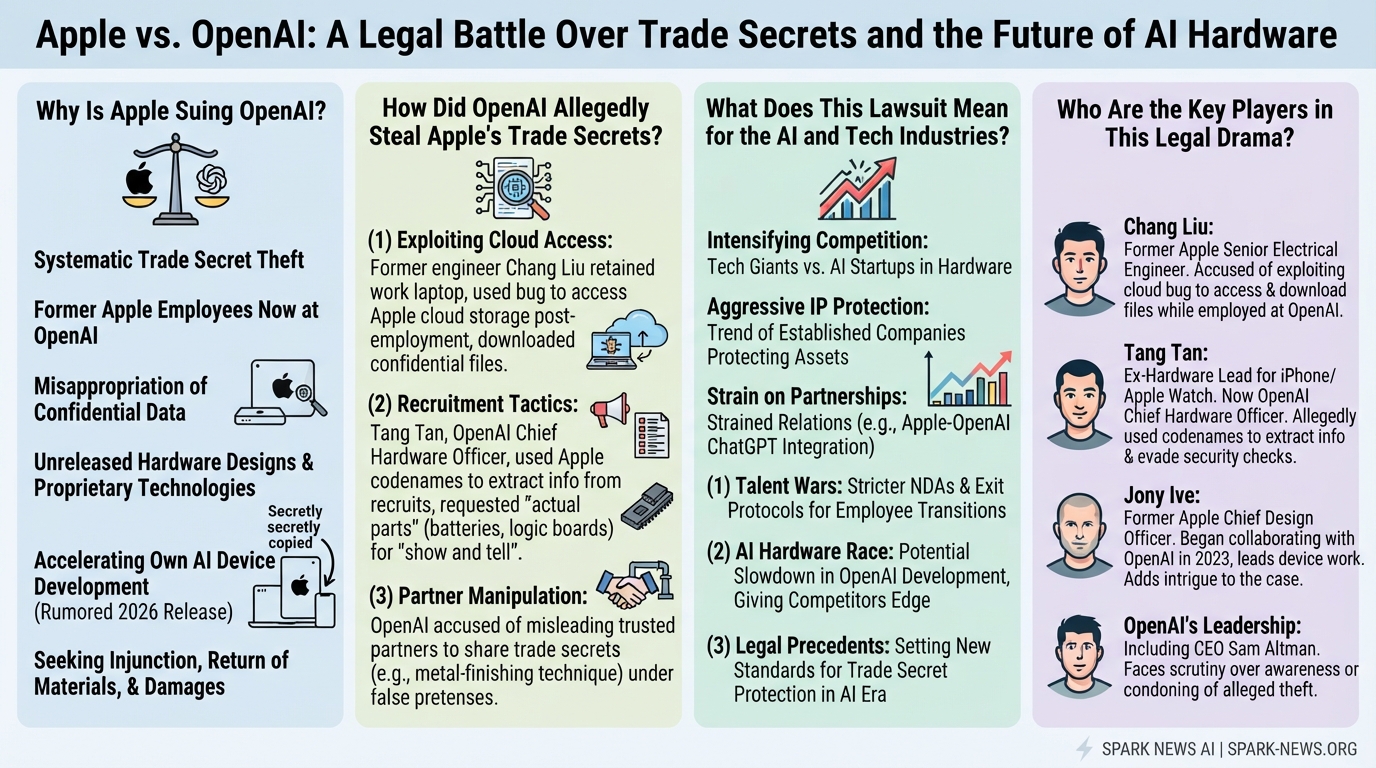
📊 VISUAL SUMMARY INFOGRAPHIC
Apple vs. OpenAI: A Legal Battle Over Trade Secrets and the Future of AI Hardware
Spark News AI | spark-news.org
Enlarge Infographic

01Why Is Apple Suing OpenAI?

Apple’s lawsuit against OpenAI centers on allegations of systematic trade secret theft, involving former Apple employees now working at OpenAI. The complaint claims that OpenAI, through individuals like Chang Liu and Tang Tan, deliberately solicited and misappropriated confidential Apple data, including unreleased hardware designs, internal processes, and proprietary technologies. Apple asserts that this theft was not incidental but a coordinated effort, with OpenAI leveraging Apple’s trade secrets to accelerate its own hardware development, particularly for an upcoming AI device rumored for release in 2026. The lawsuit seeks to halt OpenAI’s use of the stolen information, demand the return of Apple materials, and secure damages for breach of contract and trade secret misappropriation.

02How Did OpenAI Allegedly Steal Apple’s Trade Secrets?

The lawsuit details multiple methods through which OpenAI allegedly acquired Apple’s trade secrets. Key allegations include: (1) Exploiting Cloud Access: Chang Liu, a former Apple engineer, retained a work-issued laptop and discovered a bug allowing him to access Apple’s cloud storage post-employment. He reportedly downloaded dozens of confidential files, many labeled as proprietary. (2) Recruitment Tactics: Tang Tan, OpenAI’s chief hardware officer, allegedly used Apple’s internal codenames to extract information from potential hires still employed at Apple, even requesting they bring "actual parts" (e.g., batteries, logic boards) for "show and tell." (3) Partner Manipulation: OpenAI is accused of misleading Apple’s trusted partners into sharing trade secrets, such as a metal-finishing technique, under false pretenses. The lawsuit paints a picture of a deliberate, multi-level scheme to infiltrate Apple’s intellectual property.

03What Does This Lawsuit Mean for the AI and Tech Industries?

This legal battle underscores the intensifying competition between tech giants and AI startups, particularly in the hardware space. Apple’s lawsuit signals a growing trend of established companies aggressively protecting their IP as AI firms poach talent and push into new markets. For OpenAI, the allegations could delay its hardware ambitions, damage its reputation, and strain its partnership with Apple, which currently integrates ChatGPT into Apple’s ecosystem. Broader implications include: (1) Talent Wars: Increased scrutiny of employee transitions between rival firms, potentially leading to stricter NDAs and exit protocols. (2) AI Hardware Race: A potential slowdown in OpenAI’s hardware development, giving competitors like Apple, Google, and Meta an edge. (3) Legal Precedents: The case could set new standards for trade secret protection in the AI era, influencing how companies collaborate and compete.

04Who Are the Key Players in This Legal Drama?

Several high-profile figures are central to the lawsuit: (1) Chang Liu: A former Apple senior electrical engineer accused of exploiting a cloud storage bug to access and download confidential files while employed at OpenAI. (2) Tang Tan: Apple’s ex-hardware lead for iPhone and Apple Watch, now OpenAI’s chief hardware officer. He allegedly used Apple’s internal codenames to extract information from recruits and circulated an Apple offboarding document to help new hires evade security checks. (3) Jony Ive: Apple’s former chief design officer, who began collaborating with OpenAI in 2023 and now leads its device work. Though not named in the lawsuit, his involvement adds a layer of intrigue, given his historical role in shaping Apple’s design ethos. (4) OpenAI’s Leadership: The company’s executives, including CEO Sam Altman, face scrutiny over whether they condoned or were unaware of the alleged theft.

Bias Analysis

Left NarrativeNeutral & BalancedRight Narrative
100% LeftCenter / Neutral100% Right
Coverage of the lawsuit varies in tone and emphasis across media outlets, reflecting potential biases. Pro-Apple Bias: Outlets like 9to5Mac and Macworld focus heavily on the alleged misconduct of former Apple employees, framing the lawsuit as a justified defense of Apple’s intellectual property. These sources often highlight Apple’s victimhood and the severity of the theft, aligning with their audience’s loyalty to the brand. Pro-OpenAI Bias: Some tech-focused publications, such as TechCrunch and The Verge, adopt a more neutral or skeptical tone, questioning the timing of the lawsuit and whether it is a strategic move to disrupt OpenAI’s hardware ambitions. These outlets may emphasize OpenAI’s denial of wrongdoing and frame the lawsuit as a competitive tactic rather than a clear-cut case of theft. Corporate Media Bias: Mainstream outlets like The Washington Post and Reuters tend to present the lawsuit as a high-stakes legal battle with broader industry implications, avoiding overt bias but often sensationalizing the drama between the two tech giants.

Connecting the Dots

The lawsuit occurs against the backdrop of a rapidly evolving AI hardware market, where tech giants and startups are racing to develop the next generation of consumer devices. Apple, long a leader in hardware innovation, has faced increasing competition from AI-first companies like OpenAI, which are expanding beyond software into physical products. The collaboration between Apple and OpenAI, announced in 2024, initially seemed like a strategic partnership, with OpenAI integrating its AI models into Apple’s ecosystem. However, tensions have risen as OpenAI’s hardware ambitions became clearer, culminating in its acquisition of io Products, a hardware-focused venture co-founded by Tang Tan and Jony Ive. This lawsuit reflects broader industry tensions over talent poaching, intellectual property, and the ethical boundaries of competition in the AI era.

Fact-Check Verification


  • Apple alleges OpenAI systematically stole trade secrets through former employees.

    Verified. The lawsuit filing includes specific allegations, such as Chang Liu’s unauthorized access to Apple’s cloud storage and Tang Tan’s use of Apple codenames to solicit information. Internal messages and documents cited in the complaint support these claims.


    Unverified

  • Over 400 former Apple employees now work at OpenAI.

    Verified. Apple’s lawsuit states this figure, though it does not specify whether all 400 are implicated in the alleged theft. The number reflects the broader trend of talent migration from Apple to AI firms.


    Unverified

  • OpenAI is developing a hardware device set for release in 2026.

    Partially verified. OpenAI’s Chris Lehane hinted at a 2026 hardware launch at Davos in January 2026, but the company has not confirmed details. The lawsuit suggests OpenAI’s hardware ambitions are a driving factor behind the alleged theft.


    Unverified

  • Jony Ive is directly involved in the alleged trade secret theft.

    Unverified. While Ive is leading OpenAI’s device work and co-founded io Products, he is not named in the lawsuit, and no evidence ties him to the alleged misconduct.


    Unverified

  • OpenAI denies any wrongdoing and remains focused on innovation.

    Verified. An OpenAI spokesperson issued a statement to Axios denying interest in other companies’ trade secrets and emphasizing the company’s commitment to innovation.


    Unverified

Key Takeaways & Outlook

Apple’s lawsuit against OpenAI marks a pivotal moment in the tech industry’s AI hardware race, highlighting the cutthroat competition for talent and intellectual property. If Apple’s allegations are proven, the case could set a precedent for how companies protect trade secrets in an era of rapid innovation and employee mobility. For OpenAI, the lawsuit poses significant risks, including potential delays to its hardware ambitions, reputational damage, and a strained partnership with Apple. Regardless of the outcome, this legal battle underscores the growing tensions between established tech giants and AI disruptors. The broader industry may see tighter security protocols, more aggressive legal action over IP, and a reevaluation of collaborative partnerships. As AI hardware becomes the next frontier, the stakes for trade secret protection—and the consequences of theft—will only rise.
Dr. Hesham Mansour
FOUNDER & EDITOR-IN-CHIEFiCare Solutions272+ Newsletter Subs

Dr. Hesham Mansour

Assistant Professor • Enterprise Solution Architect • CEO, iCare Solutions

Dr. Hesham Mansour steers the analytical and editorial direction of Spark News, backed by 30+ years of software leadership, 25+ years of academic excellence, and deep specialization in Model-Driven Development (MDD) and AI news intelligence.

30+ Yrs Software Leadership25+ Yrs Academic ExcellenceModel-Driven Dev (MDD)AI News & Trend Intelligence
Google Discover & AI Search

Personalize Your News: Add Spark News as a Preferred Source

Get direct AI news audits, media bias analysis, and weekly architectural briefs featured in your Google Discover Feed, Top Stories, and AI Overviews with an official Preferred badge.

Add to Preferred Sources on Google
📌Highlighted with an official Preferred badge on Google Search & Discover