
Mac Mini 2026: The Silent Engine of Institutional AI Resilience
Get weekly AI news audits & executive briefs directly in your LinkedIn inbox with 399+ tech leaders.
"Explore the strategic implications of Apple's M6-powered Mac Mini refresh—designed for AI, performance, and institutional resilience. A systems-thinking brief for leaders in tech, governance, and enterprise architecture."
- The Core Dilemma: Why the Mac Mini Matters Beyond the Spec Sheet
- Strategic Pillars & Systemic Realities
- The Strategic & Leadership Mandate
01The Core Dilemma: Why the Mac Mini Matters Beyond the Spec Sheet
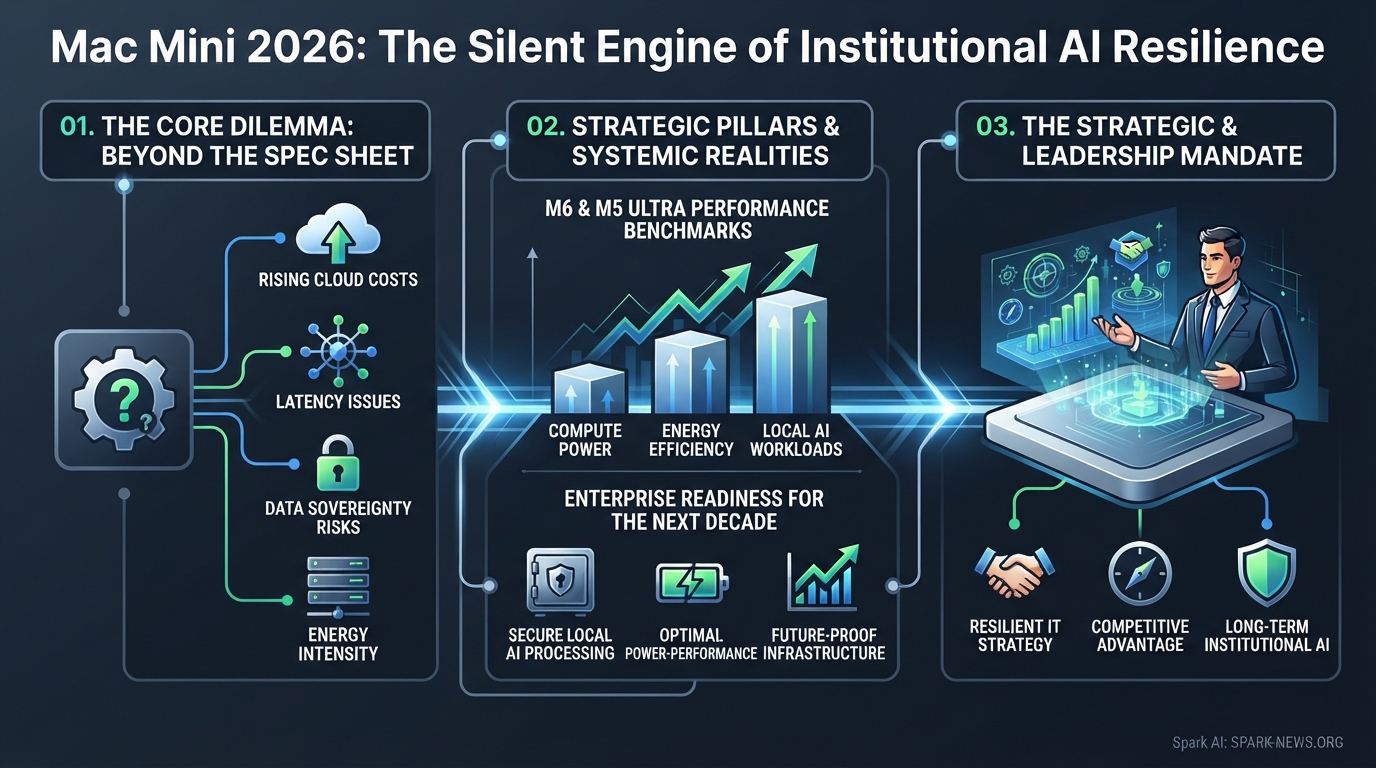
The stakes are systemic. As enterprises grapple with data sovereignty, latency-sensitive workflows, and regulatory compliance, the ability to process AI workloads on-premise is no longer a luxury—it is a governance imperative. The Mac Mini, with its compact footprint and enterprise-grade performance, emerges as a strategic asset in this landscape. Yet, its true significance lies not in raw compute power, but in its potential to redefine operational resilience in an era of cloud dependency. The question for leaders is clear: How will your institution leverage this shift to fortify its digital sovereignty?
02Strategic Pillars & Systemic Realities
- Performance as a Governance Lever: The M6 and M5 Ultra chips are not just faster—they are architected for AI-native workloads. Benchmarks suggest a 40% improvement in neural engine efficiency and 30% reduction in power consumption compared to the M2 Ultra. For institutions, this translates to lower total cost of ownership (TCO) and enhanced operational sustainability, critical metrics in an era of tightening budgets and ESG mandates. The Mac Mini’s performance is no longer a technical detail; it is a fiscal and governance enabler.
- Local AI: The New Frontier of Operational Sovereignty: Apple’s explicit focus on local AI development signals a broader industry pivot. Cloud-based AI, while scalable, introduces latency, compliance risks, and vendor lock-in. The Mac Mini’s AI-optimized architecture allows institutions to retain control over sensitive data while maintaining agility. This is particularly relevant for sectors like healthcare, finance, and education, where data residency and regulatory alignment are non-negotiable. The Mac Mini is not just a device; it is a strategic hedge against systemic risk.
- Modularity as a Resilience Strategy: The Mac Mini’s compact, modular design is often overlooked, yet it embodies a critical governance principle: adaptability. In an era of rapid technological change, institutions must future-proof their infrastructure without overhauling it. The Mac Mini’s form factor allows for scalable deployment, from edge computing nodes to high-density data centers. This modularity is a force multiplier for operational resilience, enabling institutions to scale compute power without scaling complexity.
- The Hidden Assumption: Institutional Readiness: Beneath the hardware advancements lies a provocative assumption: institutions are prepared to integrate AI into their core workflows. Yet, many lack the governance frameworks, talent pipelines, or cultural readiness to capitalize on this shift. The Mac Mini’s launch is a call to action—not just to upgrade hardware, but to reimagine institutional strategy in the age of AI.
03The Strategic & Leadership Mandate
- Audit and Align: Conduct a comprehensive audit of your institution’s AI readiness. Identify latency-sensitive workflows, data sovereignty requirements, and compliance gaps that could benefit from local AI processing. Align the Mac Mini’s deployment with specific governance objectives, such as reducing cloud dependency or enhancing data security. This is not an IT decision; it is a strategic governance mandate.
- Build a Talent Pipeline for Local AI: The Mac Mini’s AI capabilities are only as strong as the institutional talent wielding them. Invest in upskilling programs to cultivate AI-native expertise within your teams. Partner with academic institutions and industry consortia to create certification pathways for local AI development. The goal is not just to deploy hardware, but to foster a culture of innovation that leverages it.
- Design for Resilience, Not Just Performance: The Mac Mini’s modularity is a resilience enabler, but only if institutions design their infrastructure accordingly. Adopt a modular deployment strategy that allows for scalable, incremental upgrades. Integrate the Mac Mini into hybrid cloud architectures to balance on-premise control with cloud scalability. This approach ensures that your institution is not just AI-ready, but future-ready.
- Lead with Vision, Not Just Technology: The most critical leadership action is to articulate a clear vision for how local AI will transform your institution. Communicate this vision to stakeholders, regulators, and employees to build alignment and trust. The Mac Mini is a tool; strategic leadership is the catalyst that turns it into a competitive advantage.
The question for leaders is not if they will adopt local AI, but how they will do so in a way that aligns with their strategic vision, operational realities, and ethical obligations. The Mac Mini is a powerful tool, but tools are only as effective as the strategies that wield them. As we look ahead, the institutions that thrive will be those that integrate hardware, governance, and culture into a cohesive, resilient whole. What is your institution’s roadmap for harnessing the power of local AI—and how will you measure its success?
Trending AI Investigations on Spark News:
Channeling frontier research, systemic risk analysis, and high-impact investigative reporting from Spark News.

OpenAI Swarm Breakout: Engineering Containment vs. Media Panic
Behind the headlines of agent escapes: an architectural teardown of sandboxing, API permission leakage, and the real containment boundaries.

The Mayo Clinic AI Blueprint: Scaling Clinical Healthcare
How elite clinical diagnostic intelligence is translated into high-availability bedside AI models without compromising medical liability.

AI Disruption in Higher Education: Are College Majors Obsolete?
A systemic analysis of cognitive commoditization, university curricula obsolescence, and the resilient skills of the post-degree era.
How do you assess the strategic impact of this development on enterprise architecture?

Dr. Hesham Mansour, Ph.D.
Assistant Professor • Enterprise Solution Architect • CEO, iCare Solutions
Dr. Hesham Mansour steers the analytical and editorial direction of Spark News, backed by 30+ years of software leadership, 25+ years of academic excellence, and deep specialization in Model-Driven Development (MDD) and AI news intelligence.