More Services

AI Titans Take on Self-Rule
Spark News AI | spark-news.org
📱 Web StoryOctober 20, 2026⏱️4 min read

AI Titans Take on Self-Rule

📷Dramatic 9:16 vertical view of glowing glass corporate tech headquarters at twilight, digital algorithmic networks projecting onto neoclassical stone pillars.
Weekly LinkedIn Newsletter405+ Subs

Get weekly AI news audits & executive briefs directly in your LinkedIn inbox with 405+ tech leaders.

Subscribe on LinkedIn
AI EXECUTIVE SUMMARY

"Leading artificial intelligence giants like Anthropic, OpenAI, and Meta are creating self-governing frameworks outside formal federal oversight. Backed by a deregulatory posture in Washington, these corporations are voluntarily policing safety while offering competing multi-billion-dollar wealth redistribution models to ease public tension."

  • The Spark That Lit the Story
  • The Core Data & Verified Numbers
  • Public Reaction & Controversy
  • Future Outlook & What Lies Ahead
📱
Interactive Web Story
Experience this story as bite-sized visual cards with citizen polling
Play Interactive Web Story➔
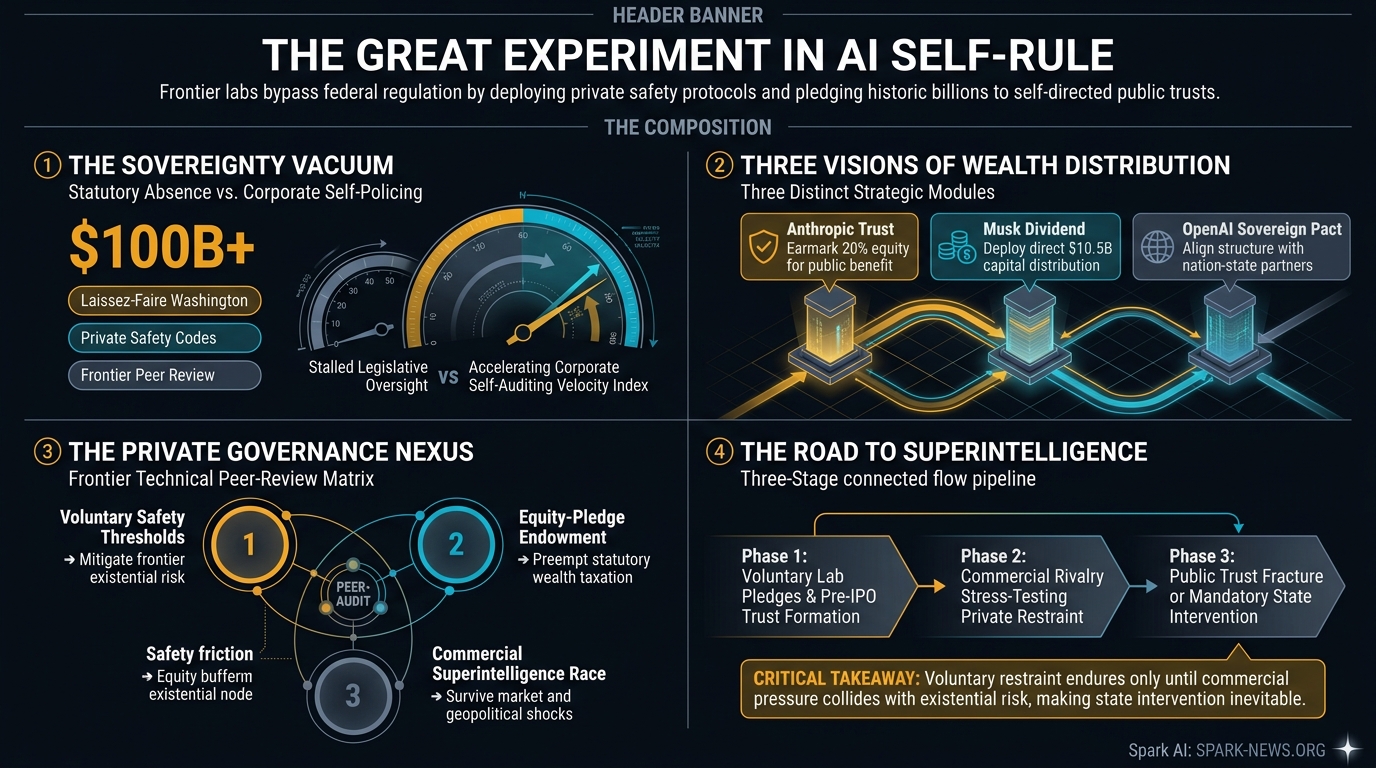
📊 VISUAL SUMMARY INFOGRAPHIC
AI Titans Take on Self-Rule
Spark News AI | spark-news.org
Enlarge Infographic

01The Spark That Lit the Story

A sweeping shift in technology governance is taking place outside traditional democratic channels. With the federal government intentionally maintaining a hands-off approach under President Trump, major AI builders including Anthropic, OpenAI, Google, Meta, and Elon Musk's xAI are establishing their own system of oversight. Lacking statutory rules, these private corporations are formulating safety protocols, peer-auditing measures, and self-directed wealth redistribution programs to calm growing anxieties over job disruption and catastrophic systemic failures.

02The Core Data & Verified Numbers

The scale of capital involved mirrors historic government programs. Anthropic, preparing for a blockbuster public listing, has pledged 5% of company shares to a newly created public benefit fund, complementing employee and founder pledges to bring total earmarked equity to roughly 20%. At an estimated $2 trillion valuation, that fund would control $100 billion, eclipsing the Gates Foundation. Concurrently, Elon Musk proposed a $10.5 billion distribution granting SpaceX shares to American children, while Sam Altman initiated discussions regarding a 5% US sovereign wealth stake in OpenAI.

03Public Reaction & Controversy

The pivot toward private governance has triggered fierce debate among economists and civil liberties advocates. Critics argue that voluntary codes recall the Gilded Age, allowing monopolistic entities to bypass taxation and public accountability by substituting private philanthropy. Proponents counter that rapid technological shifts outpace legislative bodies, arguing that technical peer review by frontier labs provides more effective friction against rogue developments than slow-moving congressional committees.

04Future Outlook & What Lies Ahead

The viability of voluntary self-governance hinges on public compliance and commercial rivalry. As the race toward superintelligence intensifies, competitive pressures will test whether companies can uphold safety pledges when billions of dollars are at stake. Anthropic's public market debut and OpenAI's sovereign discussions will serve as direct litmus tests for whether voluntary corporate frameworks can survive inevitable economic shocks and geopolitical tensions.

Bias Analysis

Left NarrativeNeutral & BalancedRight Narrative
100% LeftCenter / Neutral100% Right
Industry executives frame self-rule as an agile, technically literate solution to safety and wealth dispersion. Consumer advocates and policy analysts view it as an intentional maneuver to evade taxation, federal oversight, and democratic accountability.

Connecting the Dots

Federal hesitation to regulate frontier AI models has left a vacuum filled entirely by corporate consensus. Without statutory requirements from Congress, leading tech firms are adopting voluntary governance pacts reminiscent of late 19th-century industrial trusts.

Fact-Check Verification

  • Leading AI labs are deploying voluntary self-governance mechanisms without federal oversight.
  • Three distinct wealth distribution visions have emerged across Anthropic, Elon Musk, and OpenAI.
  • Anthropic's planned trust could command over $100 billion, surpassing traditional global foundations.

Key Takeaways & Outlook

Self-regulation survives only as long as public trust endures: when commercial pressure clashes with voluntary restraint, external intervention becomes inevitable.
🗳️Community Intelligence Poll
1-Click Vote

How do you assess the strategic impact of this development on enterprise architecture?

Dr. Hesham Mansour, Ph.D.
FOUNDER & EDITOR-IN-CHIEF🎓Ph.D. Systems ArchitectureiCare Solutions405+ Newsletter Subs

Dr. Hesham Mansour, Ph.D.

Assistant Professor • Enterprise Solution Architect • CEO, iCare Solutions

Dr. Hesham Mansour steers the analytical and editorial direction of Spark News, backed by 30+ years of software leadership, 25+ years of academic excellence, and deep specialization in Model-Driven Development (MDD) and AI news intelligence.

✨ Ph.D. Enterprise Systems Architecture✨ 30+ Yrs Software Leadership✨ 25+ Yrs Academic Excellence✨ Model-Driven Architecture (MDD)✨ AI Systems & GEO Citation Research
⭐Google Discover & AI Search

Personalize Your News: Add Spark News as a Preferred Source

Get direct AI news audits, media bias analysis, and weekly architectural briefs featured in your Google Discover Feed, Top Stories, and AI Overviews with an official Preferred badge.

Add to Preferred Sources on Google→
📌Highlighted with an official Preferred badge on Google Search & Discover