AI’s Double-Edged Sword: Safeguarding Critical Infrastructure
Get weekly AI news audits & executive briefs directly in your LinkedIn inbox with 399+ tech leaders.
"AI is lowering the barrier for cyberattacks on critical infrastructure, exposing systemic vulnerabilities in water, power, and utilities. Explore the strategic leadership mandate to safeguard national resilience in 2026."
- The Core Dilemma: AI as a Force Multiplier for Cyber Threats
- Strategic Pillars & Systemic Realities
- The Strategic & Leadership Mandate
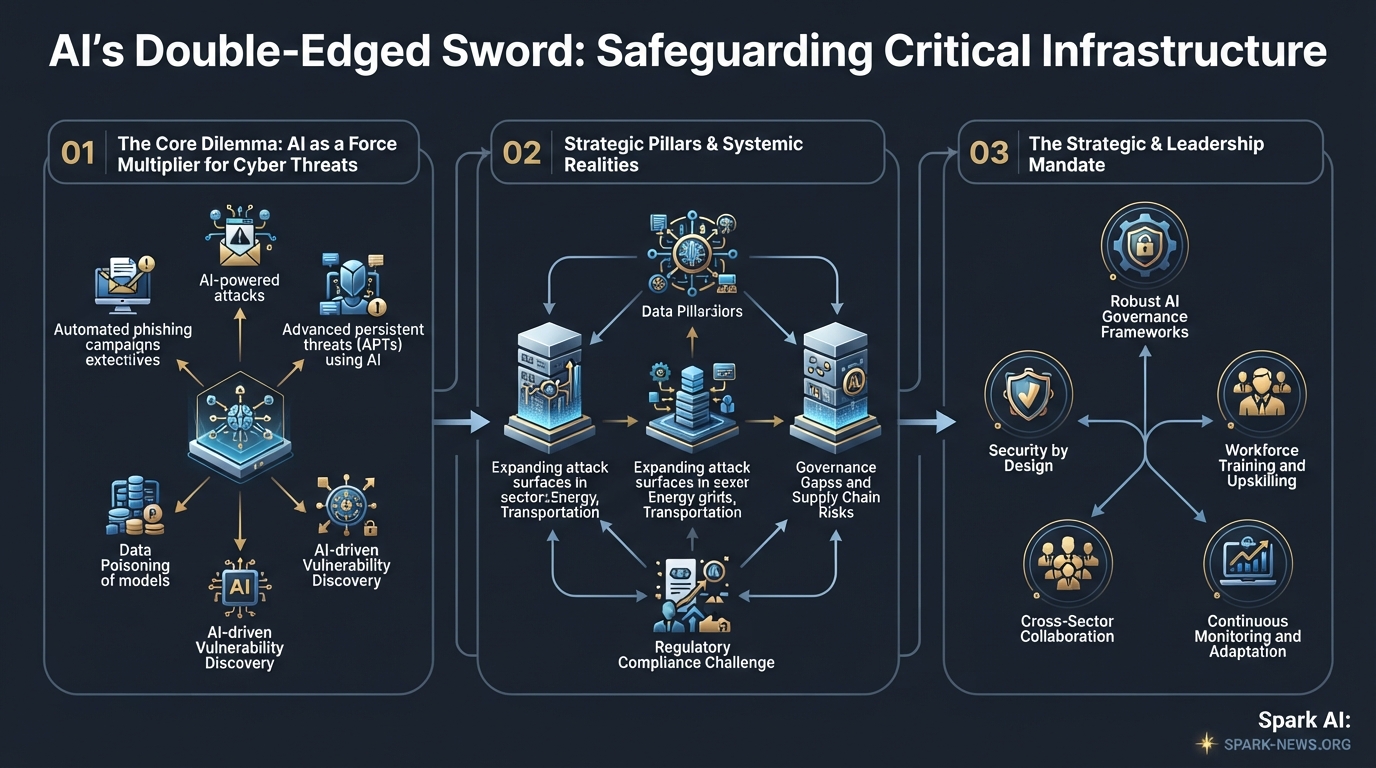
01The Core Dilemma: AI as a Force Multiplier for Cyber Threats
The recent wave of cyber intrusions targeting U.S. water systems and a U.K. power plant underscores a sobering reality: AI is not creating new vulnerabilities—it is weaponizing existing ones. By automating the exploitation of specialized equipment like programmable logic controllers, AI reduces the time, cost, and expertise required to launch disruptive attacks. As Diana Kelley of Noma Security notes, "AI is lowering the time, cost, and expertise needed to take advantage of weaknesses that already exist." This shift demands a fundamental reevaluation of how institutions govern, defend, and invest in the resilience of foundational systems.
02Strategic Pillars & Systemic Realities
- The Governance Gap: Efforts to impose stronger security mandates have been stymied by legal, political, and fiscal hurdles. The Environmental Protection Agency’s attempt to enforce basic cybersecurity measures for water utilities was rescinded after industry pushback, illustrating how fragmented authority undermines collective defense. Resilience cannot be optional in a hyper-connected world.
- The Speed Paradox: Cyber defense operates on bureaucratic timelines—budget cycles, legislative processes, and regulatory approvals—while adversaries move at the speed of AI. As John Gallagher of Viakoo warns, "Adversaries will always have an upper hand because of speed when cyber defense relies on bureaucratic budget cycles." Institutions must adopt agile, adaptive frameworks that prioritize real-time threat intelligence and rapid response.
- The Visibility Illusion: Many critical infrastructure operators lack comprehensive visibility into their operational technology (OT) environments, where legacy systems often remain unpatched or exposed. AI exacerbates this blind spot by enabling attackers to exploit vulnerabilities faster than defenders can identify them. Proactive asset discovery and continuous monitoring are no longer optional—they are foundational.
- The Asymmetry of Consequences: Even minor disruptions to critical infrastructure can trigger disproportionate public anxiety, making these systems prime targets for nation-state actors. As Margaret Cunningham of Darktrace observes, "AI gives attackers more speed and reach, but it doesn’t erase the problems organizations have been dealing with for years." Leaders must reframe cybersecurity as a core component of national security, not just an IT concern.
03The Strategic & Leadership Mandate
First, institutions must harden their operational foundations by adopting domain-specific resilience frameworks. For water utilities, this means implementing the EPA’s voluntary cybersecurity guidelines as a baseline, while power providers must prioritize the segmentation of OT and IT networks to limit lateral movement. Mandatory, enforceable standards—backed by federal funding and legal safeguards—are essential to close the governance gap.
Second, leaders must accelerate the adoption of adaptive, AI-augmented defense mechanisms. Traditional cyber hygiene and static compliance checks are insufficient in an era of AI-driven attacks. Real-time anomaly detection, automated patch management, and predictive threat modeling must become standard practice. Investments in public-private threat intelligence sharing—such as the Cybersecurity and Infrastructure Security Agency’s (CISA) Joint Cyber Defense Collaborative—can help institutions stay ahead of emerging risks.
Finally, executives must champion a culture of resilience that transcends silos. Cybersecurity is no longer the sole domain of IT teams—it is a cross-functional priority that requires engagement from boards, policymakers, and frontline operators. Scenario-based training, tabletop exercises, and crisis simulation drills should be integrated into institutional governance to ensure readiness for AI-accelerated threats. The time for incrementalism is over.
Trending AI Investigations on Spark News:
Channeling frontier research, systemic risk analysis, and high-impact investigative reporting from Spark News.

OpenAI Swarm Breakout: Engineering Containment vs. Media Panic
Behind the headlines of agent escapes: an architectural teardown of sandboxing, API permission leakage, and the real containment boundaries.

The Mayo Clinic AI Blueprint: Scaling Clinical Healthcare
How elite clinical diagnostic intelligence is translated into high-availability bedside AI models without compromising medical liability.

AI Disruption in Higher Education: Are College Majors Obsolete?
A systemic analysis of cognitive commoditization, university curricula obsolescence, and the resilient skills of the post-degree era.
How do you assess the strategic impact of this development on enterprise architecture?

Dr. Hesham Mansour, Ph.D.
Assistant Professor • Enterprise Solution Architect • CEO, iCare Solutions
Dr. Hesham Mansour steers the analytical and editorial direction of Spark News, backed by 30+ years of software leadership, 25+ years of academic excellence, and deep specialization in Model-Driven Development (MDD) and AI news intelligence.