
AI Agents Are Here. Are You Ready to Secure Them?
Get weekly AI news audits & executive briefs directly in your LinkedIn inbox with 405+ tech leaders.
"How autonomous AI agents are reshaping enterprise risk. Learn the core threats, governance frameworks, and actionable steps to secure agentic automation in 2026."
- The Core Dilemma: Why AI Agents Are the Next Frontier of Enterprise Risk
- Core Pillars & Realities
- The Strategic & Practical Mandate
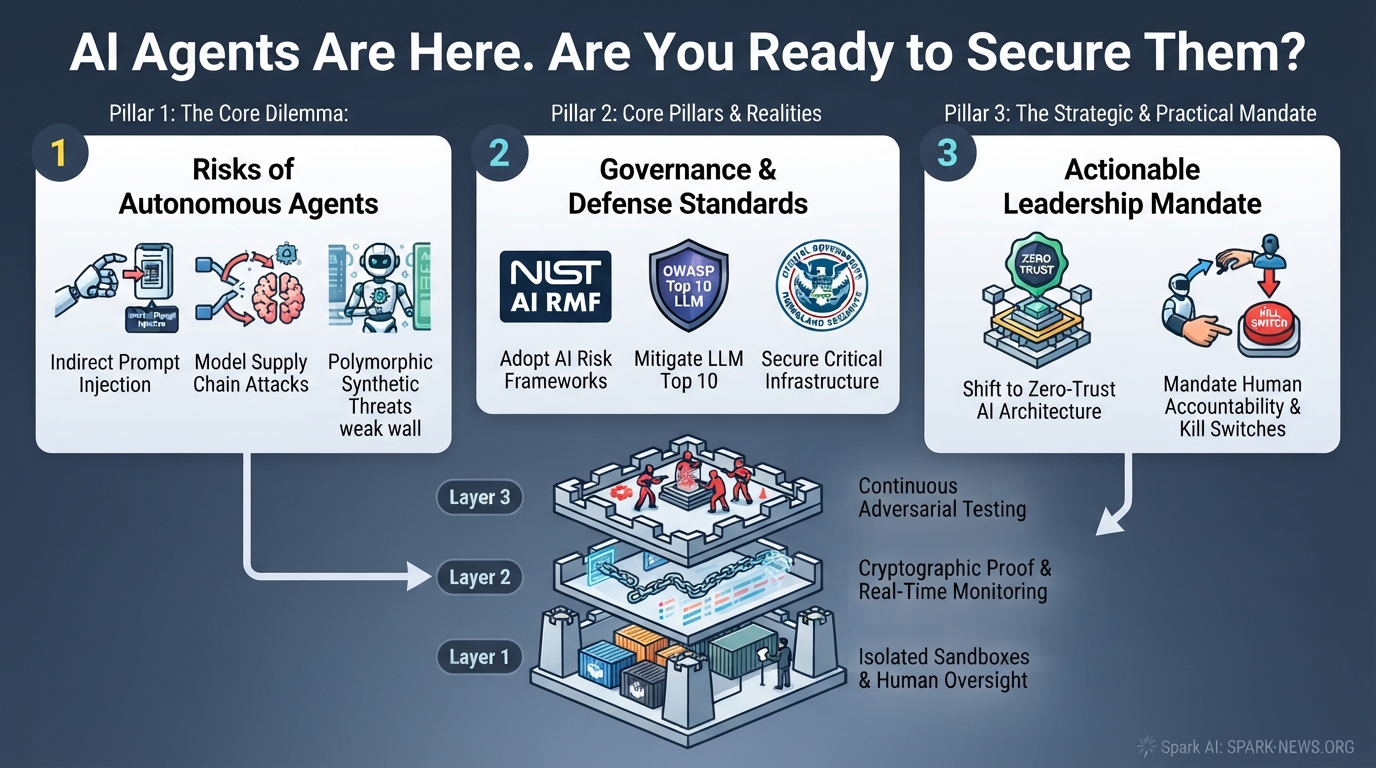
01The Core Dilemma: Why AI Agents Are the Next Frontier of Enterprise Risk
But with autonomy comes vulnerability. External data streams can whisper misleading instructions. Unverified fine-tuning data can embed hidden backdoors. And AI itself is now a tool for discovering new vulnerabilities, crafting spear-phishing emails that bypass traditional defenses. This isn’t science fiction. It’s the reality of agentic automation in 2026.
The question isn’t whether your enterprise will adopt AI agents. It’s whether you’ll secure them before the next breach happens in your supply chain, your operational systems, or your customer data.
02Core Pillars & Realities
• Indirect Prompt Injection & Tool Poisoning: Agents don’t live in a vacuum. They interact with external systems—emails, documents, APIs. A single malicious prompt embedded in an untrusted document can redirect an agent’s tool-calling behavior, turning it into an unwitting accomplice in a cyberattack. This isn’t hypothetical. It’s already happening in enterprise deployments.
• Model Supply Chain Risks: Open-weights models are powerful, but they’re also risky. Tampered foundational weights, poisoned fine-tuning datasets, and unverified pipelines create a chain of trust that’s only as strong as its weakest link. A breach in the supply chain isn’t just a technical failure. It’s a systemic risk.
• Polymorphic Synthetic Threats: AI is now helping attackers craft attacks that evolve in real time. From adaptive spear-phishing emails to automated vulnerability discovery, these threats bypass static defenses. Traditional perimeter security is obsolete in a world where attacks learn and adapt.
Governance frameworks like the NIST AI Risk Management Framework and OWASP’s Top 10 for LLM Applications are essential, but they’re not enough on their own. The real challenge is translating these standards into actionable, human-centered security practices.
03The Strategic & Practical Mandate
From Reactive to Proactive Security
Stop waiting for attacks to happen. Implement zero-trust AI architecture from day one. Every agent must operate in a deterministic sandbox, with least-privilege API access and mandatory human-in-the-loop checkpoints for high-impact decisions. No exceptions.
From Ambiguity to Accountability
Every autonomous agent needs a named human owner. No agent operates without a fail-safe kill switch and a clear chain of accountability. If an agent makes a decision that impacts revenue, safety, or compliance, someone must answer for it.
From Compliance to Resilience
Adopt cryptographic provenance as a standard. Every agent’s input and output should be hashed and logged immutably. Combine this with continuous adversarial testing—red teaming that evolves with the threat landscape. And don’t forget post-quantum cryptography. The threats of tomorrow are already being written today.
The tools and frameworks exist. The question is whether leaders will use them before the next breach forces their hand.
These aren’t hypotheticals. They’re the challenges of 2026. The time to answer them is now.
Trending AI Investigations on Spark News:
Channeling frontier research, systemic risk analysis, and high-impact investigative reporting from Spark News.

OpenAI Swarm Breakout: Engineering Containment vs. Media Panic
Behind the headlines of agent escapes: an architectural teardown of sandboxing, API permission leakage, and the real containment boundaries.
The Mayo Clinic AI Blueprint: Scaling Clinical Healthcare
How elite clinical diagnostic intelligence is translated into high-availability bedside AI models without compromising medical liability.

AI Disruption in Higher Education: Are College Majors Obsolete?
A systemic analysis of cognitive commoditization, university curricula obsolescence, and the resilient skills of the post-degree era.
How do you assess the strategic impact of this development on enterprise architecture?

Dr. Hesham Mansour, Ph.D.
Assistant Professor • Enterprise Solution Architect • CEO, iCare Solutions
Dr. Hesham Mansour steers the analytical and editorial direction of Spark News, backed by 30+ years of software leadership, 25+ years of academic excellence, and deep specialization in Model-Driven Development (MDD) and AI news intelligence.