Trump’s Birthright Plan B: A New Front in the Immigration Wars
Get weekly AI news audits & executive briefs directly in your LinkedIn inbox with 383+ tech leaders.
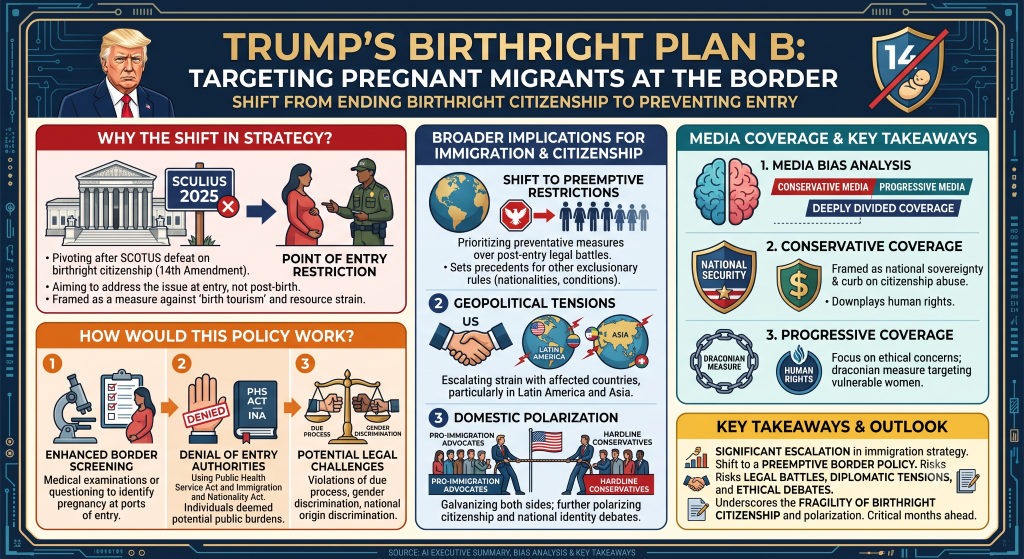
"In 2026, Trump's administration shifts focus to blocking pregnant migrants at the border after a Supreme Court loss on birthright citizenship. This report explores the legal, ethical, and geopolitical implications of this controversial immigration strategy."
- Why Is the Trump Administration Targeting Pregnant Migrants at the Border?
- How Would This Policy Work—and Is It Legal?
- What Are the Broader Implications for Immigration and Citizenship?
- How Is the Media Covering This Development—and What’s Missing?
01Why Is the Trump Administration Targeting Pregnant Migrants at the Border?
02How Would This Policy Work—and Is It Legal?
03What Are the Broader Implications for Immigration and Citizenship?
04How Is the Media Covering This Development—and What’s Missing?
Bias Analysis
Connecting the Dots
Fact-Check Verification
The Trump administration’s Plan B aims to end birthright citizenship by blocking pregnant migrants at the border.
Partially true. The policy does not directly end birthright citizenship but seeks to prevent pregnant foreign women from entering the U.S., thereby reducing the number of children born to undocumented parents on American soil. The Supreme Court’s 2025 ruling upheld birthright citizenship, making a direct challenge unlikely to succeed.
Unverified
Birth tourism is a widespread issue that justifies restrictive border policies.
Debatable. While birth tourism exists, its scale is disputed. The Center for Immigration Studies estimated in 2023 that tens of thousands of women travel to the U.S. annually for birth tourism, but other studies suggest the numbers are significantly lower. The lack of comprehensive data makes it difficult to assess the true extent of the phenomenon.
Unverified
The policy could violate due process and discriminate based on gender and national origin.
Likely true. Legal experts argue that targeting pregnant women for exclusion could constitute gender discrimination, while the policy’s implementation may disproportionately affect women from certain countries, raising concerns under the Equal Protection Clause. The administration would need to demonstrate a compelling government interest to justify such distinctions.
Unverified
Existing laws, such as the Public Health Service Act, provide legal authority for this policy.
True. The Public Health Service Act and the Immigration and Nationality Act grant broad powers to exclude individuals based on health or economic grounds. However, the application of these laws to pregnant women specifically would likely face legal challenges on constitutional grounds.
Unverified
Key Takeaways & Outlook
How do you assess the strategic impact of this development on enterprise architecture?

Dr. Hesham Mansour, Ph.D.
Assistant Professor • Enterprise Solution Architect • CEO, iCare Solutions
Dr. Hesham Mansour steers the analytical and editorial direction of Spark News, backed by 30+ years of software leadership, 25+ years of academic excellence, and deep specialization in Model-Driven Development (MDD) and AI news intelligence.