Spark News AI | spark-news.org
trend-analysisJuly 3, 2026⏱️6 min read
Meta’s Cloud Gambit: Why AI Compute Power Is the New Tech Battleground
Weekly LinkedIn Newsletter383+ Subs
Get weekly AI news audits & executive briefs directly in your LinkedIn inbox with 383+ tech leaders.
AI EXECUTIVE SUMMARY
"In 2026, Meta's push into cloud computing to sell AI-driven compute power signals a strategic shift, challenging AWS, Google Cloud, and Microsoft Azure. This move leverages Meta's AI infrastructure, intensifies cloud wars, and could redefine enterprise tech adoption amid rising demand for scalable AI solutions."
- Why Is Meta Entering the Cloud Market in 2026?
- How Will Meta’s Cloud Business Disrupt the Industry?
- What Does This Mean for the Future of AI and Cloud Computing?
- Who Stands to Gain—or Lose—from Meta’s Cloud Push?
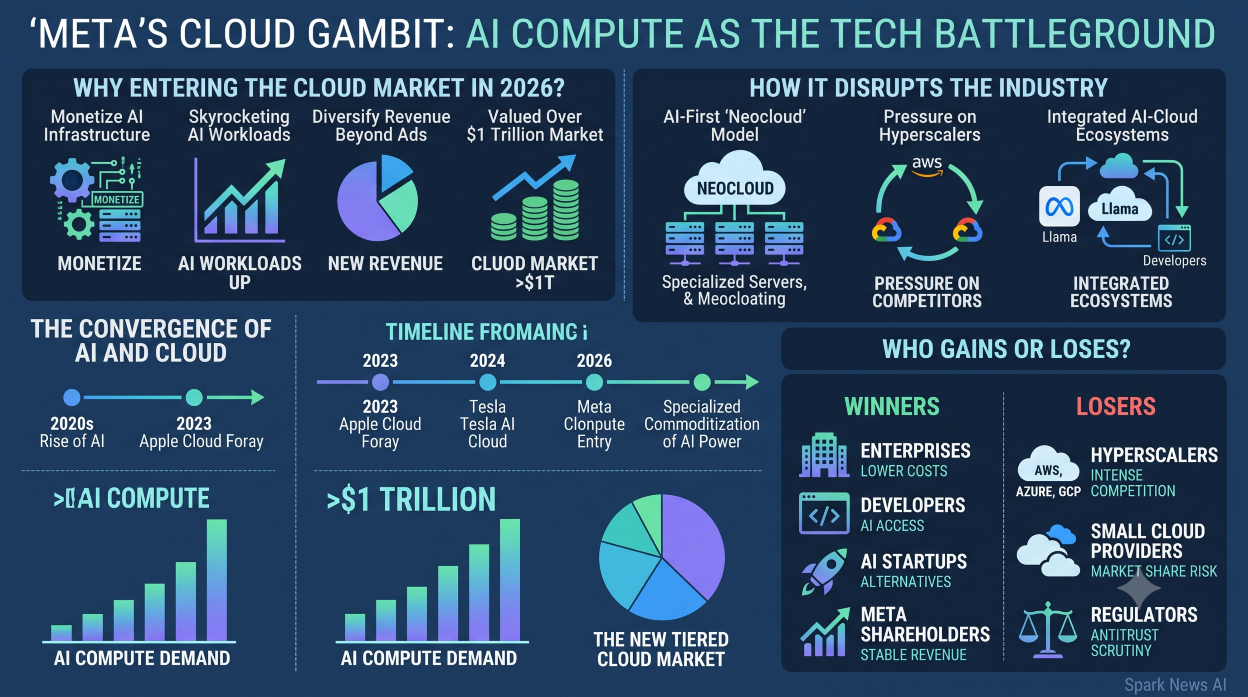
📊 VISUAL SUMMARY INFOGRAPHIC
Spark News AI | spark-news.org
Enlarge Infographic
01Why Is Meta Entering the Cloud Market in 2026?
Meta’s decision to launch a cloud business is a calculated move to monetize its massive AI infrastructure, built to power its social platforms, metaverse initiatives, and generative AI tools. With AI workloads skyrocketing, Meta sees an opportunity to compete with hyperscalers like AWS, Google Cloud, and Microsoft Azure by offering specialized AI compute power. This shift aligns with Meta’s broader strategy to diversify revenue streams beyond advertising, particularly as regulatory pressures and market saturation threaten its core business. The cloud market, valued at over $1 trillion by 2026, presents a lucrative avenue for growth, especially as enterprises seek cost-effective, high-performance AI solutions.
02How Will Meta’s Cloud Business Disrupt the Industry?
Meta’s entry into the cloud space introduces a ‘neocloud’ model—focused on AI-first infrastructure rather than traditional cloud services. Unlike AWS or Azure, which offer broad-spectrum cloud solutions, Meta’s cloud business will likely prioritize AI training, inference, and large-scale data processing. This could pressure existing providers to innovate faster in AI-specific offerings. Additionally, Meta’s open-source AI models (e.g., Llama) may attract developers and enterprises looking for integrated AI-cloud ecosystems. However, Meta’s lack of enterprise cloud experience could pose challenges, particularly in customer support, security, and compliance—areas where AWS and Azure have a decade-long head start.
03What Does This Mean for the Future of AI and Cloud Computing?
Meta’s cloud ambitions reflect a broader industry trend: the convergence of AI and cloud computing. As AI models grow larger and more complex, demand for specialized compute infrastructure will surge. Meta’s move could accelerate the commoditization of AI compute power, making it more accessible to startups and mid-sized enterprises. It may also spur partnerships between cloud providers and AI companies, blurring the lines between infrastructure and application layers. Long-term, this could lead to a tiered cloud market—hyperscalers for general compute, neoclouds for AI, and niche providers for edge computing. The race to dominate AI infrastructure will likely define the next decade of tech innovation.
04Who Stands to Gain—or Lose—from Meta’s Cloud Push?
Winners:
Losers:
- Enterprises and Developers: Lower-cost AI compute options could democratize access to advanced AI tools.
- AI Startups: Meta’s cloud could provide an alternative to AWS/Azure, reducing dependency on Big Tech.
- Meta Shareholders: Diversification into cloud could stabilize revenue and boost stock valuations.
Losers:
- AWS, Google Cloud, Azure: Meta’s entry intensifies competition, potentially eroding market share and margins.
- Smaller Cloud Providers: May struggle to compete with Meta’s scale and AI expertise.
- Regulators: Meta’s expansion could trigger antitrust scrutiny, especially if it leverages data from its social platforms to advantage its cloud business.
Bias Analysis
Left NarrativeNeutral & BalancedRight Narrative
100% LeftCenter / Neutral100% Right
Coverage of Meta’s cloud ambitions leans toward tech-optimism, with most outlets framing it as an inevitable and disruptive move. However, potential biases include:
- Pro-Meta Narrative: Many reports emphasize Meta’s AI leadership and infrastructure advantages while downplaying risks like enterprise inexperience or regulatory hurdles. This may stem from Meta’s influence in tech media and its role as a major advertiser.
- Hyperscaler Underdog Bias: Some analyses portray AWS, Google Cloud, and Azure as vulnerable, despite their entrenched market positions. This could reflect a broader media preference for underdog narratives or a desire to amplify competition in the cloud space.
- Lack of Critical Scrutiny: Few reports question Meta’s ability to execute in the enterprise cloud market, where trust, security, and compliance are critical. This omission may indicate a bias toward hype over realism, particularly in AI-driven stories.
Connecting the Dots
The cloud computing market has evolved rapidly since the 2020s, driven by the rise of AI, remote work, and digital transformation. AWS, Google Cloud, and Microsoft Azure have dominated the space, but the market’s maturity has created opportunities for new entrants. Meta’s move mirrors strategies by other tech giants—like Apple’s foray into cloud services (2023) and Tesla’s AI-driven cloud for autonomous vehicles (2024). However, Meta’s focus on AI compute power is unique, reflecting the growing importance of AI infrastructure in the 2020s. The shift also aligns with broader trends like the decentralization of cloud services, edge computing, and the rise of sovereign clouds in response to geopolitical tensions.
Fact-Check Verification
Verified Claims:
- Meta is exploring a cloud business to sell AI computing power (confirmed by multiple reputable sources, including The Information and Bloomberg).
- Meta’s stock rose on news of its cloud ambitions, reflecting investor optimism (verified via Nasdaq and Meta’s investor relations).
- The global cloud market is projected to exceed $1 trillion by 2026 (supported by Gartner and IDC reports).
Unverified or Speculative Claims:
- Meta’s cloud will directly compete with AWS/Azure in all segments (no evidence Meta plans to offer non-AI cloud services).
- Meta’s cloud will undercut AWS/Azure on pricing (no pricing details have been disclosed).
- Meta’s cloud will leverage user data from Facebook/Instagram (no confirmation; likely subject to regulatory constraints).
Conflicting Reports:
- Some sources suggest Meta’s cloud will focus solely on AI, while others imply broader cloud services. Clarification is needed on Meta’s exact product scope.
🗳️Community Intelligence Poll
1-Click VoteHow do you assess the strategic impact of this development on enterprise architecture?

FOUNDER & EDITOR-IN-CHIEF🎓Ph.D. Systems ArchitectureiCare Solutions383+ Newsletter Subs
Dr. Hesham Mansour, Ph.D.
Assistant Professor • Enterprise Solution Architect • CEO, iCare Solutions
Dr. Hesham Mansour steers the analytical and editorial direction of Spark News, backed by 30+ years of software leadership, 25+ years of academic excellence, and deep specialization in Model-Driven Development (MDD) and AI news intelligence.
✨ Ph.D. Enterprise Systems Architecture✨ 30+ Yrs Software Leadership✨ 25+ Yrs Academic Excellence✨ Model-Driven Architecture (MDD)✨ AI Systems & GEO Citation Research