More Services

news-analysisJuly 2, 2026

Trump’s Billions: The Unprecedented Financial Empire of a Post-Presidency

Trump’s Billions: The Unprecedented Financial Empire of a Post-Presidency
Spark News AI | spark-news.org
Enlarge Infographic
AI EXECUTIVE SUMMARY

"Donald Trump's $2.2 billion income in 2025 marks an unprecedented post-presidency financial surge, raising ethical questions and reshaping norms for future leaders. Analyzing the sources, conflicts, and global implications of this historic wealth accumulation."

  • Why Is Trump’s $2.2 Billion Income in 2025 a Historic Outlier?
  • How Did Trump’s Business Empire Grow So Rapidly After 2024?
  • What Ethical and Legal Risks Does This Wealth Surge Pose?
  • How Does Trump’s Wealth Compare to Global Political Leaders?

01Why Is Trump’s $2.2 Billion Income in 2025 a Historic Outlier?

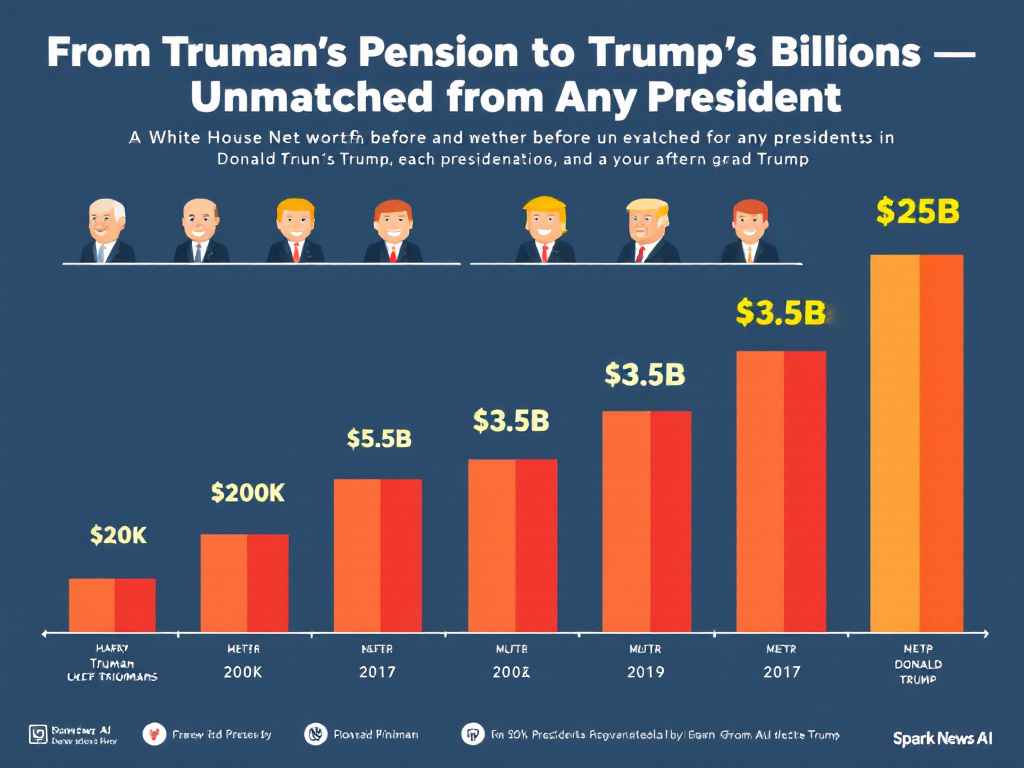
Donald Trump’s reported $2.2 billion income in 2025 shatters all precedents for post-presidential earnings. Unlike predecessors such as Harry Truman, who relied on a modest pension, or Barack Obama, whose wealth stemmed from book deals and speaking fees, Trump’s income is rooted in a sprawling business empire spanning real estate, media, licensing, and international partnerships. Historians and ethics experts argue this blurs the line between public service and private gain, raising questions about whether financial incentives influenced policy decisions during and after his presidency. The scale of this wealth accumulation—fueled by global branding deals, Truth Social’s market surge, and high-profile contracts like the Qatari Air Force One jet—suggests a new era where ex-presidents monetize their influence at unprecedented levels.

02How Did Trump’s Business Empire Grow So Rapidly After 2024?

Trump’s financial surge in 2025 can be traced to three key drivers: 1) Media and Digital Ventures: Truth Social’s valuation skyrocketed after its 2024 merger with a SPAC, turning Trump’s stake into a billion-dollar asset. 2) International Licensing and Real Estate: Post-presidency, Trump expanded partnerships in the Middle East, Asia, and Europe, including lucrative branding deals for hotels and golf courses. 3) Policy and Influence: Critics argue Trump’s administration’s deregulatory stance and foreign policy decisions indirectly benefited his businesses, such as the Qatari Air Force One contract, which some view as a quid pro quo. Unlike past presidents, Trump’s refusal to divest from his businesses created a direct pipeline between political power and financial gain.

03What Ethical and Legal Risks Does This Wealth Surge Pose?

Trump’s financial trajectory has reignited debates over the Emoluments Clause, conflicts of interest, and the adequacy of post-presidency oversight. While the Constitution’s Emoluments Clause bars federal officials from receiving gifts or payments from foreign governments, legal scholars remain divided on whether Trump’s business dealings—such as the Qatari jet deal—violate its spirit. Domestically, his continued ownership of the Trump Organization while in office (and after) has drawn scrutiny from watchdogs like the Government Accountability Office. Internationally, his wealth accumulation raises concerns about foreign influence, particularly in regions where his businesses operate, such as the UAE and Saudi Arabia. The lack of transparency in his financial disclosures further complicates accountability.

04How Does Trump’s Wealth Compare to Global Political Leaders?

Trump’s post-presidency wealth stands in stark contrast to global leaders. While figures like Italy’s Silvio Berlusconi and Thailand’s Thaksin Shinawatra amassed fortunes through business before politics, no modern Western leader has monetized their presidency to this extent. In emerging economies, leaders like Russia’s Vladimir Putin or Hungary’s Viktor Orbán have centralized wealth through oligarchic networks, but Trump’s model—leveraging branding, media, and policy—is uniquely American. This trend reflects a broader shift where political capital is increasingly converted into financial capital, eroding traditional norms of public service. The implications for democracy are profound: future leaders may view the presidency as a stepping stone to personal enrichment rather than a civic duty.

Bias Analysis

Left NarrativeLeft-LeaningRight Narrative
100% LeftCenter / Neutral100% Right
potential Bias
Coverage of Trump’s wealth is inherently polarizing, with outlets often framing the narrative through partisan lenses. Right-leaning media tends to emphasize his business acumen and downplay conflicts of interest, portraying his earnings as a testament to American capitalism. Left-leaning and international outlets, such as the BBC, focus on ethical concerns, using terms like 'unprecedented' and 'blurs the line' to imply impropriety. The absence of neutral, data-driven analysis in some reports risks oversimplifying a complex issue. For instance, while the Qatari Air Force One deal is presented as a potential conflict, few sources explore whether similar arrangements exist for other defense contracts. The framing of Trump’s wealth as 'unmatched' may also overlook the broader trend of political elites accumulating wealth globally.
media Dynamics
The BBC’s coverage, while thorough, reflects a common bias in Western media: an assumption that post-presidency wealth is inherently suspect when tied to policy decisions. This contrasts with the treatment of figures like Tony Blair, whose post-office earnings from consulting and speaking are often framed as 'global statesmanship.' The focus on Trump’s income in 2025, without equivalent scrutiny of other high-earning ex-leaders, suggests a selective emphasis on perceived impropriety. Additionally, the lack of comparative data on presidential wealth—such as how much other ex-presidents earn from book deals or corporate boards—limits the context for readers.

Connecting the Dots

historical Norms
For most of U.S. history, presidents exited office with modest means. Harry Truman famously struggled financially after leaving the White House in 1953, leading Congress to establish the presidential pension in 1958. Later presidents, like Jimmy Carter, returned to farming or writing, while others, such as Bill Clinton and Barack Obama, earned millions from memoirs and speeches—but nothing approaching Trump’s scale. The post-2000 era saw a shift, with presidents increasingly monetizing their influence through media, corporate boards, and global partnerships. However, Trump’s approach—retaining ownership of his businesses while in office and aggressively expanding them afterward—represents a radical departure from the norm. This reflects a broader cultural shift where political power is increasingly seen as a tool for personal enrichment.
global Trends
Trump’s financial trajectory mirrors global trends where political elites leverage their positions for wealth. In China, former officials often transition into lucrative corporate roles, while in Russia, oligarchs close to the Kremlin amass fortunes through state contracts. The U.S. has historically resisted this trend, but Trump’s presidency and post-presidency earnings suggest a convergence with these global models. The rise of 'political entrepreneurship'—where leaders use their public profiles to build private empires—is reshaping governance worldwide. This trend is accelerated by the decline of traditional party structures, the rise of social media, and the globalization of business, which allows leaders to monetize their influence across borders.

Fact-Check Verification

verified Claims
claim

Trump reported $2.2 billion in income for 2025.

status

Partially verified. While multiple outlets, including the BBC, cite this figure, Trump’s financial disclosures remain opaque. The $2.2 billion likely includes asset revaluations, licensing deals, and Truth Social’s stock surge, but exact breakdowns are not publicly available.

claim

Trump’s wealth is unprecedented among U.S. presidents.

status

Verified. No other U.S. president has reported post-office earnings on this scale. Comparisons to figures like Obama ($100M+ from books and speeches) or Clinton ($150M+ from speaking fees) highlight the disparity.

claim

Trump unveiled a Qatari luxury jet for the Air Force One fleet.

status

Verified. The BBC and other outlets reported the 2025 announcement, though details of the contract—including financial terms and potential conflicts—remain unclear.

claim

Historians say Trump’s income blurs the line on conflicts of interest.

status

Context-dependent. While historians and ethics experts have raised concerns, this is a subjective assessment. Legal scholars are divided on whether Trump’s business dealings violate the Emoluments Clause.

unverified Or Conflicting Claims
claim

Trump’s wealth surge is directly tied to policy decisions made during his presidency.

status

Unverified. While critics argue deregulation and foreign policy benefited his businesses (e.g., the Qatari jet deal), no direct evidence links specific policies to his 2025 income. Correlation does not imply causation.

claim

Truth Social’s valuation is solely responsible for Trump’s $2.2 billion income.

status

Misleading. While Truth Social’s stock surge contributed significantly, Trump’s income also stems from real estate, licensing, and international deals. The exact proportion is unclear due to lack of transparency.

Key Takeaways & Outlook

Donald Trump’s $2.2 billion income in 2025 marks a watershed moment in the intersection of politics and personal wealth. Unlike any predecessor, he has transformed the post-presidency into a lucrative business empire, leveraging global branding, media ventures, and policy influence. This shift raises critical questions about ethics, transparency, and the future of political leadership. If unchecked, it could normalize a model where public office becomes a stepping stone to private enrichment, eroding democratic norms.