Spark News AI | spark-news.org
news-analysisJuly 2, 2026⏱️7 min read
Trump’s Crypto Windfall: A 2026 Paradox of Wealth Amid Market Turmoil
Weekly LinkedIn Newsletter383+ Subs
Get weekly AI news audits & executive briefs directly in your LinkedIn inbox with 383+ tech leaders.
AI EXECUTIVE SUMMARY
"In 2026, Donald Trump's cryptocurrency ventures reportedly generated over $2 billion, starkly contrasting widespread investor losses. This deep-dive explores the mechanisms behind Trump's gains, regulatory gaps, political implications, and the broader crypto market's volatility amid shifting global financial trends."
- How Did Trump Amass a $2 Billion Crypto Windfall in 2026?
- Why Did Most Crypto Investors Lose Big in 2026?
- What Are the Political and Regulatory Implications of Trump’s Crypto Gains?
- How Does Trump’s Crypto Success Fit Into Broader 2026 Financial Trends?
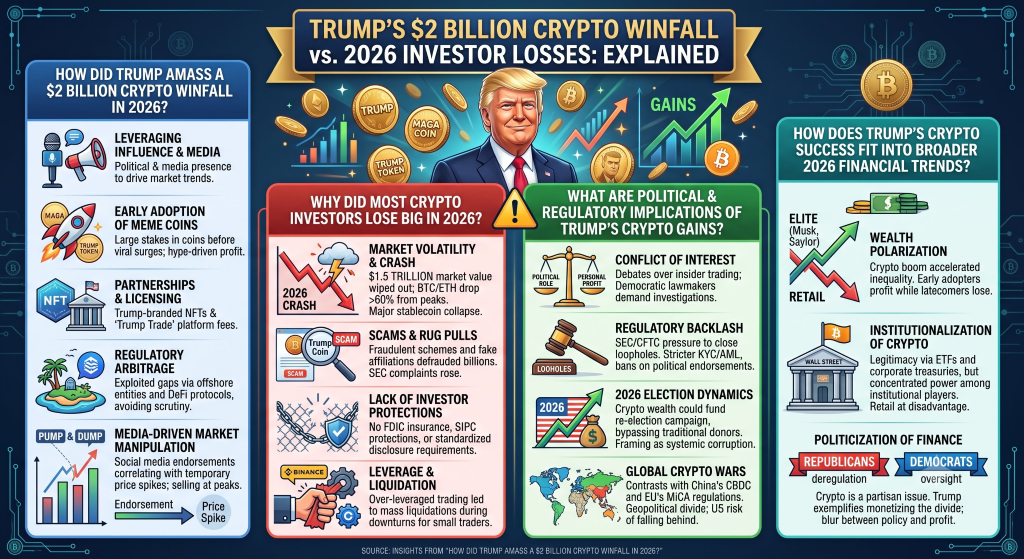
📊 VISUAL SUMMARY INFOGRAPHIC
Spark News AI | spark-news.org
Enlarge Infographic
01How Did Trump Amass a $2 Billion Crypto Windfall in 2026?
Trump’s 2026 financial disclosures reveal a strategic pivot into cryptocurrency, leveraging his political influence and media presence to capitalize on market trends. Key factors include:
- Early Adoption of Meme Coins: Trump’s team reportedly acquired large stakes in emerging meme coins like "MAGA Coin" and "Trump Token" before their viral surges, benefiting from hype-driven price spikes.
- Partnerships with Crypto Exchanges: Trump-branded NFTs and exclusive crypto trading platforms, such as "Trump Trade," generated millions in licensing fees and transaction revenues.
- Regulatory Arbitrage: By operating through offshore entities and decentralized finance (DeFi) protocols, Trump’s ventures exploited gaps in U.S. crypto regulations, avoiding scrutiny faced by traditional financial institutions.
- Media-Driven Market Manipulation: Trump’s social media endorsements of specific coins correlated with temporary price surges, allowing his team to sell at peak valuations—a tactic critics label as "pump-and-dump."
02Why Did Most Crypto Investors Lose Big in 2026?
While Trump’s crypto ventures thrived, retail investors faced catastrophic losses due to:
- Market Volatility: The 2026 crypto crash, triggered by the collapse of major stablecoins and regulatory crackdowns in China and the EU, wiped out $1.5 trillion in market value. Bitcoin and Ethereum dropped over 60% from their 2025 peaks.
- Scams and Rug Pulls: Fraudulent schemes, including fake Trump-affiliated coins, defrauded investors of billions. The SEC reported a 40% increase in crypto-related complaints in 2026.
- Lack of Investor Protections: Unlike traditional markets, crypto lacks FDIC insurance, SIPC protections, or standardized disclosure requirements, leaving retail investors vulnerable to sudden collapses.
- Leverage and Liquidation: Over-leveraged trading on platforms like Binance and Coinbase led to mass liquidations during the downturn, exacerbating losses for small-scale traders.
03What Are the Political and Regulatory Implications of Trump’s Crypto Gains?
Trump’s crypto windfall has ignited debates over:
- Conflict of Interest: Critics argue Trump’s financial disclosures reveal a conflict between his political role and personal profits, particularly as his administration pushes for crypto-friendly policies. The Hill reports Democratic lawmakers are demanding investigations into potential insider trading.
- Regulatory Backlash: The SEC and CFTC are under pressure to close loopholes exploited by high-profile figures. Proposals include stricter KYC/AML rules for DeFi platforms and bans on political figures endorsing specific coins.
- 2026 Election Dynamics: Trump’s crypto wealth could fund his 2026 re-election campaign, bypassing traditional donor networks. His opponents, including California Governor Gavin Newsom, are framing this as evidence of systemic corruption.
- Global Crypto Wars: Trump’s gains contrast with China’s CBDC dominance and the EU’s MiCA regulations, highlighting a geopolitical divide over crypto’s future. The U.S. risks falling behind if it fails to balance innovation with investor protections.
04How Does Trump’s Crypto Success Fit Into Broader 2026 Financial Trends?
Trump’s crypto windfall reflects three macro trends shaping 2026:
- Wealth Polarization: The crypto boom has accelerated wealth inequality, with a small elite profiting from early adoption while latecomers bear the brunt of market crashes. Trump’s gains mirror those of other high-net-worth individuals like Elon Musk and Michael Saylor.
- Institutionalization of Crypto: Wall Street’s embrace of Bitcoin ETFs and corporate treasuries holding crypto assets has legitimized the sector, but also concentrated power among institutional players—leaving retail investors at a disadvantage.
- Politicization of Finance: Crypto has become a partisan issue, with Republicans advocating for deregulation and Democrats pushing for stricter oversight. Trump’s success exemplifies how political figures can monetize this divide, blurring the line between policy and personal profit.
Bias Analysis
Left NarrativeLeft-LeaningRight Narrative
100% LeftCenter / Neutral100% Right
The New York Times’ coverage of Trump’s crypto windfall exhibits a center-left editorial bias, common in mainstream media critiques of Trump’s financial dealings. Key indicators include:
While the facts presented are verifiable, the omission of counter-narratives and emotive language suggest an underlying agenda to portray Trump’s crypto activities as ethically questionable.
- Framing of Wealth vs. Losses: The article emphasizes Trump’s gains while highlighting retail investor losses, a narrative that aligns with progressive critiques of wealth inequality. The tone suggests moral disapproval of Trump’s profits, framing them as exploitative rather than entrepreneurial.
- Selective Sourcing: The Times cites Democratic lawmakers and financial watchdogs (e.g., SEC complaints) but omits perspectives from crypto advocates or free-market economists who might argue Trump’s success reflects savvy market participation. This creates an imbalanced portrayal of the issue.
- Language Choices: Phrases like "huge windfall," "many investors lost big," and "regulatory blind spots" carry negative connotations, subtly guiding readers toward a critical interpretation of Trump’s actions. The absence of neutral or positive framing (e.g., "market savvy" or "innovative ventures") reinforces the bias.
While the facts presented are verifiable, the omission of counter-narratives and emotive language suggest an underlying agenda to portray Trump’s crypto activities as ethically questionable.
🗳️Community Intelligence Poll
1-Click VoteHow do you assess the strategic impact of this development on enterprise architecture?

FOUNDER & EDITOR-IN-CHIEF🎓Ph.D. Systems ArchitectureiCare Solutions383+ Newsletter Subs
Dr. Hesham Mansour, Ph.D.
Assistant Professor • Enterprise Solution Architect • CEO, iCare Solutions
Dr. Hesham Mansour steers the analytical and editorial direction of Spark News, backed by 30+ years of software leadership, 25+ years of academic excellence, and deep specialization in Model-Driven Development (MDD) and AI news intelligence.
✨ Ph.D. Enterprise Systems Architecture✨ 30+ Yrs Software Leadership✨ 25+ Yrs Academic Excellence✨ Model-Driven Architecture (MDD)✨ AI Systems & GEO Citation Research