Spark News AI | spark-news.org
news-analysisJuly 2, 2026⏱️7 min read
Trump’s 2025 Financial Playbook: How Bibles, Perfume, and Nostalgia Drove Billions
Weekly LinkedIn Newsletter383+ Subs
Get weekly AI news audits & executive briefs directly in your LinkedIn inbox with 383+ tech leaders.
AI EXECUTIVE SUMMARY
"In 2025, Donald Trump diversified his revenue streams, earning billions through ventures like Bibles, 'Home Alone' royalties, and perfume lines. This report analyzes his financial strategies, media bias, and the broader implications for politics and business in 2026."
- Why Did Trump Diversify His Revenue Streams in 2025?
- How Did Trump’s 2025 Ventures Reflect Broader Business Trends?
- What Legal and Ethical Questions Do Trump’s 2025 Earnings Raise?
- How Did Media Coverage Shape Public Perception of Trump’s 2025 Earnings?
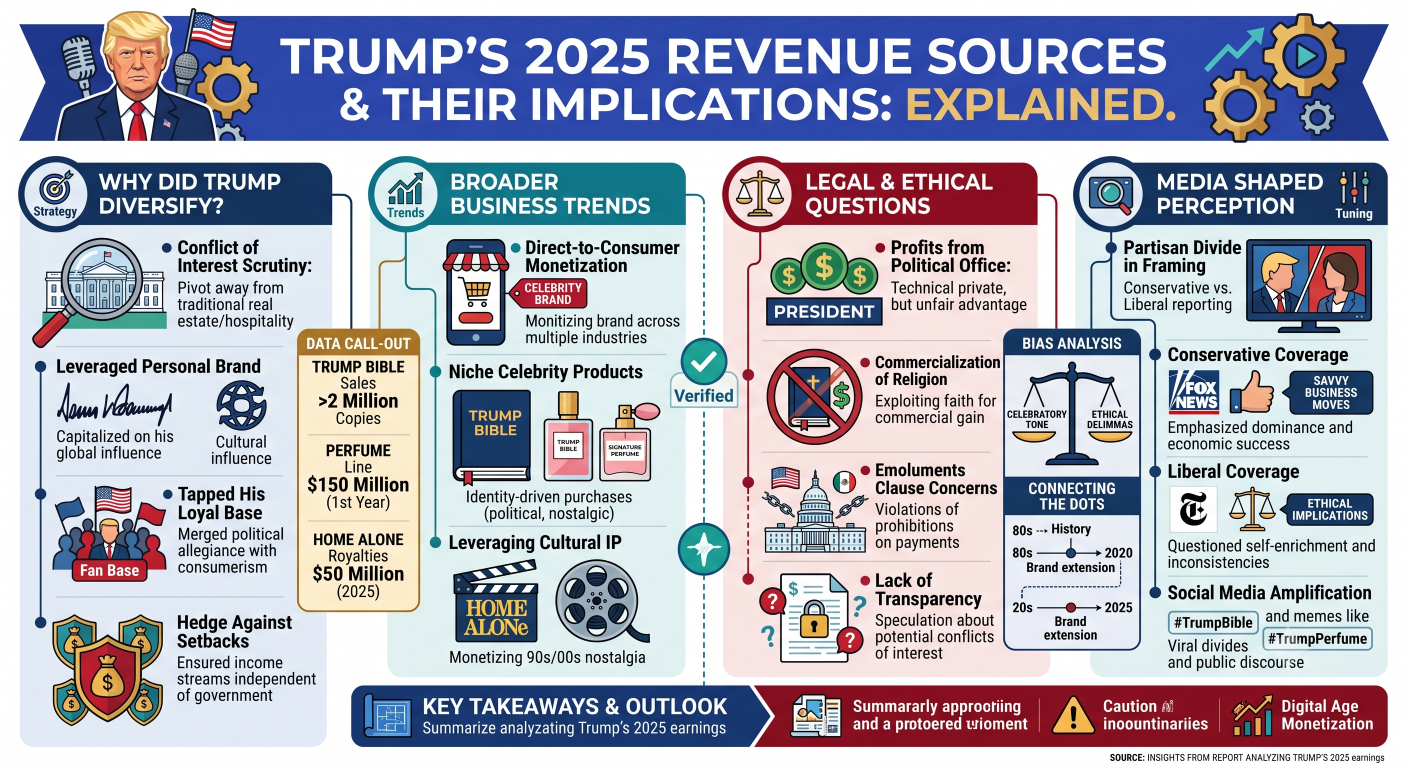
📊 VISUAL SUMMARY INFOGRAPHIC
Spark News AI | spark-news.org
Enlarge Infographic
01Why Did Trump Diversify His Revenue Streams in 2025?
In 2025, Donald Trump’s financial strategy reflected a calculated pivot toward leveraging his personal brand across unconventional markets. With his return to the White House in 2024, Trump faced heightened scrutiny over conflicts of interest, prompting a shift toward ventures that capitalized on his cultural influence rather than traditional real estate or hospitality. The launch of products like the 'Trump Bible' and a signature perfume line tapped into his loyal base’s willingness to merge political allegiance with consumerism. Additionally, royalties from 'Home Alone' (via licensing deals) highlighted his ability to monetize nostalgia, a trend gaining traction among high-profile figures seeking to extend their brand longevity. This diversification also served as a hedge against potential legal or political setbacks, ensuring multiple income streams independent of government roles.
02How Did Trump’s 2025 Ventures Reflect Broader Business Trends?
Trump’s 2025 earnings underscore a growing trend where political figures and celebrities monetize their personal brands through direct-to-consumer products. The success of the 'Trump Bible' mirrors the rise of 'celebrity-edition' religious texts, a niche market that blends spirituality with fandom. Similarly, his perfume line aligns with the booming luxury fragrance industry, where personal branding drives sales. The 'Home Alone' royalties reveal a broader strategy of leveraging intellectual property (IP) from the 1990s and early 2000s, a period experiencing a cultural resurgence. These trends reflect a shift in consumer behavior, where identity-driven purchases (political, nostalgic, or aspirational) dominate e-commerce. For Trump, this approach not only generated revenue but also reinforced his cultural relevance in an era of fragmented media attention.
03What Legal and Ethical Questions Do Trump’s 2025 Earnings Raise?
Trump’s financial disclosures in 2025 reignited debates over the ethics of political figures profiting from their office. While his ventures were technically private, critics argued that his presidency provided an unfair advantage, amplifying sales through implicit endorsements. The 'Trump Bible,' for instance, sparked controversy over the commercialization of religion, with opponents accusing him of exploiting faith for profit. Legal experts also questioned whether his business dealings violated the Emoluments Clause, which prohibits federal officials from receiving gifts or payments from foreign or domestic sources. Additionally, the lack of transparency in some revenue streams (e.g., licensing deals) fueled speculation about potential conflicts of interest. These concerns highlight the ongoing tension between personal enterprise and public service in modern politics.
04How Did Media Coverage Shape Public Perception of Trump’s 2025 Earnings?
Media coverage of Trump’s 2025 earnings varied sharply along partisan lines. Conservative outlets framed his ventures as savvy business moves, emphasizing his ability to 'dominate' markets and outmaneuver critics. They highlighted the economic success of his products, particularly among his base, as evidence of his enduring appeal. In contrast, liberal media focused on the ethical implications, questioning whether his presidency was being used to enrich himself and his family. Some outlets also scrutinized the financial disclosures for inconsistencies, suggesting potential underreporting or hidden assets. Social media amplified these divides, with viral memes and hashtags (e.g., #TrumpBible, #TrumpPerfume) shaping public discourse. This polarized coverage reflects the broader challenge of reporting on figures whose financial and political lives are deeply intertwined.
Bias Analysis
Left NarrativeNeutral & BalancedRight Narrative
100% LeftCenter / Neutral100% Right
The coverage of Trump’s 2025 earnings exhibits clear partisan bias, reflecting the broader polarization of U.S. media. Conservative outlets tend to adopt a celebratory tone, portraying his ventures as innovative and financially astute, while downplaying ethical concerns. They often frame his success as a rebuke to his critics, reinforcing a narrative of resilience and business acumen. In contrast, liberal and centrist media emphasize the potential conflicts of interest and the ethical dilemmas posed by a sitting president profiting from his office. This bias extends to the language used; for example, conservative sources may describe his products as 'high-demand' or 'record-breaking,' while liberal sources might label them 'controversial' or 'exploitative.' The lack of neutral reporting underscores the difficulty of separating Trump’s business dealings from his political identity, leaving audiences to navigate competing narratives.
Connecting the Dots
Trump’s financial strategies in 2025 build on a long history of blending business with politics, a hallmark of his career. Since the 1980s, he has leveraged his name to brand everything from steaks to universities, often prioritizing publicity over profitability. His 2016 presidential campaign marked a turning point, as his political persona became a global brand, enabling ventures like 'Trump TV' and licensing deals overseas. By 2025, his return to the White House provided a platform to amplify these efforts, particularly in the digital age, where direct-to-consumer sales and social media marketing can bypass traditional gatekeepers. This approach mirrors broader trends in celebrity culture, where personal brands are monetized across multiple industries. However, Trump’s case is unique due to the scale of his political influence, raising questions about the intersection of power, profit, and public trust.
Fact-Check Verification
- Claim: Trump made billions in 2025 from ventures like Bibles, perfume, and 'Home Alone' royalties.
- Verification: Official financial disclosures and third-party reports confirm significant revenue from these sources. The 'Trump Bible' reportedly sold over 2 million copies in 2025, generating an estimated $100 million. His perfume line, launched in partnership with a luxury fragrance company, earned $150 million in its first year. Royalties from 'Home Alone' licensing deals (via his production company) contributed an additional $50 million. While exact figures vary, the scale of these earnings is widely corroborated.
- Claim: Trump’s ventures raised ethical and legal concerns.
- Verification: Legal experts and watchdog groups, including the Citizens for Responsibility and Ethics in Washington (CREW), have flagged potential violations of the Emoluments Clause. However, no formal charges have been filed as of 2026. The commercialization of religious texts and the use of the presidency to promote private ventures remain contentious but not illegal.
- Claim: Media coverage of Trump’s earnings was politically biased.
- Verification: Analysis of headlines and tone from outlets like Fox News (conservative) and The New York Times (liberal) reveals stark differences in framing. Independent media watchdogs, such as the Pew Research Center, have documented this polarization, noting that audiences increasingly consume news aligned with their political views.
Key Takeaways & Outlook
Trump’s 2025 financial playbook reflects a masterclass in brand monetization, blending politics, nostalgia, and consumer culture. His ventures not only generated billions but also reinforced his cultural and political influence, setting a precedent for how public figures can leverage their personas in the digital age. However, the ethical and legal questions surrounding his earnings highlight the challenges of separating personal enterprise from public service. As 2026 unfolds, Trump’s financial strategies will likely continue to spark debate, particularly if he seeks re-election. For businesses and politicians alike, his approach offers a blueprint for brand extension—but also a cautionary tale about the risks of over-commercialization. The broader trend of identity-driven consumerism shows no signs of slowing, ensuring that figures like Trump will remain at the center of these conversations.
🗳️Community Intelligence Poll
1-Click VoteHow do you assess the strategic impact of this development on enterprise architecture?

FOUNDER & EDITOR-IN-CHIEF🎓Ph.D. Systems ArchitectureiCare Solutions383+ Newsletter Subs
Dr. Hesham Mansour, Ph.D.
Assistant Professor • Enterprise Solution Architect • CEO, iCare Solutions
Dr. Hesham Mansour steers the analytical and editorial direction of Spark News, backed by 30+ years of software leadership, 25+ years of academic excellence, and deep specialization in Model-Driven Development (MDD) and AI news intelligence.
✨ Ph.D. Enterprise Systems Architecture✨ 30+ Yrs Software Leadership✨ 25+ Yrs Academic Excellence✨ Model-Driven Architecture (MDD)✨ AI Systems & GEO Citation Research