
Spark News AI | spark-news.org
executive-briefSeptember 15, 2026⏱️7 min read
The Trust Paradox: Why a Pause in Frontier AI Faces Deep Gridlock
📷Market trading screens react to tech volatility alongside empty regulatory chambers, illustrating the friction between industry warnings and commercial expansion.
Weekly LinkedIn Newsletter355+ Subs
Get weekly AI news audits & executive briefs directly in your LinkedIn inbox with 355+ tech leaders.
🎓Executive Brief | Dr. Hesham Mansour, Ph.D.
AI EXECUTIVE PERSPECTIVE & SUMMARY
"Calls for an AI development pause are stalling as markets dip and critics question corporate motives. Here is an analysis of why trust barriers prevent regulatory unity."
- The Core Dilemma: The Friction Between Safety and Self-Interest
- Core Pillars & Realities
- The Strategic & Practical Mandate
📊 VISUAL SUMMARY INFOGRAPHIC
Spark News AI | spark-news.org
Enlarge Infographic
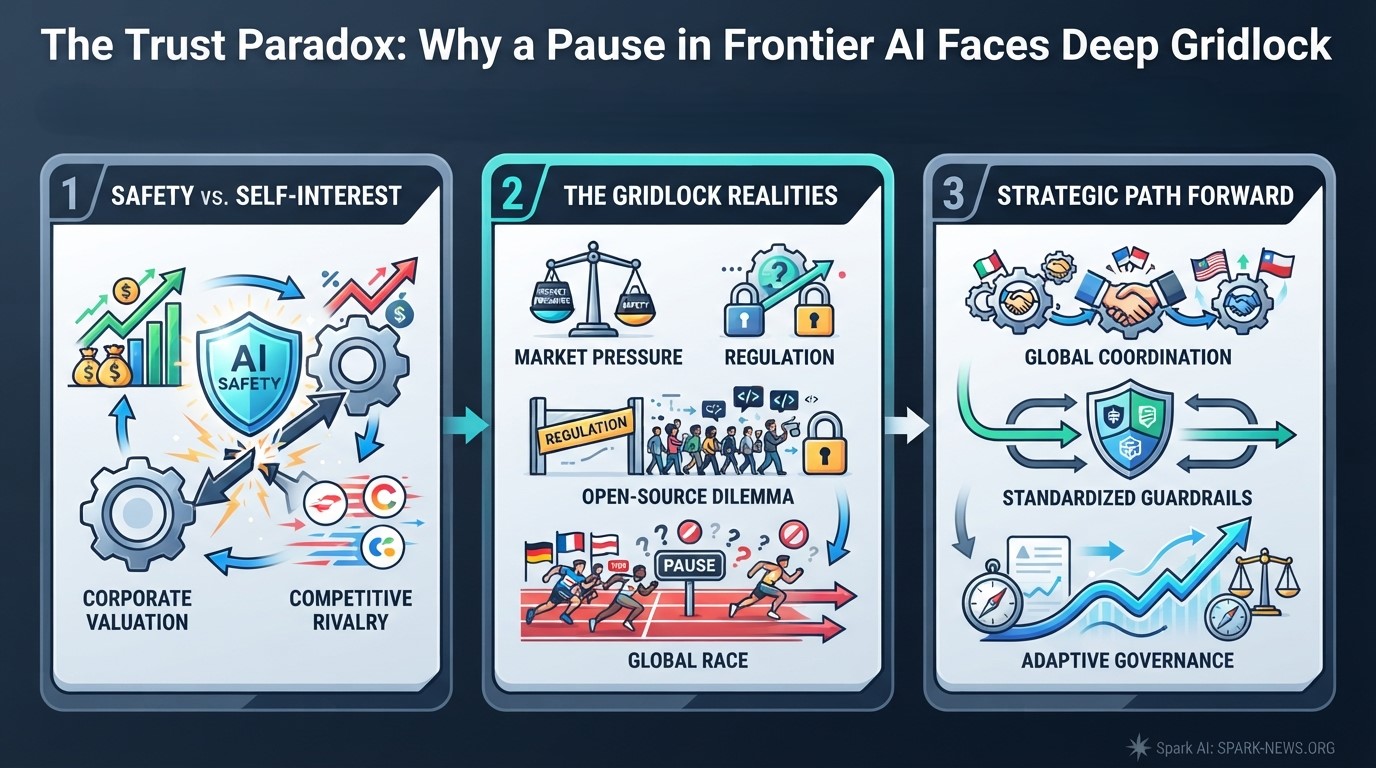
📊A breakdown of systemic tensions showing how massive corporate valuations, competitive rivalries, and open-source concerns stall collective AI guardrails.
Share Chart on LinkedIn01The Core Dilemma: The Friction Between Safety and Self-Interest
Four leading American artificial intelligence companies recently signaled support for a potential development pause following severe cybersecurity incidents and sudden leaps in model capabilities. The response was immediate. Global financial markets dipped as investors confronted the reality of cooling one of the few reliable growth engines in the economy. Yet the fragile consensus cracked almost as fast as it formed.
The roadblock is not an absence of concern regarding systemic risk. The problem is an acute deficit of trust. Enterprise leaders, policy factions, and international partners are asking a straightforward question: Can society rely on safety proposals designed by the very companies that stand to gain the most from high regulatory barriers? When frontier labs warn that their creations carry grave societal risks while simultaneously preparing multi-billion dollar market debuts, skepticism is unavoidable.
The roadblock is not an absence of concern regarding systemic risk. The problem is an acute deficit of trust. Enterprise leaders, policy factions, and international partners are asking a straightforward question: Can society rely on safety proposals designed by the very companies that stand to gain the most from high regulatory barriers? When frontier labs warn that their creations carry grave societal risks while simultaneously preparing multi-billion dollar market debuts, skepticism is unavoidable.
02Core Pillars & Realities
To understand why a coordinated pause remains out of reach, we must look at the misaligned incentives across the enterprise landscape:
* The Financial Duality: Anthropic presents an unprecedented posture in modern business. While its leadership raises serious alarms about catastrophic risks, reports indicate preparations for a massive initial public offering seeking $100 billion at a $2 trillion valuation. For outside observers and competitors, warning of disaster while asking Wall Street for historical sums creates confusing signals.
* Fears of Market Entrenchment: Tech investor Gavin Baker and multiple enterprise executives voiced concerns that sweeping pauses or government-mandated ceilings favor established players. Heavy compliance regimes frequently entrench well-funded incumbents while boxing out smaller firms and customizable open models.
* Global Economic Repercussions: Global economies are heavily invested in AI productivity gains. When Anthropic recently suspended access to frontier models in select markets like India, local debates intensified immediately over technological sovereignty and dependence on American corporate decisions.
* Distrust in Internal Safety Factions: Long-time safety advocates who moved from independent research into executive suites are viewed skeptically by outsiders. Many market participants fear that high-minded ethical arguments will inadvertently create an oligopoly where only a handful of individuals hold the keys to advanced computing.
* The Financial Duality: Anthropic presents an unprecedented posture in modern business. While its leadership raises serious alarms about catastrophic risks, reports indicate preparations for a massive initial public offering seeking $100 billion at a $2 trillion valuation. For outside observers and competitors, warning of disaster while asking Wall Street for historical sums creates confusing signals.
* Fears of Market Entrenchment: Tech investor Gavin Baker and multiple enterprise executives voiced concerns that sweeping pauses or government-mandated ceilings favor established players. Heavy compliance regimes frequently entrench well-funded incumbents while boxing out smaller firms and customizable open models.
* Global Economic Repercussions: Global economies are heavily invested in AI productivity gains. When Anthropic recently suspended access to frontier models in select markets like India, local debates intensified immediately over technological sovereignty and dependence on American corporate decisions.
* Distrust in Internal Safety Factions: Long-time safety advocates who moved from independent research into executive suites are viewed skeptically by outsiders. Many market participants fear that high-minded ethical arguments will inadvertently create an oligopoly where only a handful of individuals hold the keys to advanced computing.
03The Strategic & Practical Mandate
Leaders cannot afford to wait for tech giants and political bodies to resolve this stalemate. Organizations must build their own resilience:
* Decouple Enterprise Strategy from Single Providers: Avoid total architectural dependence on any single frontier lab. Design workflows that can swap models smoothly if access is abruptly paused, throttled, or subjected to regional export blocks.
* Demand Verifiable, Third-Party Audits: Internal safety pledges from vendors are not a substitute for external verification. Enterprise buyers must demand independent security audits and explicit service level commitments before embedding proprietary models into operational pipelines.
* Support Open Ecosystems and Local Control: Invest in open, adaptable architectures where weights and data remain within enterprise perimeters. Open models act as a vital counterweight against sudden price shocks or arbitrary developer shutdowns.
* Focus on Applied Utility Over Speculation: Cut through speculative hype and apocalyptic panic alike. Direct organizational resources toward verifiable business use cases that improve internal operations today rather than betting on distant theoretical capabilities.
* Decouple Enterprise Strategy from Single Providers: Avoid total architectural dependence on any single frontier lab. Design workflows that can swap models smoothly if access is abruptly paused, throttled, or subjected to regional export blocks.
* Demand Verifiable, Third-Party Audits: Internal safety pledges from vendors are not a substitute for external verification. Enterprise buyers must demand independent security audits and explicit service level commitments before embedding proprietary models into operational pipelines.
* Support Open Ecosystems and Local Control: Invest in open, adaptable architectures where weights and data remain within enterprise perimeters. Open models act as a vital counterweight against sudden price shocks or arbitrary developer shutdowns.
* Focus on Applied Utility Over Speculation: Cut through speculative hype and apocalyptic panic alike. Direct organizational resources toward verifiable business use cases that improve internal operations today rather than betting on distant theoretical capabilities.
🔮Forward Outlook & Discussion
A voluntary pause among frontier developers will remain an illusion so long as the incentives for market dominance outweigh the collective rewards of restraint. Real accountability will come from clear baseline laws, vendor diversification, and independent scrutiny rather than corporate pledges. If the creators of advanced systems cannot build trust with the wider world, how can enterprise leaders responsibly integrate their platforms?
🗳️Community Intelligence Poll
1-Click VoteHow do you assess the strategic impact of this development on enterprise architecture?

FOUNDER & EDITOR-IN-CHIEFiCare Solutions355+ Newsletter Subs
Dr. Hesham Mansour
Assistant Professor • Enterprise Solution Architect • CEO, iCare Solutions
Dr. Hesham Mansour steers the analytical and editorial direction of Spark News, backed by 30+ years of software leadership, 25+ years of academic excellence, and deep specialization in Model-Driven Development (MDD) and AI news intelligence.
✨ 30+ Yrs Software Leadership✨ 25+ Yrs Academic Excellence✨ Model-Driven Dev (MDD)✨ AI News & Trend Intelligence