news-analysisJuly 15, 2026

UAE’s AI Gambit: A High-Stakes Play for Global Tech Dominance

UAE’s AI Gambit: A High-Stakes Play for Global Tech Dominance
Spark News AI | spark-news.org
Enlarge Infographic
AI EXECUTIVE SUMMARY

"The UAE has invested billions in AI infrastructure, appointing the world’s first AI minister in 2017 and launching MBZUAI. Despite geopolitical tensions, Abu Dhabi remains committed to AI as a cornerstone of its post-oil economy, leveraging automation, education, and global partnerships to transform into a tech hub."

  • Why is the UAE Betting So Heavily on AI?
  • How is AI Already Transforming Daily Life in the UAE?
  • What Challenges Does the UAE Face in Its AI Ambitions?
  • How Does the UAE’s AI Strategy Compare to Global Trends?

01Why is the UAE Betting So Heavily on AI?

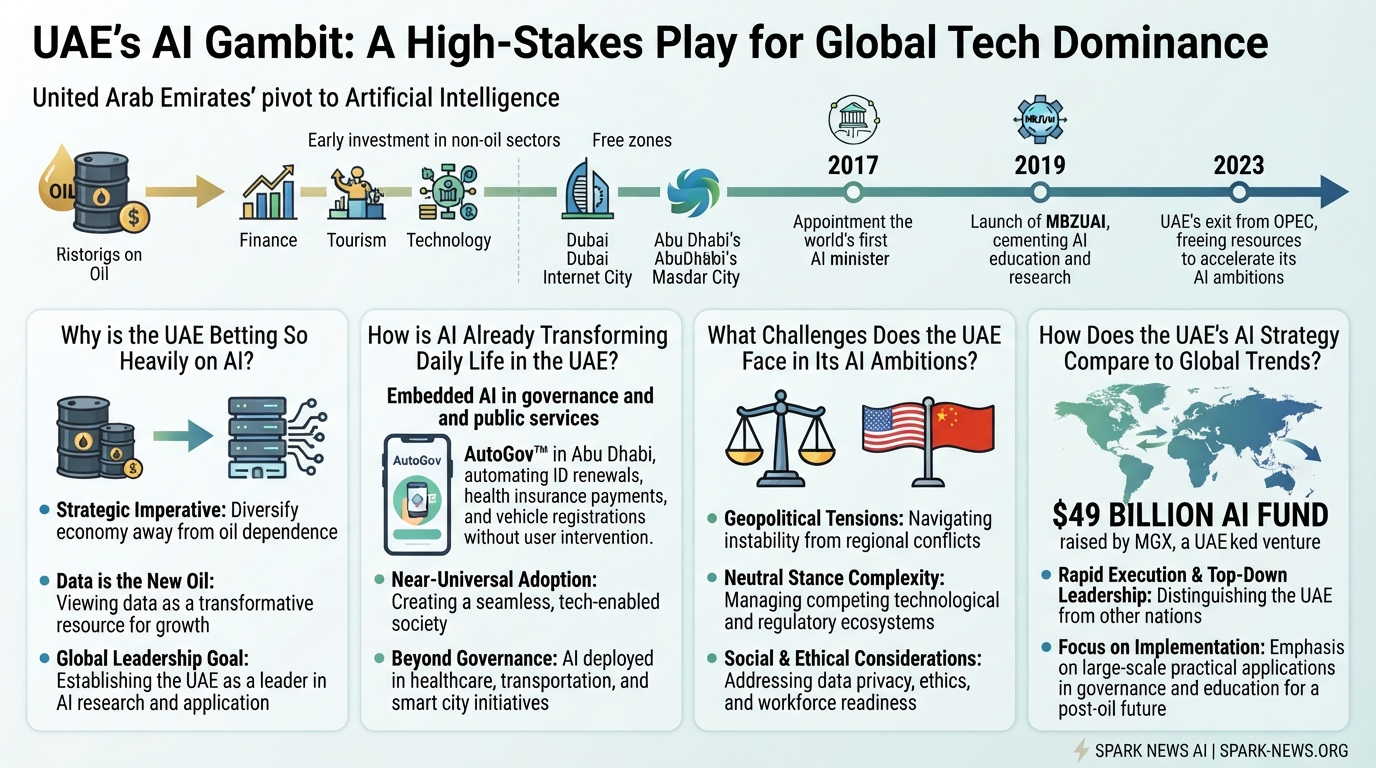
The UAE’s aggressive push into AI is driven by a strategic imperative to diversify its economy away from oil dependence. With oil revenues projected to decline due to global energy transitions, the UAE has identified AI as a critical pillar for future growth. The government’s long-term vision, articulated by leaders like Ambassador Yousef Al Otaiba, frames data and AI as the "new oil"—a transformative resource capable of driving innovation, efficiency, and economic resilience. The creation of the world’s first AI minister in 2017 and the establishment of MBZUAI in 2019 underscore the UAE’s commitment to positioning itself as a global leader in AI research and application.

02How is AI Already Transforming Daily Life in the UAE?

AI integration in the UAE is not just theoretical; it is deeply embedded in daily governance and public services. The "AutoGov" feature in Abu Dhabi’s digital infrastructure exemplifies this shift, automating bureaucratic processes such as ID renewals, health insurance payments, and vehicle registrations without user intervention. This near-universal adoption of AI-driven services reflects the UAE’s ambition to create a seamless, tech-enabled society. Beyond governance, AI is also being deployed in healthcare, transportation, and smart city initiatives, further solidifying its role as a cornerstone of the UAE’s digital transformation.

03What Challenges Does the UAE Face in Its AI Ambitions?

Despite its progress, the UAE’s AI ambitions are not without obstacles. Geopolitical tensions, particularly the ongoing conflict with Iran, have introduced instability that could deter foreign investment and talent. The UAE’s neutral stance—maintaining partnerships with both the U.S. and China—adds complexity to its AI strategy, as it navigates competing technological and regulatory ecosystems. Additionally, the UAE must address concerns about data privacy, AI ethics, and workforce readiness to ensure sustainable growth. The country’s ability to balance innovation with geopolitical and social challenges will determine the success of its AI-driven future.

04How Does the UAE’s AI Strategy Compare to Global Trends?

The UAE’s AI strategy aligns with broader global trends where nations and corporations are racing to dominate the AI landscape. However, the UAE distinguishes itself through its rapid execution and top-down leadership. While countries like the U.S. and China lead in AI research and development, the UAE’s focus on practical, large-scale implementation—such as AI-driven governance and education—sets it apart. The $49 billion AI fund raised by MGX, a UAE-backed venture, further signals the country’s intent to compete at a global level. This approach mirrors the Gulf’s broader shift toward economic diversification, with AI serving as a key enabler of a post-oil future.

Bias Analysis

Left NarrativeNeutral & BalancedRight Narrative
100% LeftCenter / Neutral100% Right
Coverage of the UAE’s AI strategy tends to oscillate between admiration for its ambitious vision and skepticism about its long-term viability. Western media outlets, such as Axios and the BBC, often frame the UAE’s AI push as a bold and forward-thinking move, highlighting its rapid adoption of cutting-edge technology. However, some reports may downplay the geopolitical risks, such as the Iran conflict, which could undermine the UAE’s stability and attractiveness as a tech hub. Additionally, there is a tendency to overemphasize the UAE’s neutrality in U.S.-China tech rivalry, potentially overlooking the complexities of navigating such a delicate balance. Overall, the coverage leans toward optimism but occasionally lacks critical analysis of the structural and external challenges the UAE faces.

Connecting the Dots

The UAE’s pivot to AI is rooted in its historical reliance on oil and its subsequent efforts to diversify its economy. Since the early 2000s, the UAE has invested heavily in non-oil sectors, including finance, tourism, and technology. The establishment of free zones like Dubai Internet City and Abu Dhabi’s Masdar City laid the groundwork for a knowledge-based economy. The appointment of the world’s first AI minister in 2017 marked a turning point, signaling the UAE’s intent to lead in the Fourth Industrial Revolution. The launch of MBZUAI in 2019 further cemented this commitment, positioning the UAE as a hub for AI education and research. This strategic shift gained momentum as global energy markets evolved, with the UAE’s exit from OPEC in 2023 freeing up resources to accelerate its AI ambitions.

Fact-Check Verification


  • The UAE appointed the world’s first AI minister in 2017.

    Verified. The UAE government appointed Omar Sultan Al Olama as Minister of State for Artificial Intelligence in October 2017, making him the first such official globally.


    Confirmed

  • MBZUAI is the world’s first graduate-level university dedicated to AI.

    Verified. Mohamed bin Zayed University of Artificial Intelligence (MBZUAI) was established in 2019 and is recognized as the first graduate-level institution focused solely on AI.


    Confirmed

  • The UAE’s AutoGov feature automates bureaucratic processes like ID renewals and payments.

    Verified. AutoGov is a real feature integrated into Abu Dhabi’s digital infrastructure, designed to streamline government services using AI.


    Confirmed

  • The UAE remains neutral in the U.S.-China tech rivalry.

    Partially confirmed. The UAE has pursued partnerships with both the U.S. and China, including collaborations with Microsoft and Chinese tech firms. However, U.S. pressure has led to some restrictions on Chinese involvement in sensitive sectors.


    Nuanced

  • The UAE’s AI strategy has been rattled by the war with Iran.

    Likely. While the UAE has not publicly scaled back its AI investments, geopolitical tensions with Iran have introduced instability that could impact foreign investment and talent acquisition.


    Plausible

Key Takeaways & Outlook

The UAE’s bold bet on AI represents a high-stakes gamble to secure its economic future beyond oil. By investing billions in infrastructure, education, and research, the country has positioned itself as a global leader in AI adoption and innovation. However, the success of this strategy hinges on its ability to navigate geopolitical challenges, foster talent, and maintain global partnerships. As of 2026, the UAE’s AI ambitions remain on track, but the coming years will be critical in determining whether it can sustain its momentum and emerge as a true tech powerhouse. If successful, the UAE could serve as a model for other nations seeking to transition to a knowledge-based economy.