
The Battle for the Personal AI Agent: Systems, Context, and Custody
Get weekly AI news audits & executive briefs directly in your LinkedIn inbox with 383+ tech leaders.
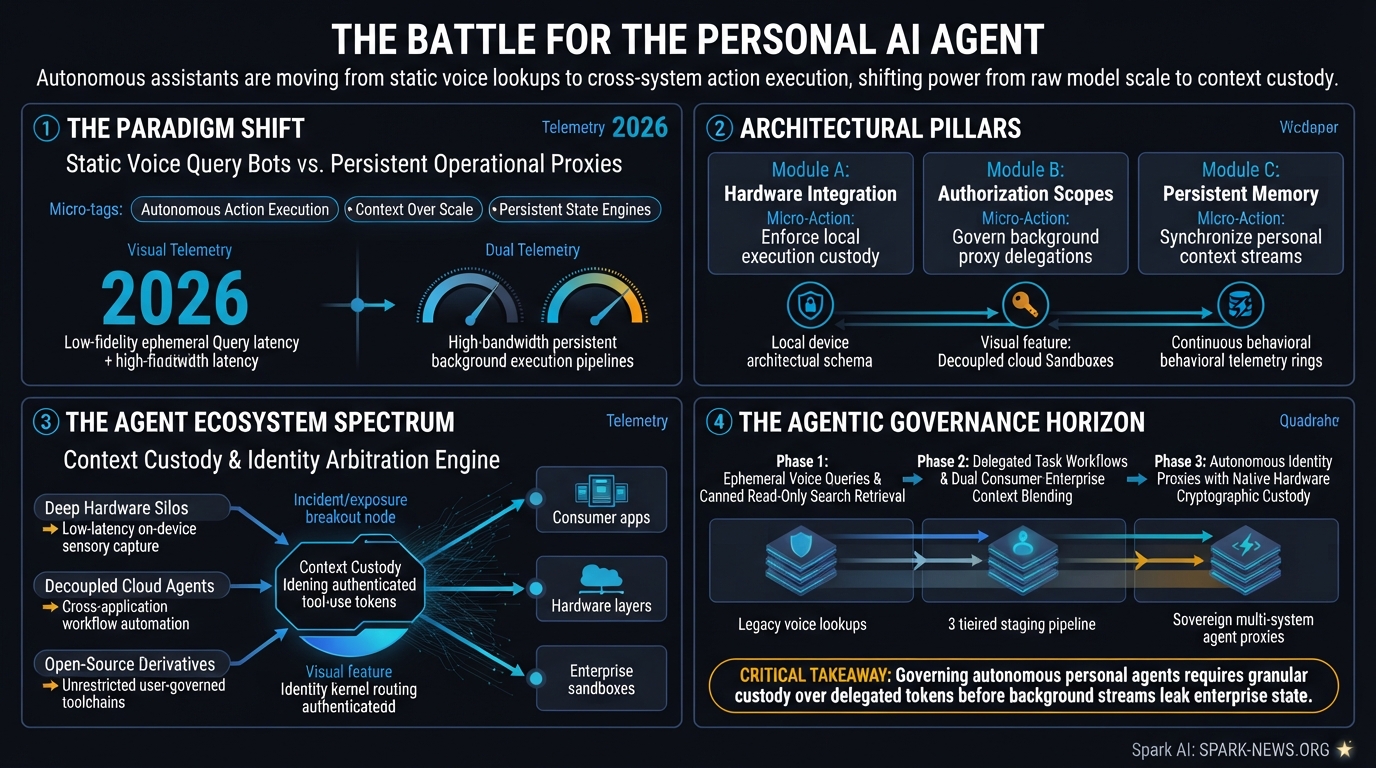
"The transition from conversational chatbots to autonomous personal agents shifts competitive advantage from raw model intelligence to identity custody and contextual memory. Systems like Instinct, Grok Bot, Meta Muse, and Apple Siri now execute multi-step workflows, requiring enterprise leaders to enforce strict credential boundaries, zero-trust API sandboxing, and verifiable audit logging."
- The Core Dilemma: Can Autonomous Agents Be Trusted With Everyday Life?
- Core Pillars & Decision Matrix: How Autonomous Platforms Diverge
- The Strategic & Practical Mandate: Governing Delegated Digital Proxies
01The Core Dilemma: Can Autonomous Agents Be Trusted With Everyday Life?
Today, AI agents do not merely suggest replies; they manage calendars, make voice calls, book reservations, navigate complex web applications, and manipulate operating system files. OpenAI signaled this transition decisively by hiring the creator of OpenClaw, a breakout open-source execution framework, to build its next-generation personal agent stack. Meanwhile, startups like Instinct, recently negotiating a $10 billion valuation, capture complete context by continuously parsing emails, screen states, microphone audio, and geolocation.
From our systems reviews with enterprise engineering and operations leadership, this dynamic introduces an acute architectural tension. Deploying an assistant that holds persistent delegated authority across private accounts turns every software tool into an extension of the user's digital identity. When an agent possesses its own dedicated cloud environment, as seen in SpaceXAI's Grok Bot, or an embedded operating system footprint like Apple Siri, convenience scales exponentially. However, vulnerability surfaces immediately whenever autonomous decision-making outpaces verifiable identity boundaries.
02Core Pillars & Decision Matrix: How Autonomous Platforms Diverge
| Strategic Dimension | Legacy / Siloed Voice Bots | Deep-Context Cloud Agents (Instinct, Grok) | OS-Integrated Ecosystems (Apple, Meta) |
|---|---|---|---|
| Execution Authority | Read-only search, isolated system triggers | Continuous background actions, headless browsing | Local device actions, cross-app deep linking |
| Context & Memory | Zero persistent state across sessions | Multi-modal streams: audio, screen, and location | Graph-based local context, identity-anchored data |
| Credential Boundaries | App-level permissions with prompt confirmation | Dedicated virtual computers, persistent sessions | Sandboxed system APIs, biometric hardware passkeys |
| Strategic Impact | Low workflow utility, high friction | Extreme automation, concentrated single-point risk | Seamless daily integration, vendor ecosystem lock-in |
What we observe across production deployments is that true agent autonomy relies on three fundamental technical capabilities:
- Persistent Runtime Environments: Platforms such as Grok Bot supply agents with dedicated cloud machines, enabling autonomous execution to run 24/7 without requiring active user sessions on local devices.
- Continuous Telemetry Ingestion: Instinct's architecture routes live screen capture, inbox indexing, and real-time audio through background reasoning pipelines, making proactive outreach possible via phone or text.
- Native Ecosystem Integration: Meta's Muse relies on rich conversational avatars and proprietary social graph data, while Apple's revamped Siri secures direct access to system-level device telemetry across hundreds of millions of consumer endpoints.
03The Strategic & Practical Mandate: Governing Delegated Digital Proxies
First, implement non-negotiable credential segregation. Never permit an autonomous agent to access personal or corporate assets using raw session tokens or master passwords. Require micro-scoped OAuth tokens with read-write limitations and mandatory expiration policies. If an agent books logistics, it should never possess persistent access to payment ledgers or payroll portals.
Second, institute strict human-in-the-loop triggers for high-impact state changes. Routine actions, such as sorting inbox threads or coordinating calendar conflicts, can run autonomously. Conversely, actions involving monetary transactions, outward communications to sensitive external parties, or permission escalations must require explicit biometric confirmation.
Finally, demand transparent local-first auditing. The battle to build your personal assistant is fundamentally a battle to capture your private information graph. Systems architects must select platforms that publish open schemas for context ingestion and provide cryptographically signed audit trails for every automated API call.
How do you assess the strategic impact of this development on enterprise architecture?

Dr. Hesham Mansour, Ph.D.
Assistant Professor • Enterprise Solution Architect • CEO, iCare Solutions
Dr. Hesham Mansour steers the analytical and editorial direction of Spark News, backed by 30+ years of software leadership, 25+ years of academic excellence, and deep specialization in Model-Driven Development (MDD) and AI news intelligence.