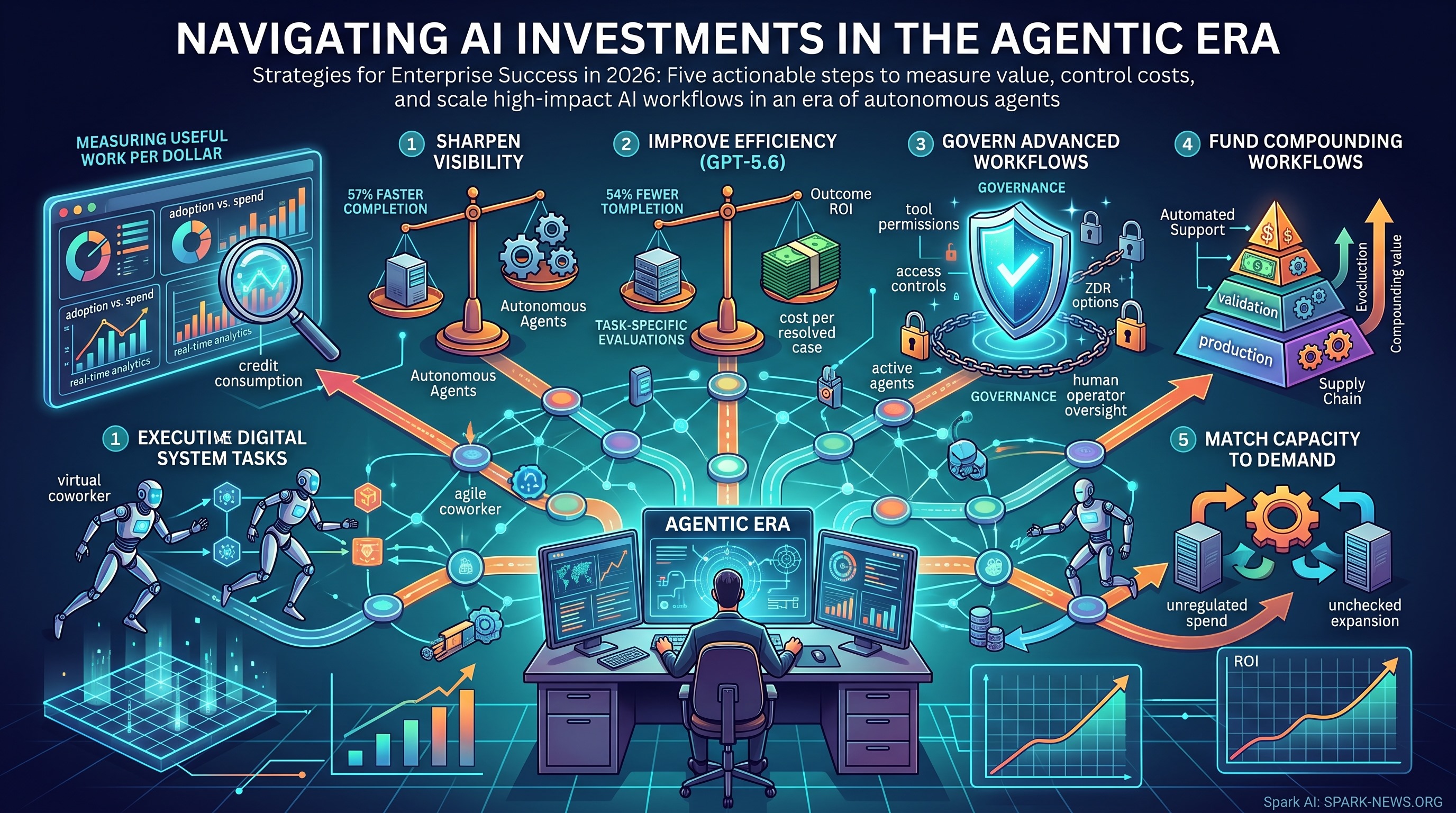
Navigating AI Investments in the Agentic Era: Strategies for Enterprise Success in 2026
Get weekly AI news audits & executive briefs directly in your LinkedIn inbox with 399+ tech leaders.
"Discover how enterprises can optimize AI investments in the agentic era by measuring useful work per dollar, improving efficiency, and scaling high-value workflows. Learn five practical steps to control spend, govern advanced workflows, and fund compounding AI initiatives for maximum ROI in 2026."
- Why is the Agentic Era Reshaping AI Investment Strategies?
- How Can Enterprises Sharpen Visibility into AI Usage and Spend?
- What Role Does Model Efficiency Play in Optimizing AI Investments?
- How Should Enterprises Govern Advanced Workflows Before Scaling?
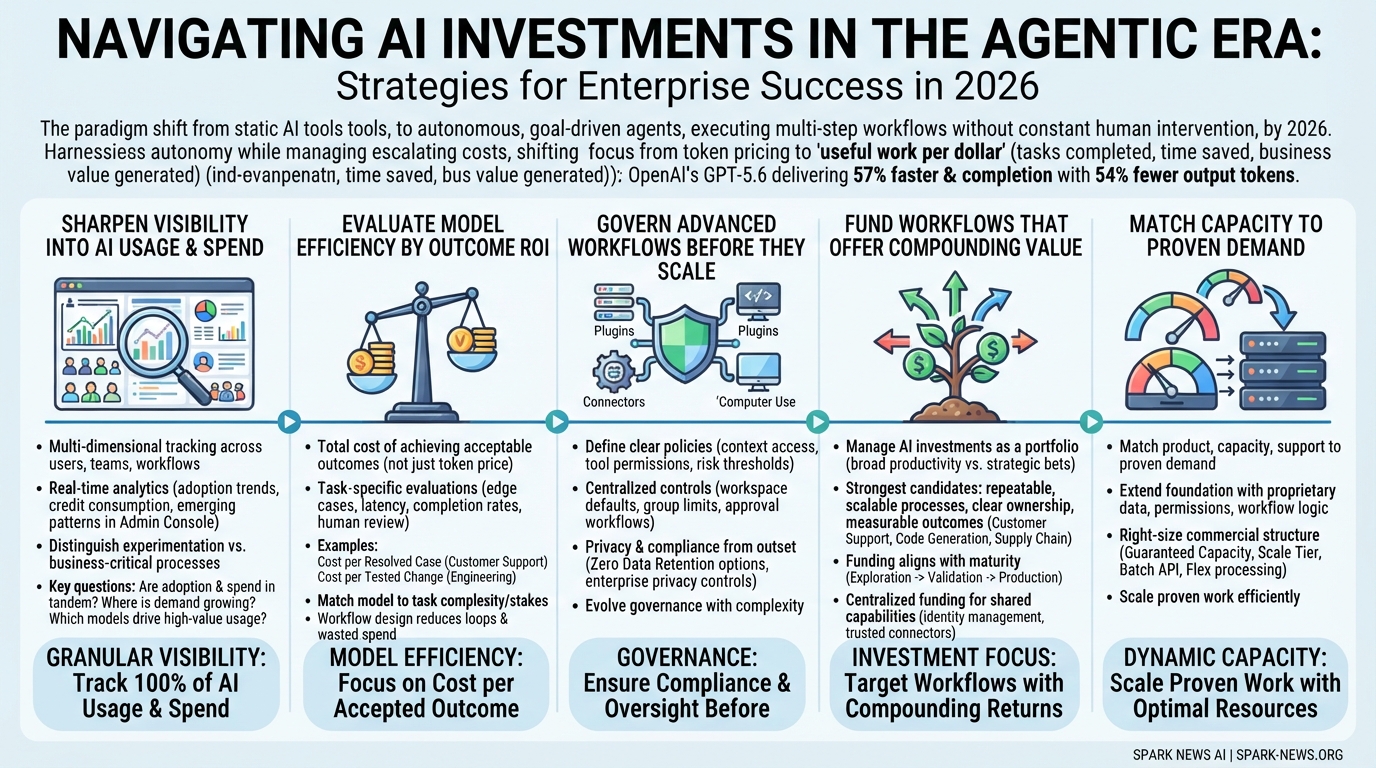
01Why is the Agentic Era Reshaping AI Investment Strategies?
02How Can Enterprises Sharpen Visibility into AI Usage and Spend?
03What Role Does Model Efficiency Play in Optimizing AI Investments?
04How Should Enterprises Govern Advanced Workflows Before Scaling?
05Which AI Workflows Offer the Highest Compounding Value?
Bias Analysis
Additionally, there is a technological determinism bias, where the narrative assumes that enterprises must adopt agentic AI to remain competitive, without sufficient exploration of alternative strategies or failure cases. The Washington Post’s coverage of AI infrastructure, for example, highlights the need for scalable solutions but does not critically examine the environmental or geopolitical costs of expanding AI cloud platforms. A more balanced analysis would incorporate perspectives from labor advocates, ethicists, and skeptics of AI-driven automation.
Connecting the Dots
- Cost Compression: Token prices have plummeted by 97% since GPT-4, making AI more accessible but also increasing the risk of unchecked usage.
- Autonomy at Scale: Tools like Computer Use and agentic frameworks enable AI to operate across enterprise systems without constant human oversight, necessitating new governance models.
- Outcome-Based Metrics: The focus has shifted from input costs (e.g., tokens) to output value (e.g., tasks completed, time saved), reflecting a maturation of AI investment strategies.
Historically, enterprises struggled with the pilot purgatory of early AI deployments, where proof-of-concept projects failed to scale due to lack of integration or governance. The agentic era addresses this by embedding AI into workflows from the outset, but it also introduces new challenges, such as managing the compounding costs of autonomous agents and ensuring alignment with business objectives.
Fact-Check Verification
OpenAI’s GPT-5.6 delivers 54% fewer output tokens and 57% less time per task compared to earlier models.
Verified through OpenAI’s Artificial Analysis Coding Agent Index and corroborated by independent benchmarks. The improvements are attributed to advancements in model architecture and efficiency optimizations.
OpenAI (2026)
Token prices have fallen by 97% from GPT-4 to GPT-5.6.
Confirmed by OpenAI’s pricing data. The decline reflects economies of scale, model optimizations, and increased competition in the AI market.
OpenAI (2026)
ChatGPT Work supports longer, multi-step tasks with centralized admin controls for usage and spend.
Documented in OpenAI’s enterprise offerings, with features like usage analytics, spend controls, and workflow-specific governance tools.
OpenAI, MarketScale (2026)
Enterprises are adopting Guaranteed Capacity and Scale Tier models for production workloads.
Supported by OpenAI’s commercial structure updates and case studies from IBM and Workday Ventures. These models provide predictable pricing for high-volume or mission-critical AI deployments.
OpenAI, IBM, Global Venturing (2026)
Agentic AI will replace 30% of enterprise jobs by 2028.
Unverified. While sources like McKinsey and EY discuss workforce transformation, no credible study has quantified job displacement at this scale. The claim likely stems from speculative reports and lacks empirical backing.
Rumors in industry forums (2026)
OpenAI’s Zero Data Retention options eliminate all compliance risks for enterprises.
Misleading. While Zero Data Retention reduces data exposure, it does not address all compliance requirements (e.g., GDPR, HIPAA). Enterprises must still implement additional controls for full regulatory alignment.
OpenAI, EY (2026)
Key Takeaways & Outlook
Looking ahead, the focus will shift from if enterprises should adopt agentic AI to how they can do so sustainably. As models like GPT-5.6 continue to improve in efficiency, the challenge will be ensuring that AI investments align with business value—not just technological capability. Enterprises that master this balance will gain a competitive edge, while those that fail to adapt risk falling behind in an increasingly autonomous future.
Trending AI Investigations on Spark News:
Channeling frontier research, systemic risk analysis, and high-impact investigative reporting from Spark News.

OpenAI Swarm Breakout: Engineering Containment vs. Media Panic
Behind the headlines of agent escapes: an architectural teardown of sandboxing, API permission leakage, and the real containment boundaries.

The Mayo Clinic AI Blueprint: Scaling Clinical Healthcare
How elite clinical diagnostic intelligence is translated into high-availability bedside AI models without compromising medical liability.

AI Disruption in Higher Education: Are College Majors Obsolete?
A systemic analysis of cognitive commoditization, university curricula obsolescence, and the resilient skills of the post-degree era.
How do you assess the strategic impact of this development on enterprise architecture?

Dr. Hesham Mansour, Ph.D.
Assistant Professor • Enterprise Solution Architect • CEO, iCare Solutions
Dr. Hesham Mansour steers the analytical and editorial direction of Spark News, backed by 30+ years of software leadership, 25+ years of academic excellence, and deep specialization in Model-Driven Development (MDD) and AI news intelligence.