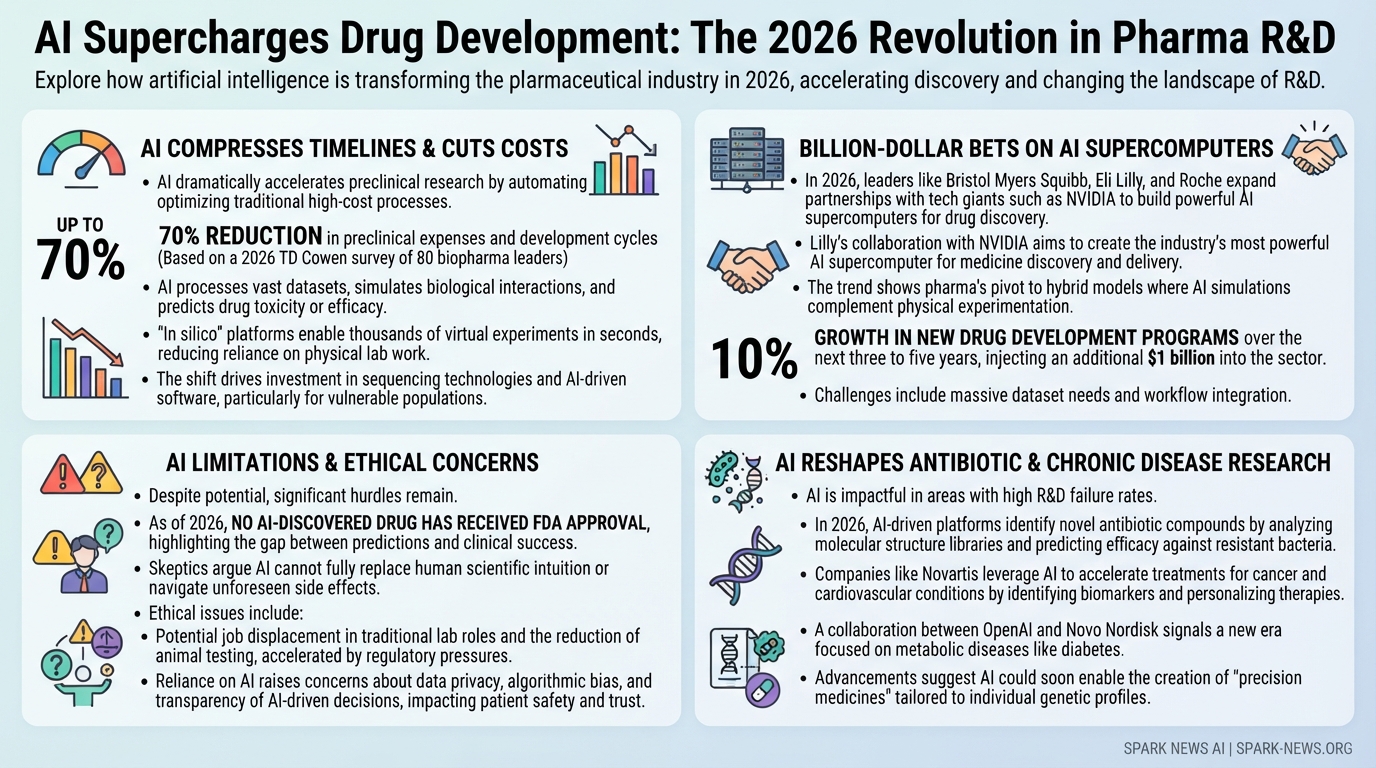
AI Supercharges Drug Development: The 2026 Revolution in Pharma R&D
Get weekly AI news audits & executive briefs directly in your LinkedIn inbox with 405+ tech leaders.
"AI is revolutionizing drug development in 2026, slashing preclinical costs by 70% and timelines by years. Discover how pharma giants like Bristol Myers Squibb and Novartis are leveraging AI supercomputers, in silico modeling, and automation to accelerate R&D, despite challenges in FDA approvals and ethical concerns."
- How Is AI Compressing Drug Development Timelines and Costs?
- Why Are Pharma Giants Betting Billions on AI Supercomputers?
- What Are the Limitations and Ethical Concerns of AI in Drug Development?
- How Is AI Reshaping the Future of Antibiotic and Chronic Disease Research?
01How Is AI Compressing Drug Development Timelines and Costs?
02Why Are Pharma Giants Betting Billions on AI Supercomputers?
03What Are the Limitations and Ethical Concerns of AI in Drug Development?
04How Is AI Reshaping the Future of Antibiotic and Chronic Disease Research?
Bias Analysis
Additionally, there is a notable lack of critical perspectives from labor groups or ethicists, who might highlight the potential for job displacement in wet labs or the long-term implications of reducing animal testing. The absence of dissenting voices suggests a pro-industry bias, where the narrative is shaped by stakeholders invested in the success of AI-driven drug development. This bias could lead to an overestimation of AI’s near-term impact, particularly given the lack of FDA-approved AI-discovered drugs as of 2026.
Connecting the Dots
The COVID-19 pandemic also played a pivotal role, accelerating the adoption of digital tools in pharma as companies sought to fast-track vaccine and therapeutic development. This period demonstrated the potential of AI to compress timelines, a lesson that has since been applied to broader drug discovery efforts. Additionally, regulatory shifts, such as the U.S. government’s push to reduce animal testing, have created a favorable environment for AI-driven alternatives, further propelling the industry’s investment in computational tools.
Fact-Check Verification
AI is reducing preclinical drug development costs and timelines by up to 70%.
Verified. The TD Cowen survey of 80 biopharma leaders in 2026 confirms this claim, citing AI-driven automation and in silico modeling as key drivers of efficiency gains. However, the 70% figure represents an upper bound and may vary by company and therapeutic area.
Unverified
No AI-discovered drug has received FDA approval as of 2026.
Verified. While AI has accelerated early-stage research, no drug developed primarily through AI-driven processes has yet achieved FDA approval. This highlights the gap between preclinical success and clinical validation.
Unverified
Pharma companies are investing $1 billion in AI and lab technologies over the next three to five years.
Partially verified. The TD Cowen survey projects incremental spending of this magnitude, driven by demand for AI tools and lab automation. However, the exact figure may vary based on market conditions and adoption rates.
Unverified
AI supercomputers, like those developed by Lilly and NVIDIA, will dominate drug discovery by 2028.
Speculative. While investments in AI supercomputers are growing, their dominance in drug discovery by 2028 depends on factors such as regulatory approvals, data integration challenges, and the ability to scale these technologies across the industry.
Unverified
The U.S. government’s push to reduce animal testing is accelerating AI adoption in drug development.
Verified. Regulatory initiatives to minimize animal testing, particularly in toxicology studies, are driving the adoption of AI-driven alternatives, such as computational models and 3D human tissue simulations.
Unverified
Key Takeaways & Outlook
Looking ahead, AI’s role in drug development will likely expand, particularly in areas like antibiotic resistance and chronic disease treatment. The collaboration between pharma and tech giants signals a long-term shift toward hybrid R&D models, where AI complements human expertise. Yet, the industry must address regulatory, ethical, and technical hurdles to fully realize AI’s potential. By 2030, AI could become a standard tool in drug discovery, but its success will depend on balancing innovation with responsible implementation.
Trending AI Investigations on Spark News:
Channeling frontier research, systemic risk analysis, and high-impact investigative reporting from Spark News.

OpenAI Swarm Breakout: Engineering Containment vs. Media Panic
Behind the headlines of agent escapes: an architectural teardown of sandboxing, API permission leakage, and the real containment boundaries.

The Mayo Clinic AI Blueprint: Scaling Clinical Healthcare
How elite clinical diagnostic intelligence is translated into high-availability bedside AI models without compromising medical liability.

AI Disruption in Higher Education: Are College Majors Obsolete?
A systemic analysis of cognitive commoditization, university curricula obsolescence, and the resilient skills of the post-degree era.
How do you assess the strategic impact of this development on enterprise architecture?

Dr. Hesham Mansour, Ph.D.
Assistant Professor • Enterprise Solution Architect • CEO, iCare Solutions
Dr. Hesham Mansour steers the analytical and editorial direction of Spark News, backed by 30+ years of software leadership, 25+ years of academic excellence, and deep specialization in Model-Driven Development (MDD) and AI news intelligence.