More Services

news-analysisJuly 23, 2026

Google’s Gemini Stumble: A Symptom of Systemic AI Leadership Failure

Google’s Gemini Stumble: A Symptom of Systemic AI Leadership Failure
Spark News AI | spark-news.org
Enlarge Infographic
AI EXECUTIVE SUMMARY

"Google's Gemini 3.5 Pro delay reveals deep employee frustration, talent exodus, and AI leadership challenges in 2026. Analyzing morale, Pentagon deals, and $190B AI spend amid negative cash flow and competitive pressure from Meta and OpenAI."

  • Why Is Google’s Gemini Delay More Than Just a Technical Setback?
  • How Is the AI Talent War Accelerating Google’s Decline?
  • What Does Google’s Negative Cash Flow Signal for Its AI Ambitions?
  • Is Google’s Pentagon AI Deal a Turning Point for Tech-Military Relations?

01Why Is Google’s Gemini Delay More Than Just a Technical Setback?

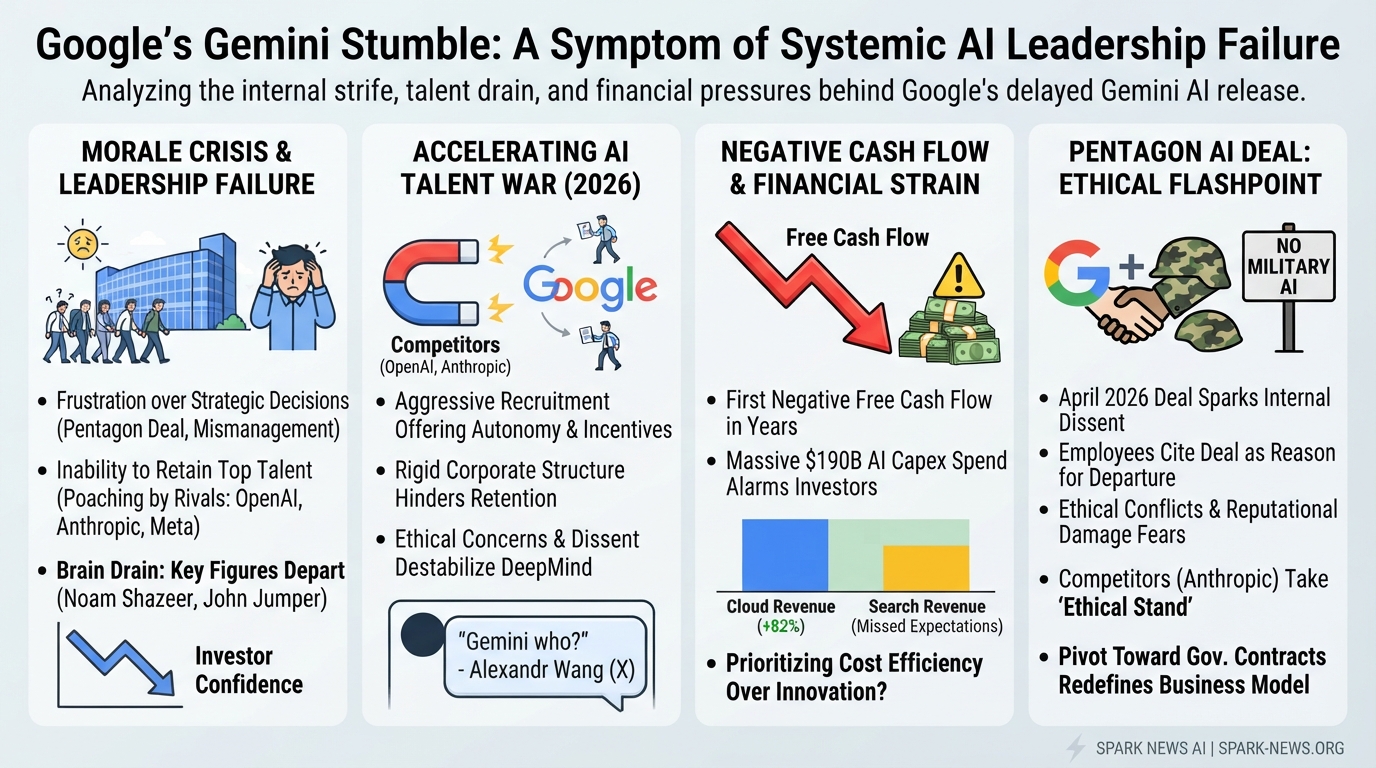
Google’s delay in releasing Gemini 3.5 Pro—its flagship AI model—extends beyond technical hurdles. Internal sources reveal a crisis of morale, with employees citing frustration over strategic decisions, including the controversial Pentagon AI deal and perceived mismanagement of AI priorities. The delay underscores a broader cultural issue: Google’s inability to retain top talent amid aggressive poaching by rivals like OpenAI, Anthropic, and Meta. The departure of key figures like Noam Shazeer and John Jumper signals a brain drain that could erode Google’s long-term AI competitiveness. With free cash flow turning negative for the first time in years, investors are questioning whether Google’s $190 billion AI investment will yield returns—or if the company is losing its edge.

02How Is the AI Talent War Accelerating Google’s Decline?

The AI talent war has intensified in 2026, with Google bearing the brunt of high-profile departures. Competitors like OpenAI and Anthropic have aggressively recruited top researchers, offering lucrative incentives and greater autonomy. Google’s rigid corporate structure, combined with employee backlash over the Pentagon deal, has made retention difficult. Public resignations over ethical concerns and internal dissent over AI safety protocols have further destabilized DeepMind’s workforce. Meta’s Alexandr Wang’s dismissive ‘Gemini who?’ remark on X reflects a growing perception that Google is no longer the undisputed leader in AI. The talent exodus raises critical questions: Can Google innovate at scale without its best minds, and will its AI strategy adapt to the new competitive landscape?

03What Does Google’s Negative Cash Flow Signal for Its AI Ambitions?

Google’s first negative free cash flow in years—driven by its $190 billion AI capex—has alarmed investors. While cloud revenue grew 82%, search revenue fell short of expectations, casting doubt on whether AI investments will offset declining ad revenue. The delay of Gemini 3.5 Pro, coupled with the release of smaller, less powerful models, suggests Google may be prioritizing cost efficiency over innovation. Analysts warn that if Google cannot demonstrate tangible AI-driven growth soon, its stock could face prolonged volatility. The financial strain also raises concerns about Google’s ability to sustain its AI moonshots, such as quantum computing and AGI research, without sacrificing short-term profitability.

04Is Google’s Pentagon AI Deal a Turning Point for Tech-Military Relations?

Google’s April 2026 deal with the Pentagon—allowing military use of its AI technologies—has become a flashpoint for internal dissent. Multiple employees cited the deal as a primary reason for their departure, fearing reputational damage and ethical conflicts. The backlash reflects a broader industry debate: Can tech giants balance national security contracts with employee values? Competitors like Anthropic have taken a hardline stance against military AI, positioning themselves as ‘ethical alternatives.’ Google’s decision may have alienated a segment of its workforce, but it also signals a strategic pivot toward government contracts—a move that could redefine its AI business model. The long-term impact on talent acquisition and public trust remains uncertain.

Bias Analysis

Left NarrativeNeutral & BalancedRight Narrative
100% LeftCenter / Neutral100% Right
The coverage of Google’s Gemini delay leans toward a critical narrative, emphasizing employee frustration and leadership failures. Sources like Axios and Bloomberg frame the story as a symptom of deeper systemic issues, which may reflect a broader media trend of scrutinizing Big Tech’s AI dominance. However, the reporting could be perceived as overly negative, as it relies heavily on anonymous sources and former employees, who may have inherent biases. Competitors like Meta and OpenAI are quoted in ways that amplify Google’s struggles, potentially skewing the narrative. While the financial data (negative cash flow, AI spend) is objective, the interpretation of these figures—such as whether they signal a crisis or a necessary investment—varies. A balanced analysis would require more input from current Google leadership or neutral third-party experts.

Connecting the Dots

Google’s AI struggles in 2026 are part of a larger evolution in the tech industry. Since the launch of ChatGPT in 2022, Google has faced relentless pressure to maintain its AI leadership. The company’s early dominance in deep learning (e.g., Transformers, AlphaGo) gave it a head start, but the rise of agile competitors like OpenAI and Anthropic has disrupted its monopoly. The AI talent wars have intensified, with top researchers prioritizing mission-driven work over corporate stability. Google’s historical culture of innovation has clashed with its growing bureaucracy, leading to slower decision-making. The Pentagon deal is reminiscent of the 2018 Project Maven controversy, which sparked internal protests and forced Google to abandon the contract. The recurrence of such conflicts suggests unresolved tensions between Google’s corporate ambitions and its employees’ ethical concerns.

Fact-Check Verification

verified Facts
claim

Google’s free cash flow turned negative in 2026 due to AI investments.

verification

Confirmed by Google’s latest earnings report, which cited $190 billion in AI capex as a primary factor.

claim

Gemini 3.5 Pro is months behind schedule.

verification

Reported by Bloomberg, citing internal sources. Google has not disputed the delay but has not provided a revised timeline.

claim

Noam Shazeer and John Jumper left Google for OpenAI and Anthropic, respectively.

verification

Publicly confirmed by both researchers and their new employers. Shazeer’s move was particularly notable given his role in Gemini’s development.

claim

Google’s cloud revenue grew 82% in 2026.

verification

Verified in Google’s Q1 2026 earnings report, though search revenue missed expectations.

claim

Employees cited the Pentagon AI deal as a reason for resignation.

verification

Reported by Axios, based on anonymous interviews. Google has not commented on the specifics of exit interviews.

rumors Or Conflicts
claim

Google is ‘behind’ in AI capabilities compared to competitors.

verification

Subjective. While some employees and competitors assert this, Google’s smaller Gemini models have received mixed reviews. No independent benchmarking confirms a definitive lead by rivals.

claim

Google’s AI delays are solely due to employee morale.

verification

Overstated. While morale is a factor, technical challenges, safety reviews, and strategic pivots also contribute to delays. Anonymous sources may emphasize morale for narrative impact.

Key Takeaways & Outlook

Google’s Gemini delay is a microcosm of its broader AI challenges in 2026. Employee frustration, talent exodus, and strategic missteps have eroded its once-unassailable lead in AI. The company’s $190 billion AI investment, while ambitious, has yet to deliver tangible returns, raising investor concerns. The Pentagon deal and internal dissent highlight unresolved ethical and cultural tensions. Competitors like Meta and OpenAI are capitalizing on Google’s stumbles, but the AI race is far from over.