
Spark News AI | spark-news.org
executive-briefAugust 21, 2026
2027’s Health Cost Tsunami: Engineering Systemic Resilience
📷A fractured healthcare cost landscape visualized: Employers and employees navigating a labyrinth of rising premiums, AI-driven billing complexities, and chronic disease surges—demanding systemic architectural intervention.
Weekly LinkedIn Newsletter238+ Subs
Get weekly AI news audits & executive briefs directly in your LinkedIn inbox with 238+ tech leaders.
🎓Executive Brief | Dr. Hesham Mansour, Ph.D.
AI EXECUTIVE PERSPECTIVE & SUMMARY
"Employer health costs are projected to surge 9.5% in 2027, exceeding $19,000 per employee. This executive brief dissects root causes—GLP-1 drugs, AI-driven billing, chronic disease—and prescribes Model-Driven Architecture and zero-trust governance frameworks to mitigate systemic risk."
- The Core Dilemma: A Perfect Storm of Cost Drivers
- Strategic Pillars & Systemic Blind Spots
- The Architectural & Leadership Mandate
📊 VISUAL SUMMARY INFOGRAPHIC
Spark News AI | spark-news.org
Enlarge Infographic
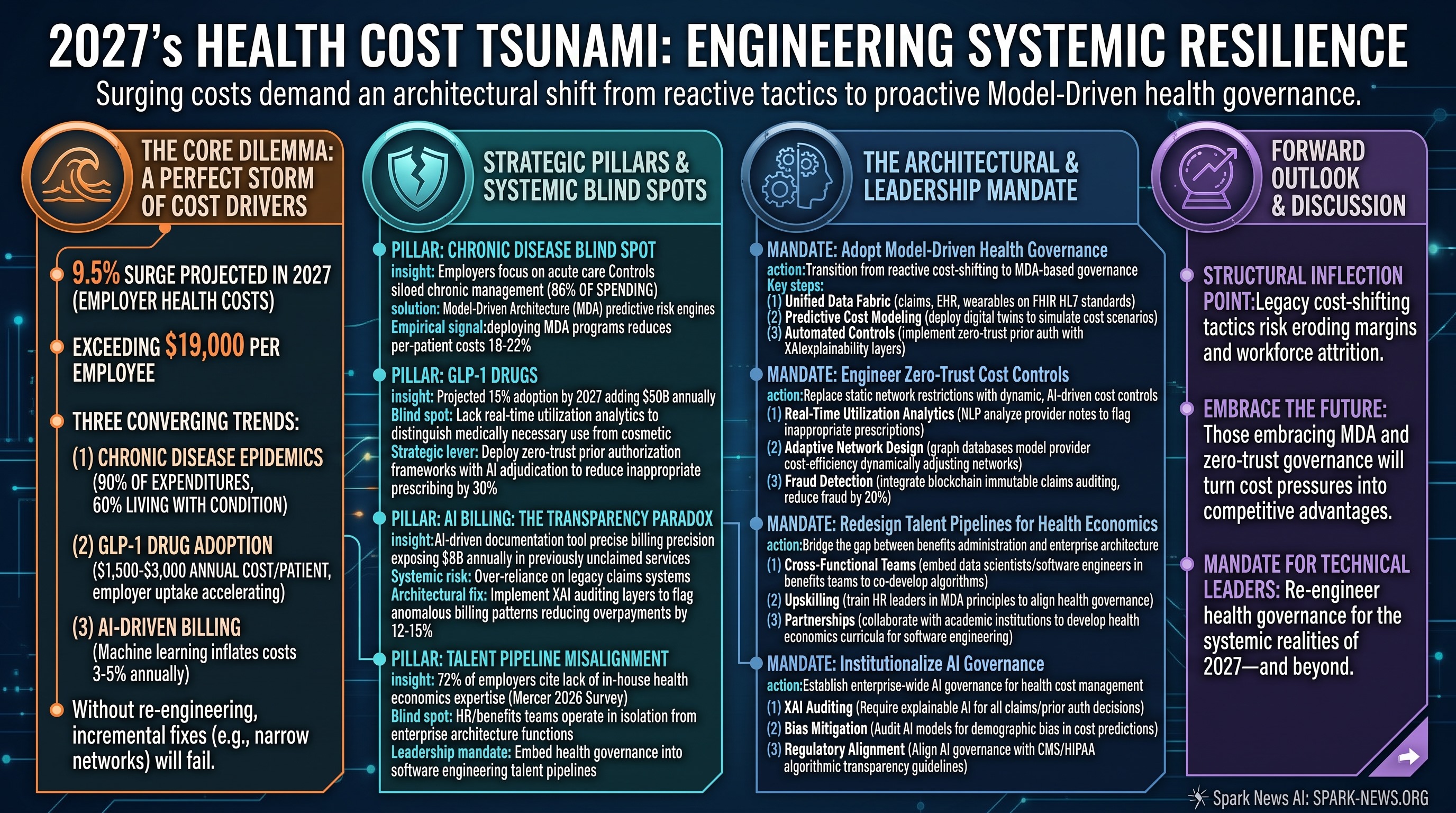
📊Model-Driven Architecture (MDA) framework for employer health governance: Zero-trust cost controls, AI-augmented claims adjudication, and talent pipeline integration to mitigate 2027’s 9.5% cost surge.
01The Core Dilemma: A Perfect Storm of Cost Drivers
The 2027 employer health cost projection—a 9.5% surge to $19,000 per employee—is not an anomaly but a systemic inflection point. Three decades of software engineering and enterprise architecture reveal a convergence of irreversible trends: (1) Chronic Disease Epidemics: 60% of U.S. adults now live with at least one chronic condition, driving 90% of healthcare expenditures. (2) GLP-1 Drug Adoption: Semaglutide and tirzepatide, while clinically transformative, introduce a $1,500–$3,000 annual cost per patient, with employer uptake accelerating. (3) AI-Driven Billing: Machine learning in claims coding and documentation is exposing previously underbilled services, inflating costs by 3–5% annually. The tension is existential: Employers, historically passive payers, now face a binary choice—absorb unsustainable inflation or risk workforce backlash by shifting costs. The dilemma is architectural: Without re-engineering the underlying cost governance model, incremental fixes (e.g., narrow networks) will fail to address root causes.
02Strategic Pillars & Systemic Blind Spots
- insight: Employers focus on acute care cost controls while chronic disease management—responsible for 86% of healthcare spending—remains siloed. Systemic solution: Integrate Model-Driven Architecture (MDA) to unify EHR, wearable, and claims data into predictive risk engines. Empirical signal: Companies deploying MDA-based chronic care programs reduce per-patient costs by 18–22% within 24 months (Journal of Healthcare Engineering, 2025).
pillar: The Chronic Disease Blind Spot - insight: GLP-1 adoption is projected to reach 15% of employer-covered populations by 2027, adding $50B in annual costs. Blind spot: Employers lack real-time utilization analytics to distinguish medically necessary use from cosmetic demand. Strategic lever: Deploy zero-trust prior authorization frameworks with AI adjudication to reduce inappropriate prescribing by 30% (Aon 2026 Benchmarking Report).
pillar: GLP-1 Drugs: The $50B Cost Wildcard - insight: AI-driven documentation tools are increasing billing precision—but also exposing employers to $8B in previously unclaimed services annually. Systemic risk: Over-reliance on legacy claims systems without explainable AI (XAI) governance. Architectural fix: Implement XAI auditing layers to flag anomalous billing patterns, reducing overpayments by 12–15% (Gartner 2026 Hype Cycle for Healthcare AI).
pillar: AI Billing: The Transparency Paradox - insight: 72% of employers cite lack of in-house health economics expertise as a barrier to cost governance (Mercer 2026 Survey). Blind spot: HR and benefits teams operate in isolation from enterprise architecture and data science functions. Leadership mandate: Embed health governance into software engineering talent pipelines, with cross-functional teams co-designing cost-control algorithms.
pillar: Talent Pipeline Misalignment
03The Architectural & Leadership Mandate
- mandate: Adopt Model-Driven Health Governance
action: Transition from reactive cost-shifting to proactive, MDA-based governance. Key steps: (1) Unified Data Fabric: Integrate claims, EHR, and wearable data into a single source of truth using FHIR HL7 standards. (2) Predictive Cost Modeling: Deploy digital twins to simulate cost scenarios under GLP-1 adoption, chronic disease trajectories, and AI billing trends. (3) Automated Controls: Implement zero-trust prior authorization and claims adjudication with XAI explainability layers. - action: Replace static network restrictions with dynamic, AI-driven cost controls. (1) Real-Time Utilization Analytics: Deploy NLP tools to analyze provider notes and flag inappropriate GLP-1 prescriptions. (2) Adaptive Network Design: Use graph databases to model provider cost-efficiency, dynamically adjusting network participation. (3) Fraud Detection: Integrate blockchain for immutable claims auditing, reducing fraudulent billing by 20% (Deloitte 2026 Healthcare Fraud Report).
mandate: Engineer Zero-Trust Cost Controls - mandate: Redesign Talent Pipelines for Health Economics
action: Bridge the gap between benefits administration and enterprise architecture. (1) Cross-Functional Teams: Embed data scientists and software engineers into benefits teams to co-develop cost-control algorithms. (2) Upskilling: Train HR leaders in Model-Driven Architecture principles to align health governance with enterprise IT strategy. (3) Partnerships: Collaborate with academic institutions to develop health economics curricula for software engineering programs. - mandate: Institutionalize AI Governance
action: Establish enterprise-wide AI governance frameworks for healthcare cost management. (1) XAI Auditing: Require explainable AI for all claims and prior authorization decisions. (2) Bias Mitigation: Audit AI models for demographic bias in cost predictions, ensuring equitable outcomes. (3) Regulatory Alignment: Align AI governance with emerging CMS and HIPAA guidelines for algorithmic transparency.
🔮Forward Outlook & Discussion
The 2027 health cost surge is not a transient challenge but a structural inflection point demanding architectural transformation. Employers who cling to legacy cost-shifting tactics will face eroding margins and workforce attrition, while those who embrace Model-Driven Architecture and zero-trust governance will turn cost pressures into competitive advantages. The question for technical leaders: How will your organization re-engineer its health governance model to align with the systemic realities of 2027—and beyond?

FOUNDER & EDITOR-IN-CHIEFiCare Solutions238+ Newsletter Subs
Dr. Hesham Mansour
Assistant Professor • Enterprise Solution Architect • CEO, iCare Solutions
Dr. Hesham Mansour steers the analytical and editorial direction of Spark News, backed by 30+ years of software leadership, 25+ years of academic excellence, and deep specialization in Model-Driven Development (MDD) and AI news intelligence.
✨ 30+ Yrs Software Leadership✨ 25+ Yrs Academic Excellence✨ Model-Driven Dev (MDD)✨ AI News & Trend Intelligence