
Cheap, Capable AI Models Unlock True Enterprise Production Scale
Get weekly AI news audits & executive briefs directly in your LinkedIn inbox with 383+ tech leaders.
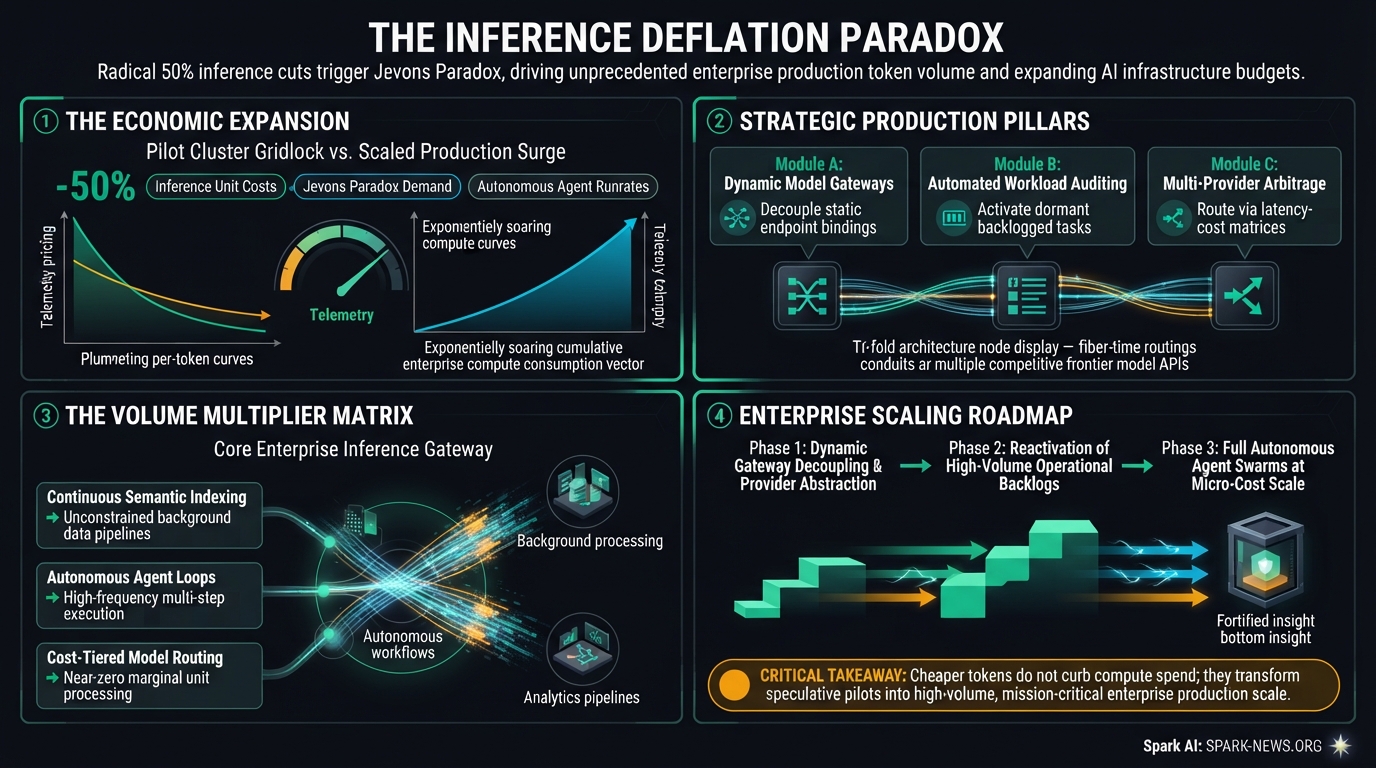
"Plummeting frontier inference costs, exemplified by OpenAI GPT-6 Sol reducing enterprise operational expenses by 50% and Anthropic Opus 5.5 cutting run costs by 40%, resolve AI demand risks through Jevons Paradox. As token prices decline, enterprise consumption scales exponentially, turning inference savings into expanded computing infrastructure deployments."
- The Core Dilemma: Can Plummeting Model Prices Sustain the AI Infrastructure Buildout?
- Core Pillars & Decision Matrix: Analyzing the Economics of Inference Deflation
- The Strategic & Practical Mandate: Repositioning Systems for High-Volume Inference
01The Core Dilemma: Can Plummeting Model Prices Sustain the AI Infrastructure Buildout?
That economic equation is now shifting decisively. OpenAI has introduced GPT-6 Sol and GPT-6 Luna, slashing token costs for core enterprise accounts by 50%. Anthropic followed immediately with Opus 5.5, delivering frontier intelligence at 40% lower runtime expense than Opus 5, while xAI fielded Grok 4.7 with aggressive price-performance targets. When auditing enterprise pipelines, we find that this sudden wave of cost reduction does not erode infrastructure viability. Instead, it triggers classic economic behavior: lower input prices are stimulating unprecedented systemic usage across business workflows.
02Core Pillars & Decision Matrix: Analyzing the Economics of Inference Deflation
| Strategic Dimension | Legacy / Siloed Approach | Rewired / Modern Architecture | Expected Impact & ROI |
|---|---|---|---|
| Model Selection | Single monolithic frontier model for all tasks | Tiered routing across specialized, low-cost endpoints | 45% to 60% reduction in blended per-query expenditure |
| Workload Scope | Restricted human-in-the-loop batch processes | Continuous autonomous agent execution in runtime pipelines | 5x to 10x throughput expansion across routine operations |
| Governance & Margin | Unpredictable token usage and volatile monthly spikes | Dynamic inference rate-limiting and localized edge nodes | Predictable OPEX run rates with clear cost attribution |
- Rapid Token Deflation: Frontier releases like GPT-6 Sol cut baseline enterprise API pricing by half within a single release cycle.
- Compressed Competitive Cycles: The price advantage of newly deployed models, such as Grok 4.7, faced competitive parity within 24 hours due to simultaneous releases from competing labs.
- Net Budget Expansion: Citadel Securities client tracking confirms that aggregate enterprise spending on model computing continues to rise as lower per-unit fees unlock heavy programmatic volume.
03The Strategic & Practical Mandate: Repositioning Systems for High-Volume Inference
Second, audit backlog workloads that were shelved during the high-cost regime of 2024 and 2025. Complex real-time synthetic data validation, document reconciliation, and multi-step agent verification are suddenly viable operating models. Leaders who redesign their enterprise pipelines around accessible high-throughput intelligence will capture immediate efficiency gains, while competitors remain trapped debating whether frontier computing is worth the cost.
How do you assess the strategic impact of this development on enterprise architecture?

Dr. Hesham Mansour, Ph.D.
Assistant Professor • Enterprise Solution Architect • CEO, iCare Solutions
Dr. Hesham Mansour steers the analytical and editorial direction of Spark News, backed by 30+ years of software leadership, 25+ years of academic excellence, and deep specialization in Model-Driven Development (MDD) and AI news intelligence.